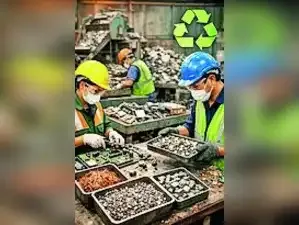
The budget announcement on dedicated rare earth corridors in 4 states - Tamil Nadu, Kerala, Odisha and Andhra Pradesh - to promote mining, processing, research and manufacturing of rare earth elements (REE) and critical minerals ticks all the right boxes: it reduces dependence on China, drives economic growth through clean industrial manufacturing, decarbonises the economy, and creates jobs. Alongside this new initiative, recovery and recycling of REE and critical minerals from e-waste, mine tailings and industrial waste can also boost supply. Estimates suggest that e-waste alone could generate 1,300 t of REE. Last year's ₹1,500 cr scheme to build capacity to extract and produce critical minerals from waste streams was a start, but it remains insufficient.
The regulatory framework must be fit for purpose - e-waste management rules should classify critical minerals as high-value materials, Extended Producer Responsibility (EPR) rules must incentivise recycling and recovery. The informal recycling sector must be formalised through capacity building, technology transfer, know-how and financial support with incentives for transition.
A mechanism to match supply with demand, including a national stockpile, is crucial to accelerate domestic consumption, while mandates for using recycled critical minerals will strengthen the ecosystem. This approach will boost supply, support clean industrial manufacturing, enhance self-reliance and competitiveness, generate jobs, improve resource efficiency, and reduce the economy's waste and emissions footprint. Most importantly, it will create secure, well-supported jobs with benefits, providing workers the social safety nets essential for a modern, resilient economy - turning resources into opportunity.
The regulatory framework must be fit for purpose - e-waste management rules should classify critical minerals as high-value materials, Extended Producer Responsibility (EPR) rules must incentivise recycling and recovery. The informal recycling sector must be formalised through capacity building, technology transfer, know-how and financial support with incentives for transition.
A mechanism to match supply with demand, including a national stockpile, is crucial to accelerate domestic consumption, while mandates for using recycled critical minerals will strengthen the ecosystem. This approach will boost supply, support clean industrial manufacturing, enhance self-reliance and competitiveness, generate jobs, improve resource efficiency, and reduce the economy's waste and emissions footprint. Most importantly, it will create secure, well-supported jobs with benefits, providing workers the social safety nets essential for a modern, resilient economy - turning resources into opportunity.