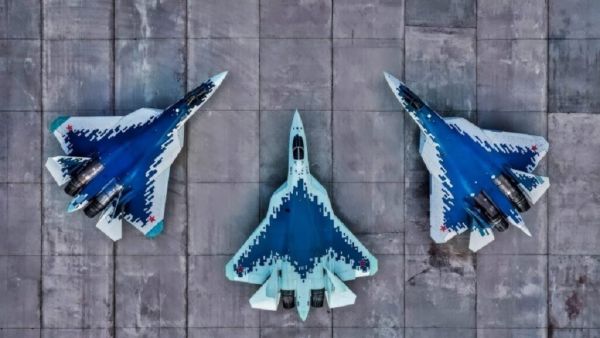
Talks between India and Russia regarding the fifth generation stealth fighter jet Su-57 have reached a turning point. Russia has confirmed that discussions on the deal have now moved beyond the preliminary stage and entered a deeper technical and industrial stage. Vadim Badekha, chief executive of Russia’s United Aircraft Corporation (UAC), told the media on the sidelines of the Wings India 2026 air show in Hyderabad that talks with New Delhi now focus on detailed technical planning and industrial cooperation.
According to the report, the current talks are not limited to the purchase of aircraft but are aimed at setting the technical framework for a long-term aerospace partnership between the two countries. It is indicated that such agreements impact bilateral relations for generations to come. This development makes it clear that India intends to customize the Su-57 to suit the specific operational requirements of the Indian Air Force rather than purchasing it directly ‘off-the-shelf’.
An important aspect of the discussion is the local production of Su-57 in India. For this, the possibility of using the already existing infrastructure under the Su-30MKI program is being considered. This model is in line with India’s ‘Make in India’ policy and builds on the experience of earlier licensed manufacturing programmes.
The UAC chief has said that priority will be given to wider participation of Indian industries in the proposed framework. This includes the possibility of integrating indigenous mission computers, avionics and electronic warfare systems into the Russian stealth airframe. If this strategy is implemented, India’s dependence on foreign supply chains could be reduced and local companies would gain significant experience in fifth generation technologies.
Experts believe that this experience can prove useful for India’s indigenous programs, especially the Advanced Medium Combat Aircraft (AMCA). Local assembly and maintenance of the Su-57 could increase efficiency in stealth coating, sensor fusion and low-observable technologies.
However, Badekha also pointed out the complexities of the project. It will be a challenging task to match Russian engineering standards, Indian manufacturing capabilities and operational principles in the advanced stage. The issues of extent of technology transfer, proportion of indigenous manufacturing and strength of logistics infrastructure are being thoroughly considered by the technical teams of both the countries.
For India, the domestically produced Su-57 with indigenous systems could become an effective interim solution until a fully indigenous stealth fighter comes into service. At the same time, this agreement is an opportunity for Russia to strengthen its long-term presence in the world’s most competitive defense markets.
Stock market rises sharply after India-US trade agreement
Wanting to become Sarpanch, father becomes murderer, throws 6 year old daughter in canal
Headmaster of Mathura government school used to force children to offer namaz, suspended
“People criticized the tariffs, but our patience paid off”
-
School Assembly News Headlines Today February 4, Top National, International, Sports, Business News

-
Security Tightened At Rohit Shetty’s Juhu Home After Firing Linked To Bishnoi Gang
-
Dhurandhar 2 The Revenge: After Uri, Yami Gautam set to reunite with Aditya Dhar for Ranveer Singh starrer? Here’s what we know

-
Silver Rate Today, February 4: Silver prices witnesses massive surge of over 9 percent, check prices in Delhi, Noida, Ghaziabad, Chennai, Surat
-
MS Creative Schools organises grand annual Akhlaaq Show 2026