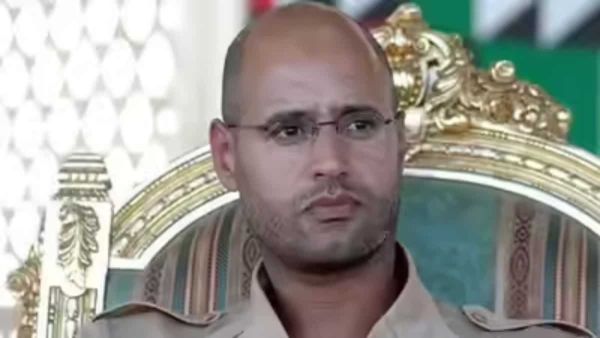
Saif al-Islam Gaddafi, the most prominent son of former Libyan leader Muammar Gaddafi, has been killed in Libya, according to statements by his lawyer and political adviser, as well as local media reports.
His lawyer, Khaled al-Zaidi, and political adviser Abdulla Othman separately announced the death of the 53-year-old on social media on Tuesday, February 3, without disclosing further details.
Libyan outlet Fawasel Media quoted Othman as saying that armed men attacked Gaddafi at his residence in the town of Zintan, around 136 kilometres southwest of Tripoli.

Four masked assailants shot him dead: Gaddafi’s team
A later statement from Gaddafi’s political team alleged that four masked assailants stormed his home and shot him dead in what it described as a “cowardly and treacherous assassination”.
According to the statement, Gaddafi resisted the attackers, who disabled the house’s security cameras in an attempt to conceal evidence, a report by Al Jazeera said.
Khaled al-Mishri, former head of Libya’s Tripoli-based High State Council, called for an “urgent and transparent investigation” into the killing, warning that the incident could further destabilise the country’s fragile political landscape.
Although Saif al-Islam Gaddafi never held an official government post, he was widely viewed as his father’s heir apparent from the early 2000s until the collapse of the Gaddafi regime in 2011.
Played key role in Libya’s efforts to re-engage with International community
Born in Tripoli in June 1972, he was Western-educated and played a key role in Libya’s efforts to re-engage with the international community. He was instrumental in negotiations that led to Libya abandoning its weapons of mass destruction programme and in talks over compensation for victims of the 1988 Lockerbie bombing.
Educated at the London School of Economics, Gaddafi often portrayed himself as a reformist voice, advocating constitutional governance and limited political liberalisation. His academic work focused on the role of civil society in global governance reforms.
During 2011 uprising
However, during the 2011 uprising against his father’s rule, he emerged as a leading figure in the regime’s violent crackdown on protesters, issuing stark warnings of widespread bloodshed and pledging to fight “to the last man, woman and bullet”.
Following the fall of Tripoli, Gaddafi attempted to flee Libya but was captured by militia forces and detained in Zintan. He was later placed under United Nations sanctions and became the subject of an arrest warrant issued by the International Criminal Court for alleged crimes against humanity.
In 2015, a Tripoli court sentenced him to death in absentia. He was released from detention in 2017 under a general amnesty and remained largely out of public view in Zintan, citing security threats.
Re-emergence in Nov 2021
Gaddafi re-emerged in November 2021 when he announced his bid for Libya’s presidency, a move that reignited deep political divisions.
His candidacy was ultimately rejected due to his prior conviction, and disputes surrounding his appeal contributed to the collapse of the electoral process, pushing Libya back into a political stalemate.
Authorities have not yet announced arrests in connection with his killing.
-
U19 World Cup: Vaibhav Suryavanshi has a chance to become number 1, can break Babar Azam’s record
-
Enphase Or SolarEdge: Which Solar Stock Does Wall Street Prefer?

-
India US Trade Deal: Know on which Indian products America will impose zero tariff? | India Us Trade Deal Offers Zero Tariff On Key Indian Exports
-
Hundreds of things are made from cow slaughter – do you also use these products daily?… – News Himachali News Himachali

-
Who is Vaibhav Suryavanshi? Know About India’s Young Cricket Star Education, School Fees and More