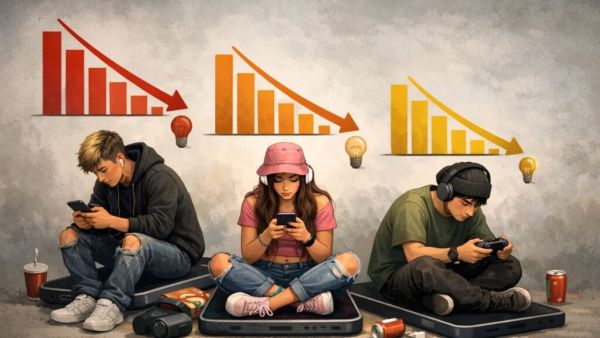
Morning starts with mobile, studies on tablet, questions answered with video, and notes with AI. This is the lifestyle of today’s generation. But are these habits gradually reducing their ability to think and understand? A neuroscientist claims that Gen Z has less brains than Millennials.
Research has said that the methods of study have changed, but the needs of the brain have not changed and this is where the problem started.
Gen Z has less brains than Millennials
Earlier there were books, blackboard and direct conversation with the teacher. Now the same place has been taken by smart screens, short videos and digital notes. Information is available faster than ever, but time and patience for deeper understanding is diminishing. According to experts, learning is not just taking information, but understanding it by thinking, connecting and remembering, which is not possible with fast scrolling.
What changed after 2010?
Neuroscientist Dr. Jared Cooney Horvath says that after about 2010, students’ thinking ability started declining. Skills like reading comprehension, grasp of mathematics, concentration power and problem solving were found to be weaker than before. During the same period, the use of digital devices increased on a large scale in schools. He claims that as technology in education increased, a negative impact on the quality of learning started appearing.
small videos vs big books
Dr. Jared Cooney Horvath said that the human mind needs time and depth to understand anything properly. Reading big books, understanding long articles and discussing them in detail forces the mind to think. In contrast, short videos or information presented in points only provide a superficial understanding. Due to this, depth of the topic cannot be developed and the ability to remember can also gradually weaken.
lack of human contact
Experts say that humans have always learned to communicate and learn together. Talking to the teacher, discussing with friends and studying in a group makes the mind more active. But now due to excessive dependence on screens, face-to-face interaction has reduced. This is affecting the natural process of learning.
What is the solution?
Neuroscientists say that the problem will not be solved by improving technology, because the root of the problem is over-dependence on technology. For studies, it is important to again give importance to books, deep reading and face-to-face conversations. It is not possible to remove the screen completely, but only its balanced use can keep the mind healthy.
Are we losing our minds in exchange for convenience?
In today’s time, answers are available quickly, but the habit of thinking is decreasing. Convenience has increased, but is understanding decreasing? This is not a question of just one generation but of the entire education system. If the methods of learning are not rethought, it could have a profound impact on the thinking abilities of future generations.
-
Massive ICC Rankings Shake-Up! Ishan Kishan Soars After IND vs NZ Heroics

-
Big Warning From MS Dhoni To Suryakumar Yadav Ahead Of T20 World Cup 2026

-
Bhopal Tragedy: 14-Year-Old Boy Dies By Suicide, Family Links Death To Free Fire Game Addiction

-
UP Triple Suicide: What Is 'Korean Love Game' Linked To 3 Minor Sisters' Shocking Death In Ghaziabad?

-
'When Politics Enters Sport...': Lalit Modi Reflects His Thoughts On IND vs PAK ICC T20 World Cup Boycott Row