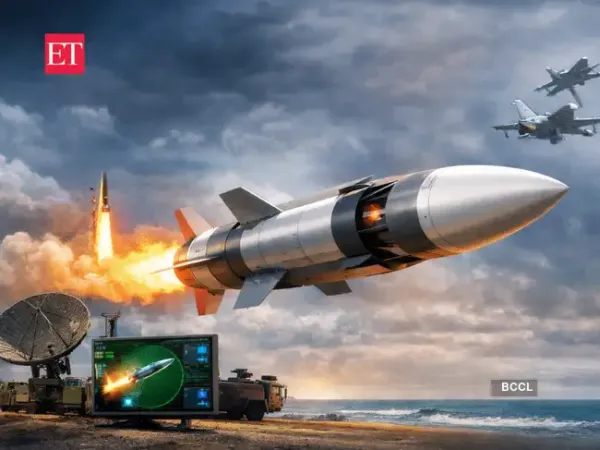
India has taken a significant leap in missile technology with the successful demonstration of the Solid Fuel Ducted Ramjet (SFDR) system by the Defence Research and Development Organisation (DRDO). Conducted from the Integrated Test Range at Chandipur, Odisha, this breakthrough places India among a select group of nations with advanced long-range missile propulsion capabilities.
The test, carried out around 10:45 am on Tuesday, saw all critical subsystems perform flawlessly, showcasing India’s growing prowess in indigenous defence technologies.
How Does SFDR Technology Give India a Tactical Edge?
The SFDR is a next-generation propulsion system designed for long-range air-to-air missiles, allowing fighter jets to engage targets far beyond visual range. Unlike conventional rocket-powered missiles, SFDR combines solid fuel with atmospheric oxygen, enabling missiles to sustain supersonic speeds for longer durations.
As per a TOI report, experts note that this technology can also be adapted for surface-to-air missile systems, enhancing India’s broader air defence capabilities. By maintaining speed, manoeuvrability, and altitude flexibility, SFDR-powered missiles provide a wider no-escape zone for enemy aircraft and greater operational versatility for Indian pilots.
How Does the SFDR Propulsion System Work?
The SFDR system comprises several innovative subsystems:
Nozzle-less booster: The missile is initially accelerated by a nozzle-less booster, pushing it to supersonic speeds within three seconds. Its unique design ensures efficiency and safety during air-launched operations.
Solid fuel ducted ramjet sustainer: Once accelerated, a boron-based solid fuel sustainer ignites, partially burning onboard fuel while drawing oxygen from the atmosphere to complete combustion. This allows long-duration powered flight, ranging from 50 seconds at sea level to 200 seconds at higher altitudes.
Hot gas valve: Regulating combustion gases based on speed and altitude, this valve uses advanced materials like carbon-carbon composites and tungsten-copper alloys, all indigenously developed.
Air intakes: Cheek-mounted intakes compress incoming air efficiently, ensuring sustained combustion during flight.
Advanced onboard systems: Modern guidance and control systems, including radio-frequency seekers, inertial navigation, jam-resistant data links, and high-torque actuators, enhance precision targeting.
The missile carries a fragmentation warhead with a proximity fuse, maximising its lethality against fast-moving aerial targets.
Why is SFDR a Game Changer in Air Combat?
SFDR-powered missiles can engage highly manoeuvrable targets at ranges between 50 km and 340 km, flying at speeds from Mach 2 to Mach 3.8. They can operate at altitudes ranging from sea level to 20 km, with vertical manoeuvres of up to 10 km.
This combination of speed, range, and agility makes enemy aircraft significantly harder to evade, giving Indian fighter jets a decisive edge in aerial combat.
What Does This Success Mean for India’s Defence Capabilities?
The successful SFDR demonstration represents a major milestone in India’s indigenous missile development programme. It strengthens the operational reach of future air-to-air and air-defence weapons, showcasing India’s ability to innovate and produce world-class defence technology independently.
Defence Minister Rajnath Singh and DRDO Chairman Samir V. Kamat congratulated the teams, recognising the achievement as a step forward in enhancing India’s strategic and tactical military capabilities.
With SFDR, India joins an elite group of nations capable of developing advanced long-range missile propulsion systems, signalling a bold stride in modernising its aerial and defence warfare potential.
Inputs from TOI
The test, carried out around 10:45 am on Tuesday, saw all critical subsystems perform flawlessly, showcasing India’s growing prowess in indigenous defence technologies.
How Does SFDR Technology Give India a Tactical Edge?
The SFDR is a next-generation propulsion system designed for long-range air-to-air missiles, allowing fighter jets to engage targets far beyond visual range. Unlike conventional rocket-powered missiles, SFDR combines solid fuel with atmospheric oxygen, enabling missiles to sustain supersonic speeds for longer durations.As per a TOI report, experts note that this technology can also be adapted for surface-to-air missile systems, enhancing India’s broader air defence capabilities. By maintaining speed, manoeuvrability, and altitude flexibility, SFDR-powered missiles provide a wider no-escape zone for enemy aircraft and greater operational versatility for Indian pilots.
How Does the SFDR Propulsion System Work?
The SFDR system comprises several innovative subsystems:Nozzle-less booster: The missile is initially accelerated by a nozzle-less booster, pushing it to supersonic speeds within three seconds. Its unique design ensures efficiency and safety during air-launched operations.
Solid fuel ducted ramjet sustainer: Once accelerated, a boron-based solid fuel sustainer ignites, partially burning onboard fuel while drawing oxygen from the atmosphere to complete combustion. This allows long-duration powered flight, ranging from 50 seconds at sea level to 200 seconds at higher altitudes.
Hot gas valve: Regulating combustion gases based on speed and altitude, this valve uses advanced materials like carbon-carbon composites and tungsten-copper alloys, all indigenously developed.
Air intakes: Cheek-mounted intakes compress incoming air efficiently, ensuring sustained combustion during flight.
Advanced onboard systems: Modern guidance and control systems, including radio-frequency seekers, inertial navigation, jam-resistant data links, and high-torque actuators, enhance precision targeting.
The missile carries a fragmentation warhead with a proximity fuse, maximising its lethality against fast-moving aerial targets.
Why is SFDR a Game Changer in Air Combat?
SFDR-powered missiles can engage highly manoeuvrable targets at ranges between 50 km and 340 km, flying at speeds from Mach 2 to Mach 3.8. They can operate at altitudes ranging from sea level to 20 km, with vertical manoeuvres of up to 10 km.This combination of speed, range, and agility makes enemy aircraft significantly harder to evade, giving Indian fighter jets a decisive edge in aerial combat.
What Does This Success Mean for India’s Defence Capabilities?
The successful SFDR demonstration represents a major milestone in India’s indigenous missile development programme. It strengthens the operational reach of future air-to-air and air-defence weapons, showcasing India’s ability to innovate and produce world-class defence technology independently.Defence Minister Rajnath Singh and DRDO Chairman Samir V. Kamat congratulated the teams, recognising the achievement as a step forward in enhancing India’s strategic and tactical military capabilities.
With SFDR, India joins an elite group of nations capable of developing advanced long-range missile propulsion systems, signalling a bold stride in modernising its aerial and defence warfare potential.
Inputs from TOI