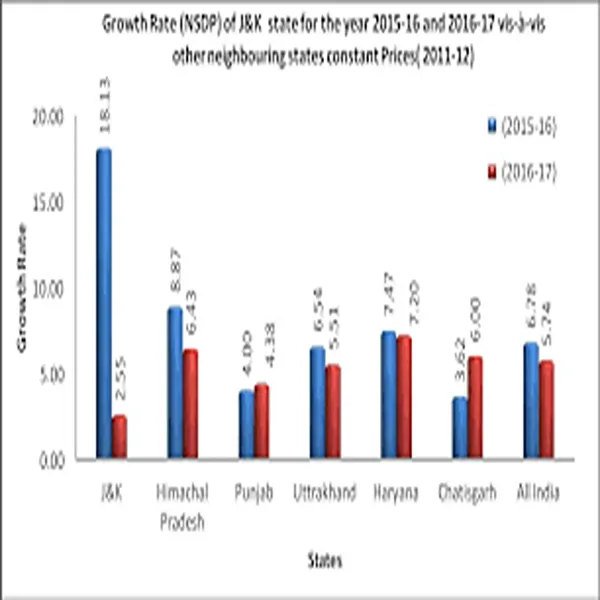
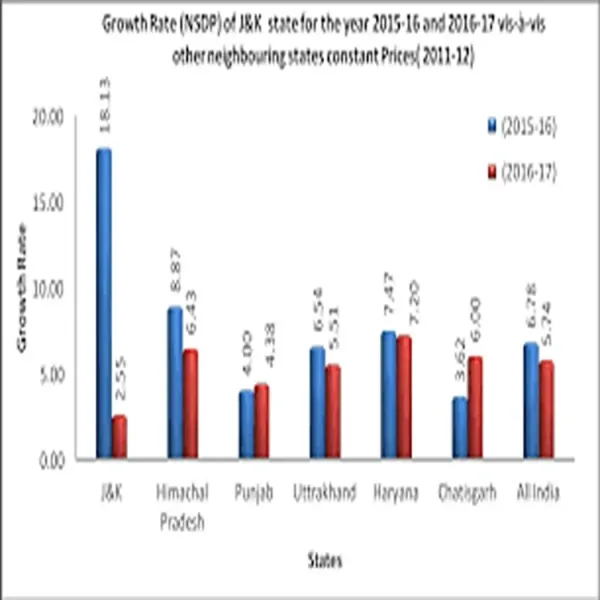
GSDP – Jammu and Kashmir’s economic landscape has demonstrated consistent progress, according to the latest Economic Survey presented in the legislative assembly. The report highlights that the Union Territory is maintaining a stable growth trajectory, supported by improvements in productivity, revenue generation, and employment indicators. Advance estimates indicate that the region’s real Gross State Domestic Product is projected to expand by 5.82 percent, reflecting gradual but steady economic strengthening.
Economic Expansion Continues with Stable Growth Indicators
The survey outlines that the nominal Gross State Domestic Product is expected to grow by 8.89 percent, placing the estimated size of Jammu and Kashmir’s economy at approximately Rs 2.86 lakh crore in current prices, while the real economic size is assessed at around Rs 1.50 lakh crore. Officials noted that the consistent expansion demonstrates economic resilience and recovery, particularly following disruptions experienced during recent years.
Between the financial years 2019-20 and 2024-25, the region recorded a compound annual growth rate of 4.47 percent in real economic output. This growth pace surpassed several northern states, including Delhi and Himachal Pradesh, while also slightly outperforming Haryana during the same period. The data suggests that Jammu and Kashmir has maintained a competitive position within the regional economic framework.
Rising Income Levels Reflect Positive Economic Momentum
The survey also pointed to a steady increase in per capita income across the Union Territory. For the financial year 2025-26, the per capita income is estimated at Rs 1,68,243. Although it remains below the national average, the report highlights that income growth rates in Jammu and Kashmir have been higher than several neighbouring states and Union Territories over recent years.
From 2019-20 to 2024-25, per capita income in the region expanded at a compound annual growth rate of 8.81 percent. This growth outpaced Himachal Pradesh, Delhi, Punjab, Chandigarh, and Haryana, indicating improved earnings potential and economic participation among residents.
Revenue Collections and Infrastructure Investment Show Strength
Government revenue receipts reached Rs 13,521 crore by November 2025, supported by strong performance in tax and non-tax collections. Key contributors to revenue growth included Goods and Services Tax, excise duties, and earnings from power-related sectors. Officials emphasised that improved revenue inflow has allowed authorities to maintain spending on public welfare and infrastructure development.
The administration has also prioritised capital expenditure aimed at building infrastructure, creating durable public assets, and completing ongoing development projects. The report suggests that these investments are expected to strengthen long-term economic capacity and improve connectivity across the region.
Employment Indicators Show Noticeable Improvement
Labour market indicators presented in the survey reveal encouraging trends in employment conditions. The unemployment rate declined to 6.1 percent in 2023-24 compared with 6.7 percent recorded in 2019-20. The reduction reflects gradual improvement in job availability and workforce engagement.
Additionally, the Labour Force Participation Rate increased significantly, reaching 64.30 percent in 2023-24, compared to 56.30 percent four years earlier. The Worker Population Ratio also rose to 60.40 percent from 52.50 percent during the same period, suggesting increased workforce involvement across multiple sectors.
Industrial Growth and Investment Activity Gain Momentum
The survey highlights notable progress in investment activity over the past seven years. During this period, 2,227 industrial units became operational with a combined investment of Rs 15,940 crore. The investment volume increased from Rs 4,146 crore in 2024-25 to Rs 5,260 crore by December 2025, representing a growth rate of nearly 27 percent within the first three quarters of the financial year.
The New Central Sector Scheme has played a major role in attracting fresh investment proposals worth Rs 14,292 crore. Among the applications received, 386 industrial units with investments totalling Rs 9,074 crore have already commenced production. These initiatives are expected to generate employment opportunities for more than 50,000 young individuals, contributing to economic stability and workforce development.
Economic Outlook Indicates Continued Progress
The Economic Survey presents a largely optimistic outlook for Jammu and Kashmir’s economic future. Authorities believe that sustained investment, infrastructure development, and workforce expansion will continue to support growth momentum. While challenges remain, the survey suggests that the region is steadily strengthening its economic fundamentals and improving key development indicators.
-
T20 World Cup 2026: Suryakumar Yadav BREAKS silence on India-Pakistan boycott row, confirms team will…
-
Rohit Shetty house firing update: Police arrest another accused, who supplied weapon to shooter

-
Delhi HC rejects Rajpal Yadav’s final plea, directs actor to surrender in cheque bounce cases

-
Nick Jonas recalls Malti Marie undergoing six blood transfusions: ‘Priyanka and I did 12-hour shifts at the hospital for 3.5 months’

-
Sensex, Nifty fall sharply, snapping three-day rally amid global jitters