Those familiar with Jane Austen’s novels of British high-society, exquisite balls and well-poised characters may find themselves drawn to the popular Netflix series Bridgertonbased on Julia Quinn’s novels that were released between 2000 to 2006.
The posh society saga revolves around the ‘Ton’, which comes from a French phrase ‘the right tone’ (“good taste” or “good manners”). The bullseye in the show, which has been presented as a Regency-era period drama, is the presence of George III, King of Great Britain and Ireland, and Queen Charlotte of Mecklenburg-Strelitz.
For more historical context, the Regency period refers to the years between 1811 to 1820 in Britain’s history. While the real-life King George III’s illness has been attributed to diseases like porphyria, bipolar disorder or even arsenic poisoning, the same ailment has been shown in his reel-life alternative history counterpart in Bridgerton.
Also read: Legacies of colonial inequality continue to shape modern lives: Oxfam
The focus of the show has been on Queen Charlotte (Golda Rosheuvel), her influence over the Ton and her matchmaking prowess in a society governed by strict rules of etiquette.
Controversies unfolded
Bridgerton has not disguised itself as a historically accurate drama in any sense. It has been quite upfront about being an ‘alternative history’ period drama about the lives of the affluent in Britain.
It’s not very often that we see people of colour on-screen, especially those linking arms with white protagonists and having a say in their own lives, with bold declarations of love, genteel social get-togethers and a relatively diverse cast.
Critics of the show call it “woke”, because the show portrays Queen Charlotte’s background as a Black woman marrying King George III as a white man, and features a variety of leading cast in interracial marriages and liaisons. Charlotte as the Queen has somehow pushed for the integration of more people of colour in affluent positions.
Racism reduced
On the other hand, critics have faulted Bridgerton for employing an overly simplistic narrative — attributing racial harmony to the interracial marriage of King George Ill and Queen Charlotte — to gloss over the pervasive racism, transatlantic slave trade, and British colonialism that defined the Regency Era and facilitated the presence of Black and Brown characters in the first place.
The references to the Ton’s vaguely racist history are far and fleeting, with an example of this in Season 1 of the show, when Lady Danbury (Adjoa Andoh) speaks to Simon (Regé-Jean Page) when he pulls away from Daphne Bridgerton (Phoebe Dynevor), “I understand that you believe such subjects as love and devotion, affection and attachment, you find it all trite and frivolous. But have you any idea those very things are precisely what have allowed a new day to begin to dawn in this society? Look at our queen. Look at our king. Look at their marriage. Look at everything it is doing for us, allowing us to become. We were two separate societies, divided by color, until a king fell in love with one of us. Love, your grace, conquers all.”
Also read: UK PM discusses racism, reveals parents urged him to speak without an accent to ‘fit in’
An article by the African American Intellectual History Society (AAIHS) gives a Black feminist lens of the show, pointing out that the showrunners seem to have reduced Lady Danbury’s character to a maternal figure for Simon, when in the books, this motherly role was taken upon by his nurse.
The article also points out the dehumanisation of Black women, playing into hypersexualised tropes such as that of Marina (Ruby Barker), the lightskinned cousin of the Featheringtons whose pregnancy scandal rocks the Ton, who never appears in the books and was a creation of Shondaland — the production company of famed producer Shonda Rhimes, who was the creative force behind Bridgerton as a show.
But is this pittance of representation enough? There have been no concrete conversations surrounding the fleeting racial biases in the show. It’s as if the show is untethered from the history of colonialism, slavery and all those brutal vices that forcefully pulled riches from colonised lands right into the British monarchy’s coffers.
Online abuse
It’s also important to note that the fans of the show subjected the cast who were people of colour to racial abuse online, with the hashtag ‘#NotMyDuke’ used to show disapproval for Regé-Jean Page’s casting as the Duke of Hastings, with the actor facing racist vitriol online after he left the show.
Actors such as Ruby Barker lambasted Shondaland and Netflix in a Variety article, “Not a single person from Netflix, not a single person from Shondaland, since I have had two psychotic breaks from that show, have even contacted me or even emailed me to ask if I’m ok or if I would benefit from any sort of aftercare or support.”
The Anti-Black racism is still prominent as even at the end of Season 3, racist online users attacked the show for casting Victor Alli as the Scottish earl Lord John Stirling, along with Masali Baduza for playing Michaela Stirling, a racial and genderbent version of John’s cousin, Michael Stirling. Baduza and her character Michaela endured homophobia online because certain people were displeased with the introduction of a potential queer plotline.
Charithra Chandran who plays the younger Sharma sister, Edwina, also spoke about racist comments on her Instagram, which included derogatory references to curry. Her response was to repost those comments, telling the bigots she’s heard it all before and she wishes they wouldn’t be so boring.
Inaccurate history
Now let’s turn the focus homeward and dive into Season 2 of Bridgerton. Set in 1814, this era in real-life saw the East India Company’s subjugation of the Indian subcontinent, yet this does not mean Indians did not travel to Britain, mingle with the Brits and make a name for themselves in the Ton.
Durba Ghosh, professor of history at Cornell University, speaks on the Indian-origin socialites in Britain’s affluent circles during the Regency Era. In a History Extra article, she tracks the histories of Kitty Kirkpatrick, Helene Bennett, and Elizabeth Ducarel, who were taken to Britain by their husbands and/or families. These women were considered aristocratic because of their status back on the Indian subcontinent, and were educated, fluent in English and Persian, and used to living among Europeans.
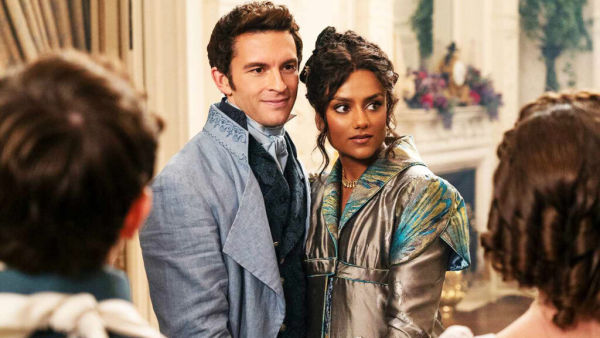
Mirroring the highly educated, well-spoken and Indian-origin socialite in English society, we meet Kate (Simone Ashley) and Edwina Sharma (Charithra Chandran) – who are called ‘Sheffeild’ in Quinn’s books – and their mother Lady Mary (Shelley Conn) who travel from the coast of Mumbai to the shores of Britain, seeking a groom for the young Edwina.
The bond between the sisters is as thick as blood gets, despite them having different mothers. Kate is the overbearing, protective sister who is claws-out for any man who may seek to hurt Edwina, and protects her younger sister from the family’s financial duress so she can marry for love, not out of filial obligation.
Kate’s strength is shown in her unabashed loud celebrations when she whoops and hollers at the Royal Races after besting Anthony Bridgerton (Jonathan Bailey) in a bet on which horse would win the race, and later when the Bridgertons and Sharmas are playing ‘pall-mall’ when she wades into a muddy area just to try and win the game against Anthony.
Edwina is doe-eyed, gentle and full of life, seeking the happiness of others and adoring her older sister, with her character arc becoming more assertive and seeking to discover life on her own terms, without her family hovering over her.
The sisters are as loving of their Indian roots as they are of the Ton’s affluence, with the presence of masala chai, oiling each other’s hair and even a ‘haldi’ ceremony held for Edwina before her marriage to Anthony. The sisters also hang heavy gold jewellery over their empire-waisted dresses, like in the Tamil culture.
Read more: IN PHOTOS: How Keeladi artefacts align with Sangam literature references
If you listen close enough, there is also a melodious string cover of Sometimes there is happiness and sometimes there is sadness.that is played in Episode Six of Season Two.
However, some viewers find that the mish-mash of languages they use puts the accuracy of their South Asian descent under question. Edwina refers to Kate as ‘bon’, a Bengali term for sister, as well as ‘didi’ which also means sister in Hindi, yet they call their father ‘appa’ which is a Tamil word for father.
The nods to Indian culture don’t stop there as there is a particularly moving scene where Kate presents Edwina with bangles that belonged to her deceased ‘Amma’ — which may signal that Kate’s mother might have been Tamil who married her father and took on the surname of Sharma, but nothing is canon as of yet. This scene also reiterates the Indian tradition of passing down gold bangles and jewellery from mothers to their daughters when they are to be wed.
Promotion discrimination
Fans have also pointed out Simone Ashley being sidelined in promotions for the show, as well as not having a proper wedding scene in the show. Bridgerton director Cheryl Dunye explained the decision to Insider“Two weddings in a show that were that spectacular, one could not do after the other,” referencing Edwina and Anthony’s fiasco at the altar when the bride runs off, and Kate and Anthony exchange vows instead, then jumping straight into their honeymoon without a wedding. For a lead couple, this raised quite a few eyebrows.
To add, Feminegra points out in one of its articles that Bridgerton’s repackaged book covers ‘failed’ the show’s dark-skinned leads, by omitting Simon and Kate’s names, instead Book One reads ‘Daphne’s Story’ and Book Two is ‘Anthony’s Story’. The article continues to point out disparities in the treatment of POC versus non-POC cast — pointing out that the darker-skinned leads are relegated to be secondary even when they are primary drivers of the story.
With the production team being open about being ‘colour-blind’ in their casting, one can only wonder if it would have been better to have been more ‘colour-conscious’ while doing so?
Colour-blind casting is when people of colour are casted in any role, taking on a neutral approach where the race of a character has little to no bearing on the storyline. Whereas, colour-conscious casting is when the race and ethnicity of a character and the person playing them has a profound effect on the storyline and adds authenticity.
While shows like Bridgerton have ostensibly advanced diversity by casting darker-skinned actors in roles long dominated by white-centric stories, one must ask: is this truly a step forward? Or does it mask a deeper regression, as the production repeatedly fails to acknowledge and support its BIPOC cast? Such doubts become pronounced by the show’s adoption of South Asian aesthetics, but its disregard for their authentic preservation, which get compounded by glaring inequities in promotional materials.
-
More People Are Buying The Top-End Sierra As The Waiting Period Increases

-
SKY Credits India's Success To Mindset: India Captain States Consistency Across Competitions Has Been The Key
-
'Tumne Apni Dosti Bech Di': The 50's Vanshaj Singh Slams Siwet Tomar For Flipping On Him - FPJ Exclusive

-
Pakistan: Ajay Banga Highlights Integrated Housing Need, Connects Safe Homes With Human Capital Development
-
Shah Rukh Khan, Farah Khan reunite for ‘Main Hoon Na 2’? Here’s all we know