When Tricog Health started analysing electrocardiogram (ECG) scans from hospitals and diagnostic centres in early 2014, it had minuscule data. Since then, the startup has collected nearly 33 million ECG scans.
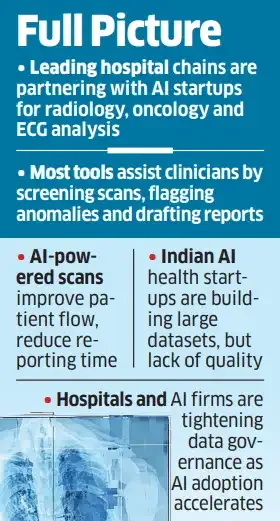
The Bengaluru-based firm is among the multiple artificial intelligence (AI) startups partnering with hospitals and diagnostic centres in the country for radiology, oncology and ECG-based scans, in an attempt to reduce time and workforce requirements.
Hospital chains including Aster DM Healthcare, Yashoda Hospitals, Manipal Hospitals, Apollo Hospitals and Global Health recently partnered with or are in talks with AI startups for diagnostics. Their AI-powered tools, often used along with human expertise, help reduce time to identify health conditions and prepare reports. Sometimes, they even find what humans miss.
On January 28, Manipal Hospitals announced a partnership with Australian startup Harrison.ai for chest X-ray and reporting solutions in its radiology department. The collaboration will assist radiologists by screening studies, identifying findings and generating AI-assisted draft reports, it said in a statement. Chest X-rays constitute more than half of the chain’s imaging volume, it said.
Aster DM Healthcare is slowly adopting the technology.
Its chief information officer, Sundeep Dey, told ET, "Earlier we used AI for keeping IP (inpatient) records, discharge summaries and outpatient records. Now, we are even adding diagnostics to it. We are already running pilots in oncology, which will begin in the next seven months.”
Apollo Hospitals has deployed agentic technologies to “autonomously anticipate patient issues and proactively solve them”, hospital divsion's chief executive Madhu Sasidhar said during its earnings call last November. The company has not disclosed which AI systems it uses.
In November, AI-startup Qure.ai and biopharmaceutical company AstraZeneca launched an AI-enabled lung nodule clinic with Yashoda Hospitals for early identification of lung cancer and pulmonary diseases.
Improved patient outcomes
Healthcare experts say these technologies reduce diagnostic time and improve patient outcomes.
“In radiology, an AI scan can give faster results, thereby improve patient flow and reduce workforce requirements,” said Pretesh R Kiran, associate professor at St John Medical College Hospital in Bengaluru.
Most hospitals see partnering with startups as a better alternative to building in-house capabilities. “There has been a skill gap which needs to be filled. Rather than acquiring talent and having a learning curve for our internal teams, it is better to partner,” said Dey.
AI can sometimes catch what radiologists miss. “We had cases where certain things missed by the naked eye were picked up by artificial intelligence agents. That kind of process only helps radiologists,” he said.
Tricog Health has partnered with nearly 15,500 hospitals and diagnostic centres across India. The cardiac diagnosis startup uses AI and human expertise to read ECGs and identify cardiovascular conditions. In-house doctors look over scans, make changes and send final reports within five to 10 minutes, said cofounder Zainul Charbiwala.
The algorithms evolve continuously. Tricog Health uses an algorithm model built on data collected by its doctors. “We have a learning system that updates that model constantly,” said Charbiwala.
Precision-oncology startup 4baseCare on Wednesday announced partnership with multi-speciality cancer treatment hospital Caritas for building access to precision oncology using its patient data. According to founder Hitesh Goswami, "We currently operate six advanced genomics labs, including a private-public partnership with AIIMS Jammu, and have signed an MoU (memorandum of understanding) with one of the largest private hospital chains."
Lack of quality data
Lightspeed-backed Qure.ai sources anonymised data from intermediaries in the US, Europe and Asia. While India accounts for 50% of its data, the country contributes only a small percentage to its revenue. Founder Prashant Warrier said the revenue share from India will improve in the future.
India lacks mature data intermediaries compared with the US, according to him.
“There are many companies in the US that interface with healthcare providers to develop databases with anonymised longitudinal patient data, which are then used by companies like us to develop AI algorithms,” Warrier said.
The founder of an AI startup Shorthills AI's Paramdeep Singh said that the company attempted to build a bone age structure model for Indian sportsmen alongside the All India Institute Of Medical Sciences (AIIMS) and other institutions. “We thought with Indian data we could do it, but it was very difficult to get this data,” Singh said.
Healthcare firms are strengthening data protection ahead of the implementation of the Digital Personal Data Protection Act from May next year. The sector previously lacked a proper data-sharing framework.
It comes amid large hospital chains betting on AI for diagnosis. In a recent earnings call, Global Health's group chief executive Pankaj Sahni said the company had procured robotic surgery equipment and AI-driven advanced medical scanning machines.
The Bengaluru-based firm is among the multiple artificial intelligence (AI) startups partnering with hospitals and diagnostic centres in the country for radiology, oncology and ECG-based scans, in an attempt to reduce time and workforce requirements.
Hospital chains including Aster DM Healthcare, Yashoda Hospitals, Manipal Hospitals, Apollo Hospitals and Global Health recently partnered with or are in talks with AI startups for diagnostics. Their AI-powered tools, often used along with human expertise, help reduce time to identify health conditions and prepare reports. Sometimes, they even find what humans miss.
On January 28, Manipal Hospitals announced a partnership with Australian startup Harrison.ai for chest X-ray and reporting solutions in its radiology department. The collaboration will assist radiologists by screening studies, identifying findings and generating AI-assisted draft reports, it said in a statement. Chest X-rays constitute more than half of the chain’s imaging volume, it said.
Aster DM Healthcare is slowly adopting the technology.
Its chief information officer, Sundeep Dey, told ET, "Earlier we used AI for keeping IP (inpatient) records, discharge summaries and outpatient records. Now, we are even adding diagnostics to it. We are already running pilots in oncology, which will begin in the next seven months.”
Apollo Hospitals has deployed agentic technologies to “autonomously anticipate patient issues and proactively solve them”, hospital divsion's chief executive Madhu Sasidhar said during its earnings call last November. The company has not disclosed which AI systems it uses.
In November, AI-startup Qure.ai and biopharmaceutical company AstraZeneca launched an AI-enabled lung nodule clinic with Yashoda Hospitals for early identification of lung cancer and pulmonary diseases.
Improved patient outcomes
Healthcare experts say these technologies reduce diagnostic time and improve patient outcomes.
“In radiology, an AI scan can give faster results, thereby improve patient flow and reduce workforce requirements,” said Pretesh R Kiran, associate professor at St John Medical College Hospital in Bengaluru.
Most hospitals see partnering with startups as a better alternative to building in-house capabilities. “There has been a skill gap which needs to be filled. Rather than acquiring talent and having a learning curve for our internal teams, it is better to partner,” said Dey.
AI can sometimes catch what radiologists miss. “We had cases where certain things missed by the naked eye were picked up by artificial intelligence agents. That kind of process only helps radiologists,” he said.
Tricog Health has partnered with nearly 15,500 hospitals and diagnostic centres across India. The cardiac diagnosis startup uses AI and human expertise to read ECGs and identify cardiovascular conditions. In-house doctors look over scans, make changes and send final reports within five to 10 minutes, said cofounder Zainul Charbiwala.
The algorithms evolve continuously. Tricog Health uses an algorithm model built on data collected by its doctors. “We have a learning system that updates that model constantly,” said Charbiwala.
Precision-oncology startup 4baseCare on Wednesday announced partnership with multi-speciality cancer treatment hospital Caritas for building access to precision oncology using its patient data. According to founder Hitesh Goswami, "We currently operate six advanced genomics labs, including a private-public partnership with AIIMS Jammu, and have signed an MoU (memorandum of understanding) with one of the largest private hospital chains."
Lack of quality data
Lightspeed-backed Qure.ai sources anonymised data from intermediaries in the US, Europe and Asia. While India accounts for 50% of its data, the country contributes only a small percentage to its revenue. Founder Prashant Warrier said the revenue share from India will improve in the future.
India lacks mature data intermediaries compared with the US, according to him.
“There are many companies in the US that interface with healthcare providers to develop databases with anonymised longitudinal patient data, which are then used by companies like us to develop AI algorithms,” Warrier said.
The founder of an AI startup Shorthills AI's Paramdeep Singh said that the company attempted to build a bone age structure model for Indian sportsmen alongside the All India Institute Of Medical Sciences (AIIMS) and other institutions. “We thought with Indian data we could do it, but it was very difficult to get this data,” Singh said.
Healthcare firms are strengthening data protection ahead of the implementation of the Digital Personal Data Protection Act from May next year. The sector previously lacked a proper data-sharing framework.
It comes amid large hospital chains betting on AI for diagnosis. In a recent earnings call, Global Health's group chief executive Pankaj Sahni said the company had procured robotic surgery equipment and AI-driven advanced medical scanning machines.