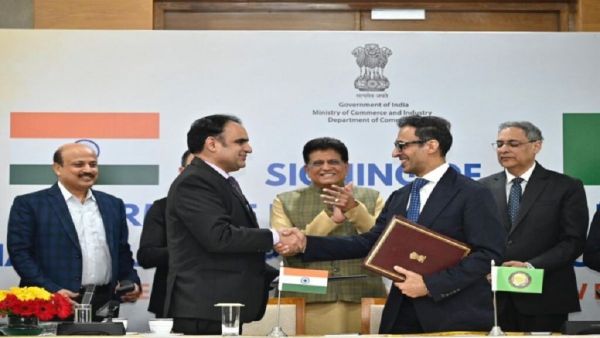
India has resumed talks on the long-pending free trade agreement (FTA) with the six-member Gulf Cooperation Council (GCC). If this agreement is signed, economic cooperation between India and GCC can reach new heights and the existing bilateral trade of $179 billion can get further momentum. This initiative comes at a time when India is rapidly expanding its trade relations globally.
On 5 February, Union Commerce and Industry Minister Piyush Goyal announced that India and the GCC have signed the terms of reference for a potential FTA. The ToR was signed by Ajay Bhadu, Additional Secretary, Department of Commerce, and Raja Al Marzooqui, GCC Secretariat, at a ceremony held in New Delhi. Speaking on the occasion, Goyal said, “As India deepens its trade ties with the developed world, the time has come to unlock the full potential of mutually beneficial economic relations with the GCC.”
India-GCC FTA negotiations were first initiated in 2004. Negotiations also progressed in 2006 and 2008, but the process stalled in 2011 after the GCC halted global trade negotiations. In 2022, both sides announced the resumption of negotiations, and in 2023 the GCC shared a draft of a revised ToR. After this, as a result of continuous talks, the way for talks has now been formally cleared. The first round of talks is likely to be held in Riyadh in the coming months, with Ajay Bhadu from the Indian side and Raja Al Marzooqui from the GCC side as the chief negotiators.
GCC is a regional organization, which was established on 25 May 1981. This includes Saudi Arabia, Kuwait, United Arab Emirates, Qatar, Bahrain and Oman. According to Article 4 of the GCC Charter, its purpose is to strengthen relations between member states and promote cooperation among their citizens. The organization aims to enhance coordination and integration in the economic, scientific, technological and industrial sectors.
The importance of GCC for India is multidimensional. “Both trading partners have been trading with each other for 5,000 years. There is now a need for a more robust and stable trading system that promotes free flow of goods and services, policy predictability and investment,” Goyal said. He also said that sectors like food processing, infrastructure, petrochemicals and information and communication technology will get special benefits from this.
According to the data, India-GCC trade was around $155 billion in 2021-22, which will increase to around $185 billion in 2022-23. It will be $162 billion in 2023-24 and will again increase to $179 billion in 2024. UAE is India’s largest trading partner among the GCC countries, followed by Saudi Arabia, Oman, Kuwait, Qatar and Bahrain. Additionally, approximately one crore Indians live and work in the GCC countries, and the UAE is one of the largest sources of remittances to India.
India has already signed trade agreements with some GCC members, including an FTA with the UAE in May 2022 and a Comprehensive Economic Partnership Agreement (CEPA) with Oman in December 2025. In such a situation, a possible FTA with the entire GCC is being considered important for India not only in terms of trade but also in terms of energy security, investment and strategic partnership.
Apogee Aerospace signs big defense deal worth ₹3,500 crore from Australia’s AAI
Lucknow Police registers FIR against Netflix show ‘Ghooskhor Pandat’
What poverty doesn’t do: Ajay Banga’s red carpet welcome in Pakistan, which hates Hindus and Sikhs.
-
Want to Keep Your Aadhaar Safe from Fraud? Follow These 5 Security Steps Shared by UIDAI

-
Oldest road in UK goes back 5,000 years and is still used today

-
Treasury issues update on plans for 'review' of road tax

-
Bengal: Three more held in Golpark clash; total number of arrests mounts to 23

-
Fire breaks out in moving train in Rajasthan's Jaisalmer; no casualties reported