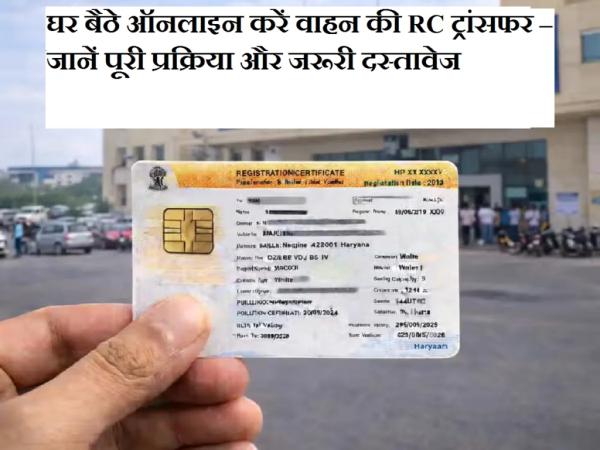
Registration Certificate (RC) is a mandatory document for any vehicle in India. It certifies that the vehicle is registered with the Regional Transport Office (RTO). Whenever the vehicle is sold, the owner dies, or the vehicle is transferred to another person, it is necessary to transfer the RC in the name of the new owner.
Due to the digital services of the government, now the process of RC transfer can be done online, which saves both time and effort.
Why is RC transfer necessary?
RC transfer ensures that:
- Legal responsibility of the vehicle passes to the new owner
- Traffic challans are registered in the name of the correct person
- Insurance and tax records stay updated
- Prevents fraud
- Government database remains accurate
If RC is not transferred, both parties may face legal problems.
Types of Vehicle Ownership Transfer
RC transfer is done in three main situations:
- In case of general sale – When the vehicle is sold from one person to another.
- after the death of the owner – When the vehicle passes to the legal heir.
- vehicle purchased at public auction – Vehicle purchased from government auction.
Documents required for RC transfer
The following documents are required for RC transfer:
- Form 29 and Form 30
- original rc
- insurance certificate
- Pollution Control Certificate (PUC)
- PAN Card or Form 60
- Print copy of chassis and engine number
- date of birth certificate
- address proof
- Buyer’s Declaration Form
- passport size photo
- tax clearance certificate
- NOC issued from RTO
- Additional form in special cases (Form 31 or 32)
Step-by-step process of online RC transfer
Step 1: Visit the website
Go to Parivahan e-service portal and select Vehicle Services.
Step 2: Select State
Select the state in which the vehicle is registered.
Step 3: Login or Register
Login with mobile number and OTP.
Step 4: Fill vehicle details
Select the vehicle registration number and the respective RTO.
Step 5: Select transfer option
Click on “Transfer of Ownership” option.
Step 6: Enter information
Fill complete information of buyer and seller.
Step 7: Verify Information
Vehicle details will appear on the screen. Check all details carefully.
Step 8: Pay the Fees
Deposit the fees online (approximately ₹300 to ₹500).
Step 9: Submit the form
Confirm all the details and submit the application.
Step 10: Submit documents at RTO
Both buyer and seller have to submit the signed documents to the RTO.
RC transfer time
If all the documents are correct, the RC transfer will cost approx. 3 to 4 weeks It takes time. In case of any mistake or doubt, RTO can call both the parties for verification.
Benefits of online RC transfer
- time saving
- transparent process
- digital payment
- less hustle and bustle
- easy tracking
Transferring vehicle RC online has become a simple and secure process today. Through Parivahan portal, vehicle owners can do this without much hassle. Applying with the right documents and correct information makes the process faster and smoother.
This digital service is making the vehicle registration system in India more transparent and modern.
-
CTET 2026 Exam: Important Details on Entry Times and Prohibited Items

-
Uttarakhand Education Department Opens Applications for 2364 Class IV Positions

-
Which? issues 'disturbing' alert as people 'cloned' after phone call

-
PB Fintech Cancels QIP Plan After Shareholder Backlash

-
Judge, activist blew whistle on deaths in Meghalaya mines – days before third explosion killed 23