DDGS is suddenly in the news after the India-US interim trade framework. From farmer organizations to opposition parties, everyone is raising questions about this. Under the recently announced India-US Interim Trade Framework, a provision has been made for reduction or abolition of duty on many agricultural products coming from America. These include DDGS, red sorghum for feed, soybean oil, tree nuts, fresh and processed fruits, wine spirits etc.
Commerce Minister Piyush Goyal said that import tax on sensitive products like DDGS, soybean oil, apple, long staple cotton will be reduced, but all this will be under Tariff Rate Quota (TRQ), i.e. low or zero duty up to a certain quantity, above that normal or high duty will continue. The government argues that the animal husbandry and poultry industry is demanding a cheap protein source. DDGS import will make fodder cheaper and there will be no uncontrolled import due to Tariff Rate Quota (TRQ).
In such a situation, it is important to understand what is DDGS? Where is it used and why has controversy arisen over it in the current India-US trade deal.
What is DDGS?
The full name of DDGS is Dried Distillers Grains with Solubles. It is basically an animal feed, which is mainly made from the residues left during the process of making ethanol from corn or other grains. When ethanol is prepared from a grain, starch is extracted from it and converted into alcohol. The solid part that remains contains protein, fiber, oil and minerals.
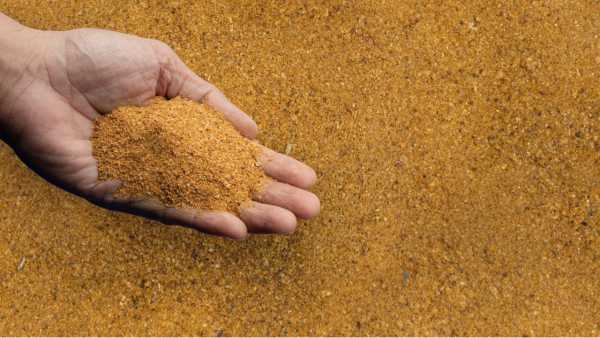
DDGS.
DDGS is prepared by drying this remaining part and adding soluble parts to it. It is used extensively in the fodder of chickens, cows, buffaloes, pigs etc., because it has good amount of protein. It can be replaced to some extent by replacing soyameal etc. It may also be relatively cheaper.
DDGS and GM crops in America?
A large portion of ethanol in America is made from genetically modified corn. For this reason, most of the DDGS produced there is believed to be derived from GM corn. According to US Grains Council data, America's ethanol plants have a capacity of more than 15 billion gallons and produce approximately 44 million metric tons of DDGS each year. This DDGS is exported to more than 5060 countries. A major cause of concern for India is that US DDGS is generally considered to be GM corn based, whereas in India there is still strong opposition and a strict regulatory system regarding GM grains.
What are the main objections of farmer organizations and opposition?
1- Fear of backdoor entry of GM crops
Many farmer organizations and opposition parties believe that DDGS is actually feed made from GM corn. It is being brought into the country as cheap animal feed. This will lead to indirect or backdoor entry of GM crops and GM products. They argue that GM food crops have not yet been widely approved in India.
Research and debate continues regarding the effects of GM on human and animal health, and biodiversity. In such a situation, bringing GM based DDGS on a large scale is a risky step from policy and scientific point of view. There is a clear demand from farmer organizations that no GM based food or feed should be allowed in any name or form.
In reply on behalf of the government, Piyush Goyal has said that when the grain is processed, its genetic modification (GM trait) identity is destroyed. And strict rules of the Environment Ministry will remain applicable on the import of GM material. But critics do not find this argument satisfactory, because they consider it to be the beginning of loosening policy commitments with the help of technical language.
2- Economic impact on soybean and other crop farmers
A big issue for farmer organizations is that reducing duty on DDGS and soybean oil will put severe pressure on indigenous soybean farmers, farmers growing maize, sorghum and fodder. According to farmer groups and agriculture related networks, the all India average market price of soybean in October 2025 was Rs 3,942 per quintal, which was about 26 percent less than the MSP of Rs 5,328 per quintal. The market price of maize in October November 2025 was around Rs 1,821 per quintal, which was about 24 percent less than the MSP of Rs 2,400 per quintal.
In such a situation, farmers are already struggling with selling below MSP, less government procurement and decreasing margins. On top of that, if cheap American DDGS and soybean oil comes, then DDGS will further replace soybean oil in the fodder market. There will be further pressure on soybean demand and prices. Prices of maize, jowar etc. may also be suppressed. This means that lakhs of soya farmers and feed farmers of states like Maharashtra, Madhya Pradesh, Rajasthan, Telangana may get into further trouble. Quoting traders, it has also been told that earlier due to US soybean oil being relatively expensive, more oil was imported from Argentina, Brazil, Russia etc. but after the tariff reduction, US soybean oil can also become competitive. Due to which the share of imports from US is expected to increase and impact on domestic oil seed farmers is being feared.
India-US Trade Agreement to strengthen livestock productivity and exports:
Concessional import of protein-rich animal feed such as DDGS and red sorghum Better nutrition to help increase per-animal productivity Reduction in US tariffs to boost exports from India pic.twitter.com/gsu2k4CAF9
— Dept of Animal Husbandry & Dairying, Min of FAH&D (@Dept_of_AHD) February 7, 2026
3- Doubt on the language removing non-tariff barriers
It also said that India has agreed to address long-standing non-tariff barriers on US food and agricultural products. Many critics believe that this is coded language, which in practice could mean gradually reducing India's strictness on GM crops and GM products. They do not consider it limited to just DDGS and soya oil but consider it as a possible beginning to open the door for more GM based products in the future.
Government's stand: Quota and security, protection of farmers
The government says that this deal opens the US market while protecting the interests of farmers. US duty on Indian spices, tea, coffee, cocoa, coconut oil, cashew nuts, many fruits and vegetables etc. will be reduced or eliminated. This will create new opportunities for Indian farmers in the US market worth more than $30 trillion.
Tariff rate quota on sensitive products like DDGS, soybean oil i.e. they will not get unlimited and zero tax entry. Quantity wise upper limit will remain fixed. Main grains and dairy products are excluded. Wheat, rice, pulses, barley, major dairy products, poultry, fuel ethanol etc. have been clearly kept out of the deal. Through this, the message is being given that staple food security will not be compromised. There is no relaxation being given on GM regulation. Environment Ministry rules will remain in place and approval and monitoring of any GM material import will continue.
The real bone of contention: fodder, GM and the direction of farming
The controversy over DDGS is not limited to just one product, but it is a bigger question on the direction of India's agricultural policy. Is India opening the market to GM based products in the name of making animal feed cheaper? Will this further weaken the livelihood of indigenous oil seed, maize, jowar and soya farmers? Is the lack of coordination between MSP, government procurement and import policy becoming a double blow to farmers? And in the name of removing non-tariff barriers, is India's cautious attitude towards GM crops gradually changing?
Farmer organizations demand that any decision on any GM based feed food products like DDGS and soybean oil should be taken only after complete transparency, scientific review, public debate, and such cheap imports should be avoided with great caution or completely avoided until domestic farmers get reliable benefits of MSP, adequate government procurement, and price stability.
In short, it can be said that DDGS is an animal feed, which is made from solid material left over from ethanol production. In America it is mostly made from GM corn. Duty reduction on DDGS and permission for quota based imports under the India-US trade deal has raised deep questions about the backdoor entry of GM in India, pressure on domestic soybean, maize, sorghum farmers and the long-term direction of agricultural policy.
The government is calling it a balanced step to connect with the global market while protecting the interests of farmers.Whereas farmer organizations and the opposition are considering it as a potential threat to Indian farmers and food security through GM products and cheap imports. This is the reason why DDGS is at the center of debate today amid the India-America trade deal.
-
Missed Your Train or Faced Heavy Delay? IRCTC’s TDR System Lets You Claim Full Ticket Refund
-
Is Your PAN Card Still Active? Check Instantly Online to Avoid Fines, Account Freeze, or Legal Trouble
-
Government Launches Free Legal Help on WhatsApp: Get Instant Advice from Home Using Nyaya Setu Service

-
India Skipper Shares Major Update On Washington Sundar’s T20 World Cup Return

-
Border 2 Enters Rs 300 Cr Club Despite 68.7% Drop In Week 2 Box Office Collection