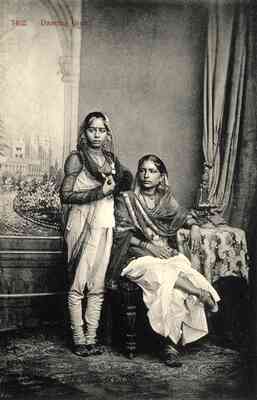
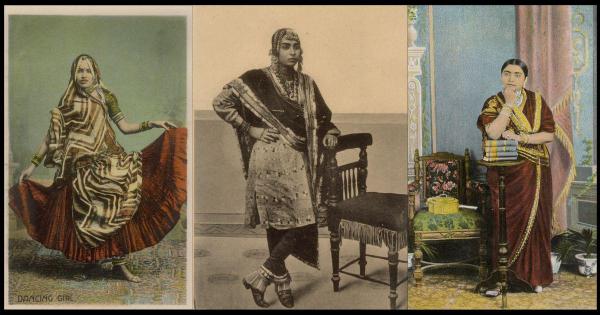
Nautch girls were significant cultural figures in pre-colonial India, though the term ‘nautch girls’ is a colonial construct, a possessive English word appended to thousands of years of tradition of many kinds. But we will use this colloquial term here, because it can be unwise to rename objects from the past. The use of the term ‘girl’ was diminutive, adding informality, indicating that she might be owned, softening and, as we shall see, disguising her agency.
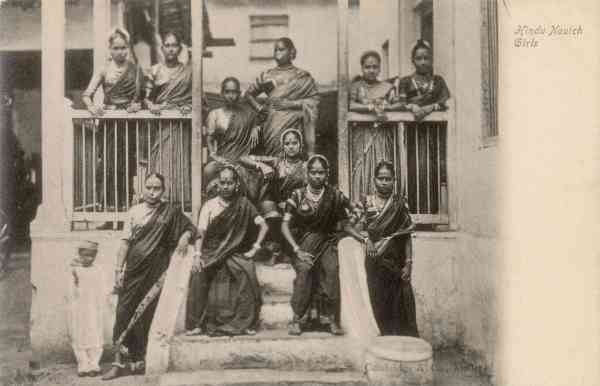
Female dancers were typecast, grouped or categorised according to the dance and music training they received, their skills and, increasingly during the Raj, their sexual availability. There were two major traditions, the devadasi associated with ritual dances at Hindu temples, particularly in South India, referred to roughly on postcards like Hindu Nautch Girls.
The second, similarly sophisticated but more secular tawaif, who performed for feudal lords, often Muslim, in North India as shown in Dancing Girls. The courtesan was a symbol of pleasure and sophistication, of economic independence, and a source of moral danger and social decay in reformist and nationalist discourse around the turn of the century.
Mirza Hadi Ruswa, author of Umrao Jaan Ada (1899), among the very first Urdu novels, told the story of nineteenth-century Lucknow’s decline through the first-person...
Read more
-
Propose Day 2026: How to propose? Step by step brother, otherwise love will come to an end! Get these tips

-
Huge cut in price of Apple iPhone 15 on Flipkart

-
India AI Impact Summit 2026: What are seven Chakras that will shape ‘future of global AI’ | Technology News

-
Rescued leopards must be checked! Forest Minister Ganesh Naik’s instructions to monitor the movement of wild animals

-
As much as India’s budget is spent on AI, these 4 companies will change the world of tech.