India is trying to bring countries together at the upcoming India AI Impact Summit to establish common minimum standards for artificial intelligence (AI) which can be deployed globally, India AI Mission CEO Abhishek Singh told ET.
This will play out through India's efforts to create multilateral consensus on deploying a set of open-access AI resources that lead to responsible and ethical deployment across the world, he said. "The first is an open source repository of AI solutions for key sectors such as agriculture, healthcare and education that can be used by all countries, especially keeping in mind nations in the global south," he said.
"This is needed for AI diffusion. The second one - trust commons - will focus on deploying safe and ethical AI, ensuring bias mitigation, regulation of deepfakes and watermarking of AI content." A common funding facility to roll out these measures are also part of the proposals that will be presented to leaders during the five-day summit beginning February 16.
Singh, who also serves as the additional secretary in the ministry of electronics and information technology (MeitY), said India will join the US-led global Pax Silica partnership on initiative for securing supply chains of semiconductors, AI infrastructure, critical minerals and advanced manufacturing. "India is aligned with major players on ways to address shortages, make value chains self-sufficient, and promote research, he said. "We will work with global companies to come out with new materials. I'm sure within 3-5 years, research will give us more materials."
 Small versus large
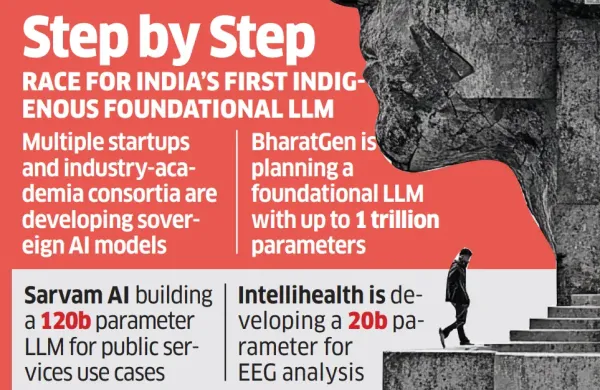
Clarifying that India is not chasing trillion parameter AI models or artificial general intelligence, he said India's requirements can be met with small language models (SLMs), going down to even just 14 billion parameters. A parameter is a variable that AI models learn during training, which gets adjusted as the AI learns from data, and ultimately determines how the input data is transformed into output.
"Our objective is to solve for India, to design the system in a way that it helps in solving our problems by leveraging Indian datasets that are domain specific. SLMs and smaller models are perfectly okay," he said. The Economic Survey 2025-26 has warned against India's pursuit of costly frontier LLMs, given the challenges of capacity, energy and infrastructure.
This will play out through India's efforts to create multilateral consensus on deploying a set of open-access AI resources that lead to responsible and ethical deployment across the world, he said. "The first is an open source repository of AI solutions for key sectors such as agriculture, healthcare and education that can be used by all countries, especially keeping in mind nations in the global south," he said.
"This is needed for AI diffusion. The second one - trust commons - will focus on deploying safe and ethical AI, ensuring bias mitigation, regulation of deepfakes and watermarking of AI content." A common funding facility to roll out these measures are also part of the proposals that will be presented to leaders during the five-day summit beginning February 16.
Singh, who also serves as the additional secretary in the ministry of electronics and information technology (MeitY), said India will join the US-led global Pax Silica partnership on initiative for securing supply chains of semiconductors, AI infrastructure, critical minerals and advanced manufacturing. "India is aligned with major players on ways to address shortages, make value chains self-sufficient, and promote research, he said. "We will work with global companies to come out with new materials. I'm sure within 3-5 years, research will give us more materials."
Clarifying that India is not chasing trillion parameter AI models or artificial general intelligence, he said India's requirements can be met with small language models (SLMs), going down to even just 14 billion parameters. A parameter is a variable that AI models learn during training, which gets adjusted as the AI learns from data, and ultimately determines how the input data is transformed into output.
"Our objective is to solve for India, to design the system in a way that it helps in solving our problems by leveraging Indian datasets that are domain specific. SLMs and smaller models are perfectly okay," he said. The Economic Survey 2025-26 has warned against India's pursuit of costly frontier LLMs, given the challenges of capacity, energy and infrastructure.