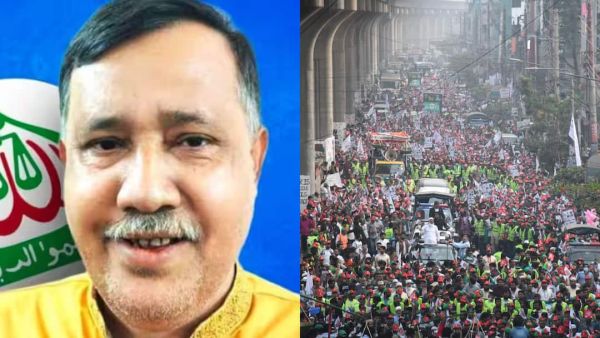
Krishna Nandi has unexpectedly become a focal point in the run-up to Bangladesh’s parliamentary elections scheduled for February 12. A veteran Hindu businessman with decades of commercial experience, Nandi is contesting from the Khulna-1 constituency on a Jamaat-e-Islami ticket—an unusual political pairing that has sparked debate and curiosity across the country. His candidature stands out not only because of his minority identity, but also due to his close political association with Jamaat’s Secretary-General, Mia Golam Parwar.
Nandi maintains that Jamaat-e-Islami is capable of representing citizens across religious lines. If elected, he says, he intends to raise Hindu concerns in the Jatiya Sangsad and challenge the perception that Islamist parties cannot accommodate minority voices.
Krishna Nandi: From Business Veteran To Political Aspirant
With a business career spanning more than 40 years, Krishna Nandi has built interests across multiple sectors, including rods, cement, motorcycles, fertiliser, tin, oil and sugar. His entry into politics dates back to 2003, when Golam Parwar first introduced him to Jamaat-e-Islami. Though Nandi originally hails from Khulna-5—the same constituency from which Parwar is contesting—Jamaat fielded him from Khulna-1 to broaden its electoral reach in the region, as per a report on The Week.
Explaining his association with Jamaat’s leadership, Nandi told Prothom Alo, “I like his ideology. He brought me into politics. My relationship with him is political. It is not a personal relationship.”
‘I Will Speak For Hindus In Parliament’
Nandi has repeatedly stressed that his motivation to enter politics is rooted in representation. He argues that minority communities need a stronger voice within mainstream politics, regardless of party labels. Articulating his goal, he said that he would go to Parliament and speak for Hindus and that this was the reason he was running for office.
He added that Jamaat-e-Islami was a party of principles and ideals, and that it had stood by the Bangladeshi public irrespective of their religion during the difficult period following the ousting of the Hasina regime.
A High-Stakes Election After Hasina’s Exit
The February 12 vote will see around 127 million registered voters elect 350 members to Bangladesh’s parliament, marking the first general election since former Prime Minister Sheikh Hasina was ousted in 2024. The country of 175 million has since grappled with prolonged instability, widespread protests and economic disruption, particularly in the garment sector, a key pillar of its economy.
The Bangladesh Nationalist Party (BNP) is widely seen as the frontrunner, while Jamaat-e-Islami is leading an 11-party alliance in a bid to reassert influence. A newly formed Gen-Z-driven party, born out of youth-led protests, has also aligned with Jamaat after failing to translate street mobilisation into standalone electoral success.
Bangladesh is currently governed by a caretaker administration headed by Nobel laureate Muhammad Yunus, installed after a student-led uprising ended Hasina’s long tenure. Alongside the parliamentary polls, voters will also take part in a referendum on the July National Charter 2025, a document intended to shape the country’s future governance framework.
-
Ram Charan’s wife Upasana shares joy after welcoming twins

-
After A Dazzling Super Bowl Halftime Show, Bad Bunny Wipes His Instagram Clean

-
BJP Candidate Dies By Suicide Ahead Of Telangana Elections; Party Alleges Harassment By Cong Leaders
-
Romantic food items to level up love meter on Valentine's Day 2026

-
20-Minute kids' lunch recipe ideas every parent will love