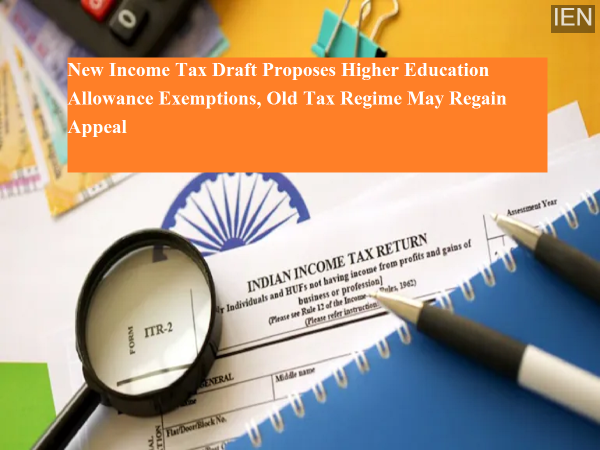
The government’s draft of the new Income Tax Rules, released on February 7, 2026, could significantly alter how salary income is taxed in India. The proposed changes focus on revising exemption limits for certain allowances and perquisites, a move that may once again make the old income tax regime more attractive for salaried taxpayers, especially those with higher education-related expenses.
While the new tax regime continues to remain the default option, the expanded exemptions under the old regime may prompt many taxpayers to reassess which structure offers better overall savings.
Major Increase Proposed in Education Allowance Exemptions
One of the most notable proposals in the draft rules is a sharp increase in the education allowance exemption. Currently, salaried employees can claim an exemption of just ₹100 per month per child, subject to a maximum of two children. Under the new draft rules, this limit is proposed to be increased to ₹3,000 per month per child, offering substantial tax relief to parents.
In addition, the hostel expenditure allowance exemption is also set for a major revision. The current exemption limit of ₹300 per month per child is proposed to be raised to ₹9,000 per month per child, again capped at a maximum of two children. These limits had remained unchanged for several years despite rising education and accommodation costs.
Tax experts believe these changes address long-standing demands for inflation-adjusted education benefits and reflect the increasing financial burden faced by families investing in higher education.
Renewed Interest in the Old Tax Regime Likely
Deductions and exemptions, such as education allowances, are available only under the old tax regime, whereas the new regime offers lower tax rates but fewer exemptions. Over the past few years, the simplified structure of the new regime has attracted many individual and salaried taxpayers.
However, experts say the revised exemption limits could tilt the balance back in favour of the old regime for employees who receive multiple allowances as part of their salary structure.
Gaurav Makhijani, Partner at Makhijani Gera & Associates, noted that increasing exemption limits on allowances could significantly enhance the attractiveness of the old regime. He added that the actual tax benefit would depend on an individual’s salary composition and the range of deductions available to them.
Vikas Sharma, Lead – Personal Tax at AKM Global, echoed similar views, stating that the choice between the old and new regimes will continue to depend on a comparative analysis of benefits rather than a one-size-fits-all approach.
Employees With Higher Allowances May Benefit More
Tax professionals suggest that salaried employees who are able to claim higher education and hostel allowances may find the old regime more beneficial. On the other hand, taxpayers with fewer exemptions and a straightforward salary structure may still prefer the new regime due to its simplicity and lower compliance burden.
The proposed education allowance hike is also seen as fulfilling a long-pending demand to align tax benefits with the rising cost of education and student accommodation.
Understanding Perquisites Under the New Draft Rules
Perquisites refer to non-cash benefits and amenities provided by employers in addition to salary. These benefits form part of taxable income and are valued according to prescribed rules, regardless of whether an employee opts for the old or new tax regime.
The draft rules propose revisions to how certain perquisites are valued, which could increase taxable income for some employees.
Higher Taxable Value for Employer-Provided Cars
Under the Income Tax Act, 1961 and existing rules, when an employer provides a car and driver for both official and personal use, a fixed monthly value is added to the employee’s taxable income. Currently, this value stands at ₹2,700 per month for small cars (up to 1.6 litres) and ₹3,300 per month for larger cars.
The draft rules propose raising these values to ₹8,000 per month for smaller cars and ₹10,000 per month for larger cars. This change would increase taxable salary and, consequently, the tax liability for employees receiving such benefits.
Gift Exemption Limit Also Proposed to Be Raised
Another relief proposed in the draft rules relates to gifts received from employers. The annual gift exemption limit is proposed to be increased from ₹5,000 to ₹15,000, offering modest additional tax relief to salaried employees.
Public Feedback Invited Before Final Rules
The government has invited public comments and expert feedback on the draft Income Tax Rules until February 22, 2026. After reviewing the suggestions, the final rules are expected to be notified.
Final Takeaway
The proposed changes to education allowances and perquisite valuation could reshape salary taxation for many employees. While higher exemptions may revive interest in the old tax regime, increased perquisite valuations could offset some benefits.
For salaried taxpayers, the key takeaway is clear: choosing between the old and new tax regimes will require careful calculation, taking into account allowances, exemptions, and long-term financial planning once the final rules are notified.
-
Nepali Man’s Thoughtful Post-Game Cleanup At Mumbai's Wankhede Wins The Internet After T20 World Cup Match

-
New Zealand's KKR Duo Tim Seifert & Finn Allen Set Record For Biggest Partnership In T20 World Cup History
-
IND Vs PAK, ICC T20 WC26: Flight Fares From Indian & Pakistani Cities To Colombo Spike After Pakistan's U-Turn On Boycott

-
Nagaland State Lottery Result: February 10, 2026, 8 PM Live - Watch Streaming Of Winners List Of Dear Destiny Sambad Night Tuesday Weekly Draw

-
'Betrayal By Another Friend': Poonam Pandey Stands In Support Of Friend Divya Agarwal, Calls Bhavya Singh's Claims A 'Personal Agenda'