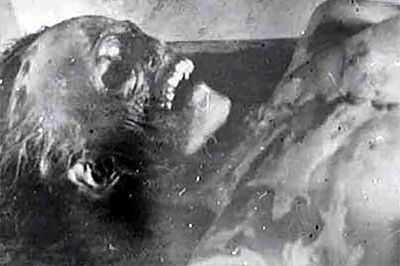
A group of students were found with bizarre injuries, missing tongues and lost eyeballs in a mystery which continues toconfound decades on.
Yetis, violent and hallucinating indigenous people, the Russian secret service and extra-terrestrial activity have all been put forward in adesperate attempt to solve the tragic and untimely deaths of these nine students.
In 1959, 10 university students set out on a skiing trek into the Ural Mountains. Their bodies were found on the Dyatlov Pass on ‘Death Mountain.’ There was just one survivor.
- 'I'm from US and there's 5 lies every American believes about the UK'
- Scientists on red alert as 'civilisation-ending' volcano begins to wake
One student, Igor, had a sister who remembers her mother begging her brother not to go on the trip. “But he pleaded with her,” said Tatyana, according to the BBC. “Just one last time Mama! Just one last time! And indeed, it was his last time.”
Tatyana said her mother never forgave herself for allowing her 23-year-old son to go. “She couldn’t ever come to terms with his loss - especially since it was such a terrible and incomprehensible death.”
Yekaterinburg’s Urals Polytechnic Institute students were experienced skiers - but this did not prevent their gruesome deaths which continue to horrify and intrigue.
Led by Igor Dyatlov the students set out on the mountain range that separates Europe and Asia.
Igor had promised to send a message to the sports club in Sverdlovsk as soon as his group was safely back at their base. When he failed to meet his 12 February deadline - there was minimal panic as there were often delays.
By 20 February the families were worried sick and the alarm was raised. The university sent out a search party - one of which was Mikhail Sharavin who was flown to the region by helicopter.
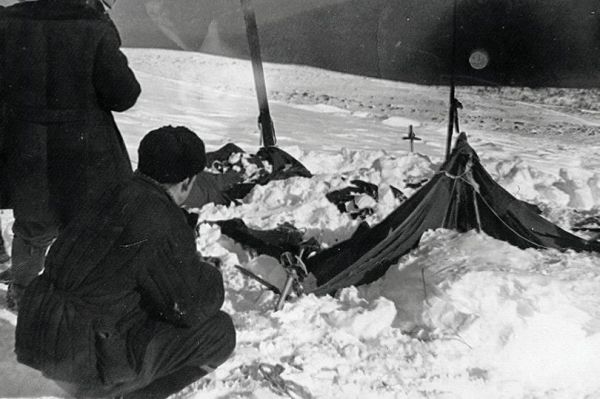
“We had gone about 500 metres when on the left I saw the tent,” said Sharavin. “Part of the canvas was poking out but the rest was covered in snow. I used an ice pick lying nearby to uncover the entrance.”
Disturbingly he found rucksacks neatly lined up, a pile of their boots and one blanket. There was also the route map, official papers, money, and a flask of alcohol, as well as a pork fat delicacy used by walkers to keep energy high.
“It was sliced up as if they were getting ready to have supper or something and didn’t have time,” he said.
Then he saw a terrifying slash mark on the inside of the tent that looked like someone had taken a knife to it to free themselves in the -20C weather.
Outside the tent, Sharavin saw eerie footprints made by eight or nine people for ten metres - some with single boots, some in socks.
Later the bodies of Zinaida Kolmogorova, 22, Yuri Doroshenko, 21,Alexander Kolevatov, 24, Yuri Krivonischenko, 23, Rustem Slobodin, 23, Nicolas Thibeaux-Brignolle 23, Lyudmila Dubinina, 20, and Semyon Zolotaryov, 38, were found.
Lyudmila wrote of her journey to the mountain. “In the train we all sang songs accompanied by a mandolin. Then out of the blue, this really drunk guy came up to our boys and accused them of stealing a bottle of vodka!
"He demanded it back and threatened to punch them in the teeth. But he couldn’t prove anything and eventually he got lost. We sang and sang, and no-one even noticed how we slipped into a discussion about love… and kisses in particular.”
Zinaida wrote to her family: “We are going camping, ten of us and it’s a great bunch of people. I have all the warm clothes I need, so don’t worry about me. How are you? Has the cow calved yet? I love her milk!”
The group hired a horse-drawn sled to carry their supplies for the last 15 miles to the abandoned North-2 mining settlement.
Yura Yudin is leaving us today,” wrote Zinaida in her diary. “His sciatic nerves have flared up again and he has decided to go home. Such a pity. We distributed his load in our backpacks.”
Zinaida skied to the Auspiya River before the final ascent.
“There was sun in the morning, now it’s very cold, All day long we followed the river. At night we’ll camp on a Mansi trail. I burned my mittens and Yura’s jacket at the camp fire – he cursed me a lot! We are on the eastern slope of Kholat Syakhyl, which (I’m told) means Mountain of Death.”
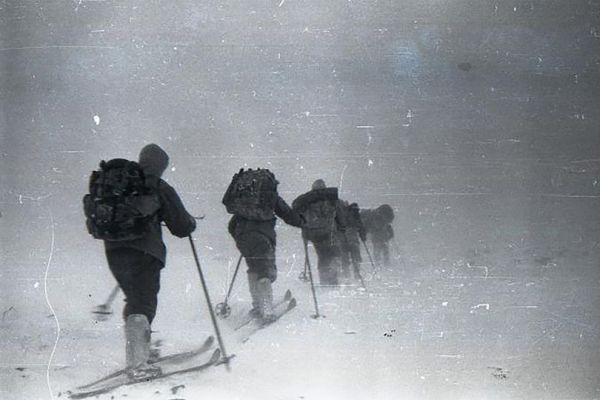
On the mountain of death extreme weather conditions lead to very poor visibility. However, on February 1 the students appeared to set up camp there in a shallow pit to shelter from the wind.
Sherman found a tent pole sticking out of the snow and then on February 27 - the bodies.
“We approached a cedar tree,” said Sharavin, “and when we were 20 metres away, we saw a brown spot – it was towards the right of the trunk. And when we got closer we saw two corpses lying there. The hands and the feet were reddish-brown.”
In their underwear - naked to the elements were the bodies of Yura Doroshenko and Yuri Krivonischenko, who had bitten off a piece of his own knuckle
Igor was dressed but shoeless and lying face down in the snow clutching a branch. Zinaida Kolmogorova’s body was in the position of someone attempting to scramble back uphill towards the tent.
A crimson mark appeared across the right side of her body, appearing consistent with a strike from a baton. The official deaths of the skiers were explained by hypothermia and frostbite, but, several bodies bore severe trauma entirely unrelated to cold exposure.
Rustem Slobodin, a long-distance runner known for his reserved nature, was discovered on March 5 with a fractured skull. Compared to others, his body was more adequately clothed, wearing a long-sleeved vest and jumper, two pairs of trousers, four pairs of socks, and a single felt boot on his right foot. His watch had stopped at 8:45am.
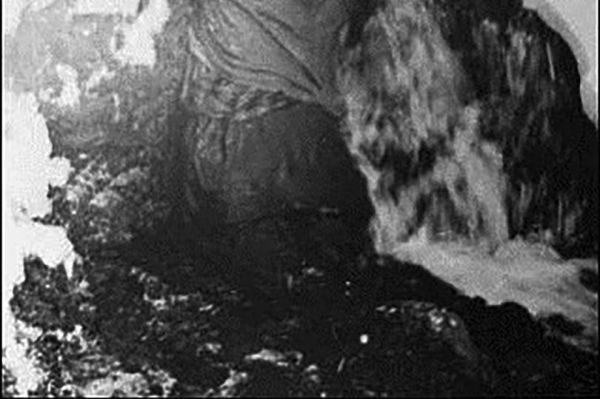
When the final four bodies were located in a gully during May, almost three months afterwards, following the snow's thaw, Nikolai Thibeaux-Brignolle, was also found with a fractured skull.
Aleksandr Kolevatov, had an odd injury behind his ear and a twisted neck. Lyudmila Dubinina and Semyon Zolotaryov, the group's eldest member, both had fractured ribs. Semyon had an injury to his skull, both were missing their eyes and Lyudmila's tongue was missing.
Tatyana was not allowed to go to Igor's funeral because fo the upsetting state of her brother's body.
"But I saw a photo of him in the coffin afterwards" she said "It was just dreadful. He looked entirely different to how he appeared before.
Her mother said she only recognised him from the gap between his teeth. His hair had turned grey. She mentioned the students' parents suspected the deaths were somehow linked to the military.
She said: "The families were told, 'You will never know the truth, so stop asking questions.' So what could we do? Remember, back then if they told you to keep quiet, you would obey."
Valery Anyamov, a member of the Mansi indigenous community said: "Soviet investigators were convinced we Mansi must have been responsible for their deaths. So many people around here were arrested and a woman from another village, who has since passed away, used to claim that the secret police tortured them.I don't know if that's true, but they were certainly questioned for weeks. "
Valery dismissed the theories. "If any of our people had been involved in that crime, they would have thrown us all into prison because it was a harsh time.
"Back then, people were executed by firing squad without investigation or trial." Lev Ivanov, who first investigated the deaths and led the official inquest in 1959, was relocated to an obscure town in the Republic of Kazakhstan and the incident was swept under the rug for three decades.
He only found the courage to speak out when the Soviet Union began to crumble. In 1990, Ivanov gave an interview to a newspaper where he confessed that he'd been astounded by the results of the autopsy on the students.
Multiple accounts emerged describing fiery spheres illuminating the heavens. However, he had received orders to classify his discoveries and disregard them entirely.
In the newspaper piece, Ivanov apologised to the families of those who died without knowing how they lost their loved ones.
Oleg Arkhipov, who lives in the nearby city of Tyumen, has written three books about the Dyatlov Pass Incident .
Oleg gained entry to the investigator's private archives and uncovered intriguing aspects of the post-mortem examinations. He found that some of the students' clothing contained radioactive traces. The temporary mortuary was cordoned off by KGB security personnel instead of regular police, with access strictly forbidden.
Oleg also found that a substantial barrel of alcohol arrived before to the autopsies were carried out, which he suspects investigators used to guard against radiation exposure.
He said: "Small containers of alcohol were sometimes used to store fragments of organs."
"But this was a very large quantity and the forensics team were given clear instructions to wipe themselves all over with the alcohol, to rub it all over their naked bodies. Such measures never normally took place in those days."
Oleg saw autopsy reports of the first five bodies, which said that fragments of their internal organs had been sent for chemical analysis.
He discovered a document confirming the successful delivery and storage of these organ samples in a fridge. However, once the results were known, the samples and the associated paperwork were removed from the laboratory.
Oleg said: "I don't exclude the possibility that the problem fell from the sky. Meaning, there was an explosion. It's impossible to say whether it was a military rocket. But why did the young people leave their tent in such a hurry and cut their way out? Because they couldn't breathe, perhaps?".
Alexander Kurennoi, spokesman for the prosecutor general, said that only three possible causes connected with extreme weather are being investigated.
"Crime is out of the question," he said at a press conference in February 2019. "There is not a single proof... it was either an avalanche, a falling slab of hard-packed snow or a hurricane."
Tatyana, sister of Igor Dyatlov, remains sceptical about the prosecutor's stance.
"You have seen for yourself what kind of avalanche could there be when their tent was almost intact? A hurricane? Well maybe, but it is possible to survive a hurricane," she argues.
"As for a snow slab which crushed their tent - that doesn't explain the injuries they had. And if it was just an ordinary hike which went wrong because of extreme weather conditions.."
"I think it means something extraordinary happened."
-
Seattle To Pay $29 Million In Settlement Over Death Of Indian Student Jaahnavi Kandula
-
KTET Admit Card 2026 Out At ktet.kerala.gov.in; Here's How To Download

-
TS ICET 2026 Application Window Opens At icet.tgche.ac.in; Apply By March 16 Without Late Fee, Exam On May 13 & 14

-
AISSEE Provisional Answer Key 2026 Issued At exams.nta.nic.in/sainik-school-society; Check Details Here

-
Rajasthan Board Class 10, 12 Exams Begin Amid Tight Security Measures