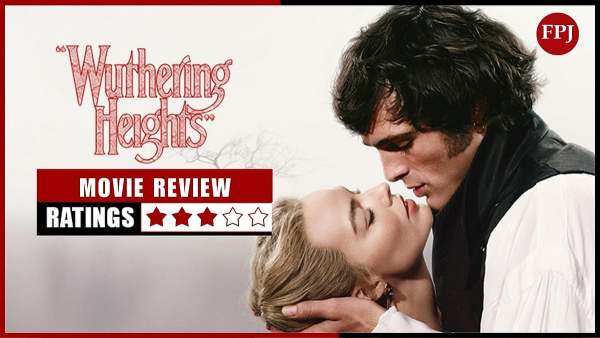
This film is bold, confident, and wilfully divisive. Thrilling in parts and excessive in others, it favours emotional heat over moral depth. As a film, it dazzles; as an adaptation, it strays freely
Title: Wuthering Heights
Director: Emerald Fennell
Cast: Margot Robbie, Jacob Elordi, Hong Chau, Shazad Latif, Alison Oliver, Martin Clunes, Ewan Mitchell, Amy Morgan
Where: In theatres near you
Rating: 3 Stars
Director Emerald Fennell’s Wuthering Heights arrives trailing perfume, provocation, and the faint smell of sacrilege. This is not Emily Brontë’s 19th-century English classic preserved in formaldehyde; it is Brontë hurled into a bonfire and filmed in slow motion. Fennell treats the novel less as scripture and more as emotional raw material, extracting obsession, desire, and spectacle while discarding much of its moral grit and generational sprawl. What emerges is a feverish romance convinced that passion alone is plot enough.
Fennell narrows the story to the centrifugal force between Catherine and Heathcliff, sanding away the social architecture that once made their love so corrosive. Class conflict, racial otherness, and the long shadow of vengeance are softened, sometimes to the point of vanishing. In their place is a heightened, sensual melodrama that wants to be felt before it is understood. The result is intoxicating in stretches, exasperating in others. The film knows exactly whom it is courting and does so without coyness, even if that courtship occasionally mistakes excess for depth.
Actors’ Performance
Margot Robbie’s Catherine is impulsive, wilful, and keenly aware of her own power. She plays Cathy as a woman driven by appetite rather than introspection, which suits Fennell’s vision even as it distances the character from her literary roots. Robbie captures the thrill of cruelty and the ache of regret, though the role often asks her to emote at full volume, leaving little room for modulation.
Jacob Elordi’s Heathcliff is a more divided proposition. He brings physical presence and wounded intensity, crafting a lover who is magnetic rather than monstrous. What is lost is the novel’s sense of menace and moral rot. This Heathcliff aches more than he terrifies. Among the supporting cast, Hong Chau quietly commands attention, grounding the film with a watchful restraint that the central romance frequently lacks.
Music and Aesthetics
Visually, the film is unabashedly lush. The moors are drenched in colour, the interiors flamboyant to the point of theatricality. Period detail flirts freely with modern stylisation, creating a world that feels less historical England and more heightened fantasy. At times this boldness exhilarates; at others it distracts, drawing attention to itself rather than the story it frames.
The music plays a crucial role in bridging centuries. Contemporary pop elements pulse through the narrative, collapsing time and insisting that this torment is eternal, not archival. The score amplifies emotion with a heavy hand, pushing scenes toward operatic intensity. Subtlety is not the aim here, and viewers resistant to sonic insistence may find it overwhelming.
FPJ Verdict
This film is bold, confident, and wilfully divisive. Thrilling in parts and excessive in others, it favours emotional heat over moral depth. As a film, it dazzles; as an adaptation, it strays freely. Overall, you may admire its passion while questioning its simplifications.
-
Karnataka Government Approves IPL Matches at M Chinnaswamy Stadium
-
Maha Shivratri vrat recipes: Dietitian shares simple, sattvic and nourishing dishes

-
What Makes VBAC Riskier for Some Women Than Others?

-
5 Oldest and iconic places to eat Hyderabadi Biryani in Mumbai

-
Tamannaah Bhatia, Junaid Khan to star in horror film‘Ragini 3’