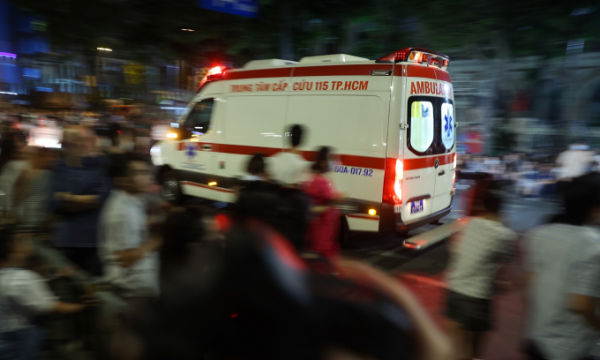
It was 5 p.m. on Feb. 7, 10 days before the Lunar New Year, and nurse Nguyen Trong Phuc of the 115 Emergency Center was transporting a man in critical condition.
The 40-year-old patient was suffering from acute respiratory failure due to unknown causes. As the ambulance moved slowly through heavy traffic, his blood oxygen saturation level dropped from 93% to 87%, indicating a rising heart rate and worsening oxygen deprivation.
The medical team switched his respiratory support from a nasal cannula to an oxygen mask to stabilize him while consoling his panicking relatives.
The team repeatedly broadcast requests for vehicles to give way on their loudspeaker, but the traffic at the congested roundabout had no room for even motorbikes to pull aside.
The three-kilometer trip from the patient’s home to the hospital in Gia Dinh Ward, which normally takes five to 10 minutes, lasted more than 30 minutes.
“We had to keep asking for right of way on the loudspeakers so other vehicles knew we were coming,” Phuc says.
Le Hoang Son, an ambulance driver with eight years of experience, describes his work during the days leading up to Tet every year as “haunting”.
He says he has to be constantly mindful of congestion hotspots, narrow alleys and traffic light cycles. At times he lowers the window to personally ask other drivers to make space.
|
An ambulance from HCMC 115 Emergency Center moves through a crowded street. Photo by Read/Quynh Tran |
HCMC has one of the highest traffic densities in the country, with some 12.7 million vehicles excluding those entering from neighboring provinces.
It has limited land for transport infrastructure, and so traffic bottlenecks such as the Hang Xanh Intersection and Lang Cha Ca Roundabout are frequently overloaded.
Traffic surges before Tet as the number of delivery vehicles increases and people travel for shopping and visits.
Major routes like National Highway 1, Hanoi Highway and Dien Bien Phu Street are congested throughout the day.
While people are more aware of yielding to emergency vehicles, limited road space often prevents them from making room because of the fear of being caught and fined by traffic cameras though there are legal exemptions for emergency situations.
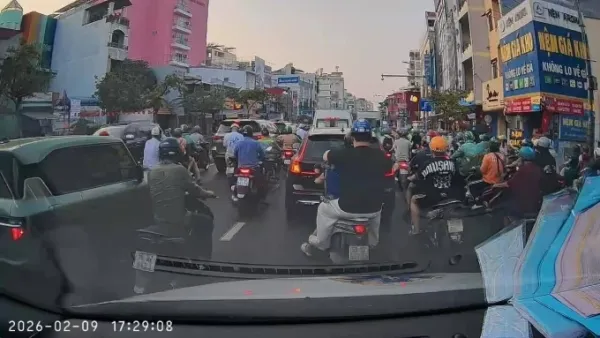
Dashcam footage of an ambulance moving slowly along a street in HCMC on Feb. 9, 2026. Video courtesy of HCMC 115 Emergency Center
Dr. Vu Khoa Cat recalls a similar situation when he was on call the night before Tet and crowds of people watching fireworks blocked roads in downtown HCMC.
An ambulance carrying a stroke patient had to mount the sidewalk to edge past the pedestrians. He was sitting with the patient, stabilizing and monitoring vital signs. Thankfully, the patient reached the hospital within six hours of the stroke and managed to recover.
To improve response times, the HCMC 115 Emergency Center deploys motorbikes to transport patients through narrow alleys and provide first aid before ambulances arrive. It has also established satellite stations across the city to shorten travel distances.
After the emergency call before Tet Phuc’s team took a short break for a quick meal before returning to duty.
Despite the heavy traffic and high pressure during the holiday period, they remain ready to respond to the next dispatch.
-
ZIM vs AUS: Zimbabwe Pull Off Stunning 23-Run Upset Over Australia In Thrilling T20 World Cup Clash At Colombo
-
AI 'SaaSpocalypse' Wipes ₹1.6 Lakh Crore: Nifty IT Crashes To 4-Month Low, TCS At 52-Week Bottom On Fears of 40% Revenue Deflation
-
'Unverified Reports...': Hrithik Roshan Denies Being Approached To Replace Ranveer Singh In Don 3

-
'Agar Ham Apni Par Aa Gaye Na…': Vada Pav Girl's Mystery Man Threatens Yugam Amid 5-Month Cheating Allegation

-
O'Romeo Box Office Collection Day 1 Prediction: Shahid Kapoor-Triptii Dimri Starrer Heading For A Strictly Decent Start