Whenever prominent figures, including Prime Minister Narendra Modi, arrive in Guwahati, the city undergoes a rapid and noticeable transformation. Streets are meticulously cleaned, traffic is expertly managed, security checkpoints increase, and public areas are closely monitored.
However, amidst this heightened security and the preparation of routes, another significant change occurs that often goes unnoticed. Numerous homeless individuals and beggars, who typically occupy sidewalks, flyovers, market areas, and temple grounds, gradually vanish from sight.
The Cycle of Displacement
Abdul, who is often seen near Sukreswar Mandir, shares that he has never been taken to a shelter. Instead, he claims that he is frequently pushed out of sight during security operations. "The police often remove us from here," he states, adding, "Even during this Republic Day, we were forced to leave. But they don’t take us anywhere."
According to Abdul, this relocation is temporary and informal. When officials arrive, he quickly gathers his belongings and moves to a nearby footpath or temple. "Once the VIP leaves or after a few days, I return to my original spot," he explains.
For Abdul, his survival heavily relies on the generosity of devotees. "People give food every day," he notes, emphasizing that this informal support system keeps him connected to the area.
Harsh Realities of Street Life
Ganesh Haloi, also found near Sukreswar Mandir, recounts a more severe experience. Originally from Hajo, he came to Guwahati seeking work but ended up living on the streets.
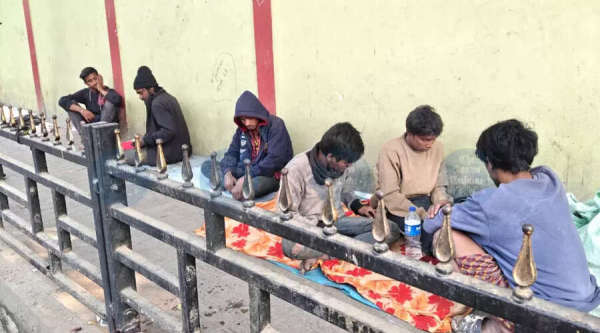
A scene from Sukreswar Ghat, Pan Bazaar, Guwahati (Photo: AT)
"When the drive happens, police storm in with warnings and batons. They don’t give us time to ask anything. If we don’t comply, they beat us," he alleges. When asked about any government support or rehabilitation, Ganesh shakes his head in denial.
Survival Strategies
Under the Ulubari flyover, Syeda Begum has been living beneath a concrete pillar for the past two weeks. Previously, she resided near Paltanbazar. "I have not been removed from here yet," she states. "But earlier, when the Prime Minister visited, I was cleared off from Paltanbazar."
Syeda survives by scavenging for garbage and occasionally begging. For her, displacement is contingent on location and timing, with certain areas facing more aggressive actions during VIP visits.
Rafiq Sarkar, also seen under the Ulubari flyover, shares a different experience. "Officials once took me to a shelter," he recalls. "They promised free food and shelter." However, his stay was short-lived. "I couldn’t remain there. I escaped," Sarkar says, without providing further details.
Official Responses to Homelessness
Officials from the District Social Welfare Department, however, portray a contrasting narrative. A district-level officer states that relocations are not solely tied to VIP visits.
"We conduct drives almost every month," the officer explains, noting that these operations are part of the Support for Marginalized Individuals for Livelihood and Enterprise (SMILE) scheme.
Under this initiative, beggars are moved to government-run and NGO-operated shelters. For women, facilities like Shakti Sadan, GOLD, NABARD, and Nirmal Ashroy in Narengi are designated.
Other available resources include the Indian Council For Child Welfare (ICCW) in Geetanagar under the Guwahati Municipal Corporation, mental health homes such as Jai Mata Di and Help Aid in Sonapur, and old-age homes like Matri Niwas.
"These homes provide food, water, clothes, medical care, everything," the officer asserts.
The department claims that relocation efforts involve collaboration between the Social Welfare Department, Guwahati Municipal Corporation, police, district administration, and NGOs.
GMC provides transportation, while police personnel are present to maintain order.
Challenges of Reintegration
Despite ongoing efforts, officials acknowledge that many individuals return to the streets. "We relocated many from Ulubari Chariali and Sukreswar Temple. But they come back," the district officer admits.
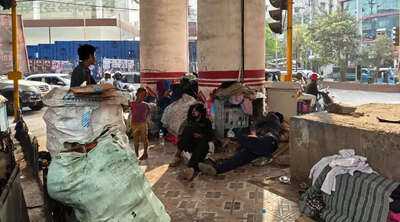
With their belongings stacked beside them, street-side residents sit under Ulubari flyover in the city (Photo: AT)
Sukreswar Ghat, in particular, poses management challenges. "They do not want to stay in confined facilities. They escape," the officer notes, adding that many receive three meals a day from temple offerings.
A junior assistant from the District Social Welfare Department, who requested anonymity, adds that many individuals in Sukreswar are neither elderly nor ill. "Most of them are young. They sit there for food and a place to sleep," the junior assistant explains.
According to officials, addiction is another factor contributing to resistance. "One reason people escape is that they don’t get alcohol or addictive substances inside homes," the junior assistant elaborates.
The Dilemma of Consent
Officials admit that obtaining consent is not always feasible. "We try to persuade them. But some become aggressive. In such cases, police use force," the district officer states.
The officer also acknowledges the absence of a written standard operating procedure. "There is no specific guideline. We rescue them and relocate them," the officer explains.
Capacity remains a significant hurdle. Mental health shelter homes in Guwahati can accommodate around 25 to 30 individuals, yet currently house 40 to 50, according to officials. "We urgently need more mental homes," the junior assistant emphasizes, noting that funding delays further complicate operations.
The Impact of VIP Visits
Both officials claim that in the past month alone, over 25 beggars have been relocated. Yet, the gap between official assurances and street-level realities is hard to overlook.
Authorities discuss designated shelter homes and structured rehabilitation, while those on the streets speak of being instructed to move, to vanish, and to return only after the convoy has passed.
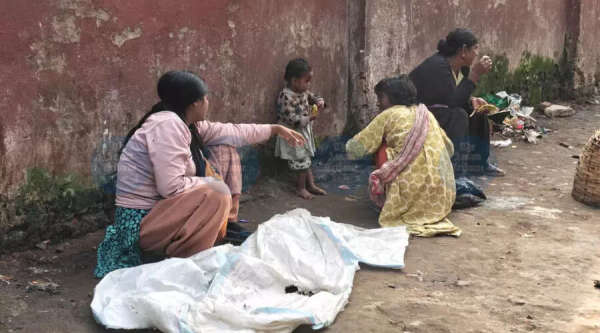
Women & children sharing a meal while sitting along a wall near Paltanbazar railway station in Guwahati (Photo: AT)
As Guwahati gears up for high-profile visits ahead of the Assembly elections, the pattern remains consistent - clear the routes, empty the pavements, and restore order for the cameras.
Some individuals are taken to shelters, while others simply scatter to nearby lanes, under flyovers, or behind temples, waiting for the city to ease its grip. Once the security measures are lifted, many return to their previous locations. Survival leaves little room for alternatives.
For Abdul, Ganesh, Syeda, and countless others, the streets provide something that institutions often fail to offer - daily food, familiar faces, and a degree of autonomy, albeit precarious.
Until rehabilitation efforts extend beyond sporadic drives and shelter capacity aligns with reality, the lingering question remains - is Guwahati addressing the issue, or merely sanitizing it for VIP visits?
-
India vs Pakistan High-Voltage Showdown Tomorrow – Times Bull

-
Clean a rusty pan with this Rs 1 shampoo, shine like new in two minutes without any effort

-
Nvidia CEO Jensen Huang to skip India AI Impact Summit next week in Delhi; Know why and check his net worth. Technology News

-
Valentine’s Day: Instagram’s Valentine’s Treat, Romantic Features for Story-Reels! Express your love in digital style now…

-
India Vs Pakistan: Will Handshake Make A Comeback In T20 World Cup Marquee Clash?