Investors in Nvidia Corp were left underwhelmed this week, even after the artificial intelligence chip giant delivered a sales forecast that comfortably surpassed Wall Street expectations.
The reaction highlights a growing reality for the world’s dominant AI processor maker: extraordinary growth is no longer enough; markets now want proof that the AI boom has staying power.
During a conference call with analysts, shares slipped as much as 1.5 per cent before ending little changed by Wednesday evening, reported Bloomberg. The muted response stood in contrast to the headline figures, which showed the company continuing to expand at a staggering pace.
For a firm that recently claimed the title of the world’s most valuable company on the back of explosive AI demand, the bar has clearly moved higher.
The Forecast That Failed To Excite
Nvidia said fiscal first-quarter revenue is expected to reach about $78 billion, comfortably above the average analyst estimate of $72.8 billion. However, some projections had edged closer to $80 billion, according to data compiled by Bloomberg.
The company’s latest quarterly performance was equally robust. Revenue for the fiscal fourth quarter ended January 25 rose 73 per cent to $68.1 billion. Profit came in at $1.62 per share, excluding certain items, ahead of expectations of $1.53. Adjusted gross margin stood at 75.2 per cent, also beating estimates.
Yet despite these numbers, scepticism lingered.
Huang Defends The AI Thesis
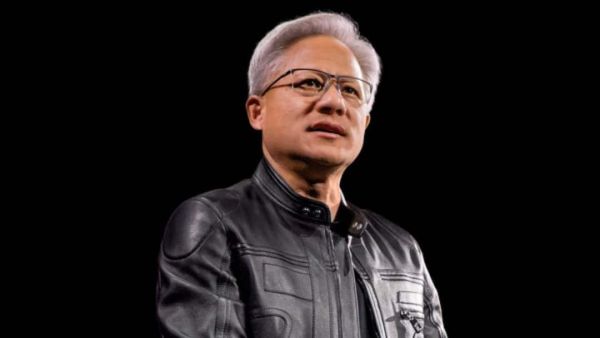
Chief Executive Officer Jensen Huang addressed concerns head-on during the call, arguing that customers are already generating returns from their AI investments. In his view, demand for computing capacity will remain elevated.
“You need compute capacity, and that translates directly to growth, and that translates directly to revenues,” Huang said. “I’m confident their cash flows are growing.”
Chief Financial Officer Colette Kress reinforced that message, insisting the company has secured sufficient supply commitments to meet rising demand, even as production of its most advanced chips remains complex.
The current Blackwell chip lineup, along with its successor Rubin, is still expected to outperform earlier projections. Nvidia had previously indicated that these chips could generate $500 billion by the end of 2026.
“We believe we have inventory and supply commitments in place to address future demand, including shipments extending into calendar 2027,” Kress said.
China And Tariffs Add Uncertainty
One persistent area of uncertainty remains China, historically one of Nvidia’s largest markets. While the US government has granted licences for limited shipments of H200 processors, the company does not yet know whether Chinese authorities will approve them.
For now, Nvidia continues to exclude China data centre revenue from its forecasts. The approved shipments must undergo US inspection, and the processors are subject to a 25 per cent tariff when entering the United States, adding another layer of complexity.
Data Centres Drive The Growth Story
The real engine of Nvidia’s expansion remains its data centre business, which generated $62.3 billion in quarterly revenue, surpassing analyst estimates of $60.4 billion. These AI accelerators and networking products are central to the creation and deployment of large-scale artificial intelligence models.
Other divisions were less impressive. Gaming revenue totalled $3.73 billion, missing expectations of $4.01 billion. Automotive sales reached $604 million, below the predicted $643 million.
A global shortage of memory chips continues to cast a shadow, pushing up costs and limiting production volumes, particularly in gaming hardware.
The Bigger Question: Is The AI Economy Sustainable?
For now, Nvidia’s financial performance remains extraordinary. Few companies in history have achieved comparable growth at this scale. But markets are shifting focus from raw expansion to durability.
With AI spending now measured in hundreds of billions of dollars, investors are increasingly asking whether this momentum can be sustained once the first wave of infrastructure buildout is complete.
-
T20 World Cup: Maheesh Theekshana stuns NZ with three wickets

-
Managing High-Demand Periods Without Burning Out Your Gym Staff

-
From the memoir: Poet Akhtarul Iman on the conflict between Urdu writers' groups in India

-
₹12,000 Annual Aid for Women: How Jharkhand's Maiya Samman Scheme Works and Who Can Apply

-
Taylor Swift and Travis Kelce's Upcoming Wedding: Excitement Builds