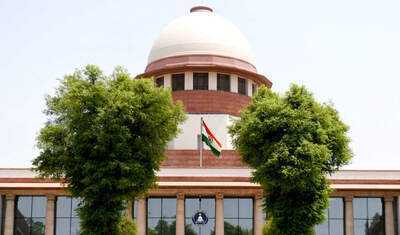
The Supreme Court has enacted a complete and absolute ban on an NCERT social science textbook that contained a chapter titled 'Judiciary Corruption.' The court described the situation as a "deep conspiracy" and issued a show-cause notice to Dinesh Prasad Saklani, the Secretary of the School Education Department, and the NCERT Director.
Government's Response to the Court
Today, the central government informed the Supreme Court that individuals involved in drafting the chapter on 'Judiciary Corruption' would not collaborate with the UGC or any ministry. Solicitor General Tushar Mehta expressed unconditional apologies, stating, "In a suo motu case, we seek unconditional forgiveness." However, Chief Justice Surya Kant retorted, "Our friends in the media have sent this notice. There is not a single word of apology in it."
Concerns Raised by the Chief Justice
When SG Mehta mentioned that 32 copies of the book had been sold but were now withdrawn, the Chief Justice remarked that this was a deliberate act. He stated, "The entire teaching community will be informed that the Indian judiciary is corrupt and that cases are pending... then students, and subsequently parents. This is a deep conspiracy."
Controversy Surrounding the NCERT Social Science Book
The chapter on 'Judiciary Corruption' in the NCERT social science book discusses issues such as corruption, a significant backlog of cases, and the shortage of judges as challenges facing the judicial system. The new book asserts that judges are bound by a code of conduct that governs their behavior both inside and outside the courtroom.
The chapter states, "People experience corruption at various levels of the judiciary. For the poor and needy, this can exacerbate access to justice issues. Therefore, continuous efforts are being made at both the state and union levels to build trust in the judicial system and enhance transparency, including the use of technology, and to take swift and decisive action against any instances of corruption."
The book estimates that there are approximately 81,000 pending cases in the Supreme Court, 6.24 million in the High Court, and 47 million in district and subordinate courts.
-
Horror-comedy blast in ‘Ram ji aake bhala karenge’ – Obnews

-
Bring home these vastu approved plants to attract money, prosperity, and peace

-
Holi Special: Make real Mathura style thandai at home, everyone will ask for the recipe as soon as you take one sip.

-
SIM binding rules will be applicable from March 1, WhatsApp will have to be stopped without SIM

-
What data does WhatsApp collect about you when you use Status and Channels? complete information