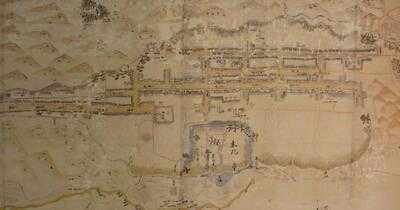
My acquaintance with Japanese historical (or period) crime/detective fiction is limited to only a handful of works: Kidō Okamoto’s Hanshichi torimonochō (translated as The Curious Casebook of Inspector Hanshichi: Detective Stories of Old Edo, University of Hawai‘i Press, 2007) and a couple of manga and anime series such as Shōtarō Ishinomori's Sabu to Ichi Torimono Hikae (Sabu and Ichi’s Detective Tales), Shōtarō Ikenami’s Onihei Hankachō (adapted into a long-running manga series by Sentaro Kubota and Takao Saitō, as well as a 2017 anime series), Yuichiro Kawada and Takase Rie’s Edo no Kenshikan (Edo Coroner), Fuyumi Ono and Niki Kajiwara’s Toukei Ibun (Strange Tales of Tokyo), Kei Toume's Genei Hakurankai, and maybe a couple more. To this list, I now have the privilege and good fortune of adding Honobu Yonezawa’s acclaimed, award-winning novel from 2021, Kokurōjō (translated as The Samurai and the Prisoner, Yen Press, 2023).
The period in which The Samurai and the Prisoner is set – 1578-79, falling in the last quarter of the Sengoku era – predates the historical setting of the other aforementioned works. This makes for interesting outcomes. For one, this is a far more chaotic time in history, marked by incessant, excessive warfare and strife, compared to the Edo and later periods. Second, the more visible difference is that the resulting focus or the gaze of this novel, unlike that of...
Read more
-
Madhya Pradesh to hold 'Agriculture Cabinet' in tribal-dominated Barwani

-
Effective Ways to Clean a Burnt Tawa in Minutes
-
Chelsea next five fixtures compared to Liverpool, Man Utd and Aston Villa in Champions League race

-
UK seaside town with incredible 623ft pier named best in Britain

-
'I was close to joining Chelsea - now I could make £90m transfer after snubbing them'