
Canadian PM Mark Carney's visit to India concludes, revitalizing ties. Key outcomes include a $2.6B uranium deal, a critical minerals MoU, and a goal to boost annual trade to $50 billion, placing the relationship on a firm footing.
A productive diplomatic mission has concluded as Canadian Prime Minister Mark Carney departed for Australia on Monday, following a successful official visit to India. The Canadian leader was seen off at the airport by the Union Minister of State for Commerce and Industry and for Electronics and Information Technology, Jitin Prasada.

In a post on X, Ministry of External Affairs spokesperson Randhir Jaiswal stated, "A productive visit concludes. Prime Minister @MarkJCarney departed for Australia following a successful Official Visit to India. He was seen off by MoS for Commerce & Industry and for Electronics & IT @JitinPrasada." A productive visit concludes. Prime Minister @MarkJCarney departed for Australia following a successful Official Visit to India. He was seen off by MoS for Commerce & Industry and for Electronics & IT @JitinPrasada. The visit delivered tangible outcomes in key areas and… pic.twitter.com/LNFqr4QLzY — Randhir Jaiswal (@MEAIndia) March 2, 2026
The visit, which included high-level delegation talks and the signing of a landmark uranium supply deal, is viewed as a significant turning point in bilateral relations. Highlighting the impact of the trip, Jaiswal noted, "The visit delivered tangible outcomes in key areas and placed the relationship on a firm footing with a forward-looking agenda imparting strength to multifaceted and longstanding India-Canada ties."
Strategic Pacts on Energy and Trade
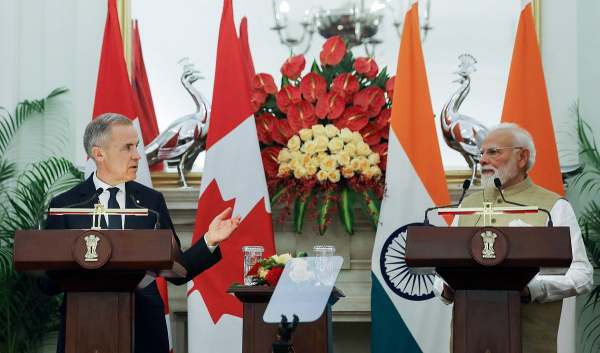
These outcomes were reflected in the substantive agreements reached during the visit. India and Canada have significantly strengthened their bilateral partnership by sealing major agreements on the supply of uranium and critical minerals, while committing to a target of USD 50 billion in annual trade by 2030.
Following high-level discussions in the national capital on Monday, Prime Minister Narendra Modi and his Canadian counterpart, Mark Carney, finalised a strategic framework aimed at revitalising a relationship that has transitioned toward "new energy, mutual trust and positivity."
A cornerstone of the visit was a USD 2.6 billion agreement for long-term uranium supply, intended to bolster India's civil nuclear energy sector. Prime Minister Modi highlighted the depth of this collaboration, stating, "In civil nuclear energy, we have signed a landmark deal for long-term uranium supply. We will also work together on small modular reactors and advanced reactors."
Addressing Shared Security Concerns
Beyond energy cooperation, the two leaders also addressed shared security concerns, particularly regarding global stability and the ongoing crisis in West Asia. Prime Minister Carney noted that both nations identify "terrorism, extremism, and radicalisation" as "common and serious challenges not only for India and Canada but for all humanity," adding that "our close cooperation against these is crucial for global peace and stability."
On the situation in the Middle East, Prime Minister Modi expressed "deep concern," asserting that "India supports the resolution of all disputes through dialogue and diplomacy." He further committed to ensuring the "safety of all Indian citizens in the region" amidst the volatile security climate.
Expanding Economic Cooperation
The economic dimension of the reset featured prominently in the discussions, particularly as Canada navigates a complex trade environment with the Trump administration, leading Ottawa to seek resilient partnerships elsewhere. Highlighting the goal to nearly quadruple current trade volumes from USD 13 billion to USD 50 billion, PM Modi stated, "Unlocking the full potential of economic cooperation is our priority. Therefore, we have decided to finalise the Comprehensive Economic Partnership Agreement soon." He also pointed to the "USD 100 billion" invested by Canadian pension funds as a symbol of "their deep belief in India's growth story."
Complementing these economic ambitions, the visit also yielded a Memorandum of Understanding (MoU) on critical minerals to secure "resilient supply chains," leveraging Canada's vast reserves of rare earth materials. Prime Minister Carney described these initiatives as "the beginning of a new, prosperous relationship that will offer generational opportunities for workers and businesses."
New Frontiers in Defence and Education
Strategic cooperation was further expanded in the defence sector, with the two democracies agreeing to establish the "India-Canada defence dialogue" to enhance maritime domain awareness and military exchanges. Educational ties were also strengthened, with PM Modi announcing that "Canadian universities opening campuses in India" would be a key feature of the new partnership.
This diplomatic breakthrough follows a period of strained relations triggered by events in 2023. However, since Prime Minister Carney's election victory last year, both nations have worked consistently to normalise ties, culminating in this visit, which PM Modi believes has transformed their shared vision into a "next level partnership." (ANI)
(Except for the headline, this story has not been edited by Asianet Newsable English staff and is published from a syndicated feed.)-
India, Canada Reset Ties: $50 Billion Trade Target, Defence And AI Deals Signed
-
Man Climbs Puri Jagannath Temple's Lion's Gate While Chasing Monkey To Retrieve Bag

-
Tottenham slapped with Champions League fan ban and charged by UEFA over 'Nazi salutes'

-
Zinc Deficiency In Women: Hair loss and period problems? Are you also a victim of this essential mineral deficiency?

-
Madhya Pradesh CM participates in 'Bhagoriya Fest' in Barwani
