Donald Trump's health has remained a subject of intense online discussion since he first assumed office in 2016. The scrutiny has intensified further during his second presidential campaign, particularly after he repeatedly challenged Joe Biden's fitness for office based on age-related concerns.
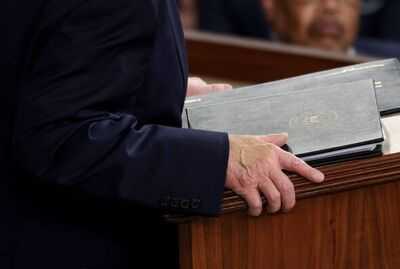
Most recently, noticeable bruising on his hands triggered renewed online debate about his condition. The official White House explanation stated that the marks emerged after he "clipped" his hand on the corner of a signing table during a World Economic Forum event in January 2026.
Government officials confirmed Trump also takes a daily 325mg dose of aspirin - which is recognised for potentially thinning the blood and increasing susceptibility to bruising. Some of his earlier minor bruising has also been linked to frequent handshaking.
Addressing the speculation, Dr Helen Wall suggests a measured approach is required: "I've been a doctor for 20 years, and I think there's a few bits of speculation that just need a little bit of caution applying to them," she explains.
"Firstly, obviously age itself is not a disease. There's lots of people who get into their 70s, 80s, 90s who are perfectly fit and well with no underlying health conditions", reports the Mirror US.
Nevertheless, she acknowledges that ageing naturally brings visible physical changes. "The skin is aged, the blood vessels are aged. You're more likely to get more tired. That doesn't mean you've got an underlying condition."
Addressing the bruising directly, she offers her opinion on whether the official explanation is medically plausible: "I think President Trump's team have come out and said it's because he's on aspirin, it's because he's doing plenty of handshakes. That's a perfectly reasonable explanation as far as I can see.
"We see a lot of older adults who get easy bruising because of blood thinners such as aspirin, clopidogrel, warfarin. So that's not in itself an alarming feature in someone of his age.

"It would be much more of an alarming feature in a young adult who suddenly started having significant bruising and particularly if they weren't on any medication."
Dr Wall also cautions against making medical judgements based on images. She emphasised that "photos, videos, social media clips - they're actually very poor tools for clinical assessment.
"You cannot diagnose any of that from still images, from snapshots in time that are shown on pictures, on social media. It's just not possible.
"People in this age group quite often have more medical signs than younger adults like occasional bruising, leg swelling or reduced stamina. That's just a part of ageing."
Ensure our latest headlines always appear at the top of your Google Search by making us a Preferred Source. Click here to activateor add us as your Preferred Source in your Google search settings.
-
After 40, new love came into life? Don’t forget these 6 tips to sweeten the relationship

-
Gujiya will remain crisp for months, just follow this easy and correct way to store it.

-
This Holi, bring a smile on the faces of your loved ones, send these love and colorful messages.

-
This time to do WhatsApp, the knot will be cut! Big announcement may be coming soon

-
Will Virat Kohli miss the opening matches of IPL 2026? Suspense on cricketer’s return amid Iran-Israel war