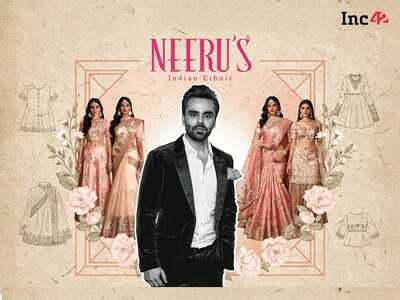
In 2020, Hyderabad-based Neeru’s was on a strong growth trajectory. The women’s ethnic wear brand, built over four decades, had reached an annual run rate of INR 100-150 Cr. It was growing steadily and projected to sustain a year-on-year growth rate of 30–40% over the next two to three years.
The business followed a familiar pattern: opening new stores across cities, welcoming walk-in customers and driving sales via physical retail.
Then the shutters came down. Everywhere.
The Covid-19 pandemic did more than slow the business — it brought Neeru’s to a standstill. Revenues declined sharply, with topline sales contracting by nearly 50% as stores were forced to shut and strict retail protocols limited operations. For a brand built around the in-store shopping experience, there was no playbook for navigating a crisis of this scale.
“Many of our stores were shut down, and we had zero sales,” Avnish Kumar, MD and CEO of Neeru’s, told Inc42. “I never imagined days like that would come. But somehow, we found the strength to get through it, keep the business afloat and move forward.”
The crisis forced the team to ask tough questions. Could a business tethered to brick-and-mortar stores survive when customers could no longer visit those shops? Neeru’s had a website, but it was not set up for commerce. As Kumar put it, “The domain was not up there for building brand awareness; it was not a sales engine.”
Before the pandemic, Neeru’s had the necessary infrastructure, including warehouses, inventory systems and a loyal customer base that had grown up with the brand. As the retail sector shifted towards an omnichannel model, the company made a phased integration of necessary components at the store and product levels. The goal was not to displace its store-first DNA but to ensure that more people could shop at Neeru’s, online and offline.
Today, Neeru’s has emerged as an omnichannel brand aiming to reach INR 500 Cr in revenue in the next two to three years, with online sales accounting for 25-30% of its business. Its strategy hinges on a hybrid future grounded in physical retail.
Neeru’s Journey From A 150 Sq Ft Tailoring Shop To A 30K Sq Ft Store“We are looking at an average run rate of at least INR 7-8 Cr just from our website in the next 12-18 months,” said Kumar, marking the brand’s push for digital commerce.
Kumar’s grandmother, Basant Kaur, launched the family business in 1971 from a modest 150 sq. ft tailoring shop in Hyderabad’s King Koti district. Her son, Harish, quickly stepped in to manage daily operations. When Harish married in 1979, he renamed the shop after his wife, Neeru. Working side by side, the couple devoted their energy and vision to growing the business.
At the time, traditional sarees dominated South Indian fashion. Ready-made ethnic wear — like salwar suits inspired by Bollywood and emerging styles favoured by young women — was almost unheard of.
“Tailoring was the only way you could get those outfits,” said Kumar. “People were keen to try Punjabi suits and salwar kameez, the kind of modern clothes that were rare in Hyderabad. My parents saw that gap in the market, and that’s how Neeru’s story really began.”
For the next 20 years, the brand flourished, as the family explored the rich heritage of Indian handloom and used classic fabrics to make stylish, ready-to-wear pieces. The brand soon started wholesaling to shops across India, putting Hyderabad firmly on the country’s fashion map, but the spotlight stayed on Mumbai and Delhi.
“We didn’t just sell clothes; we made handloom cool again,” said Kumar. “That’s when people really began to notice Hyderabad for its unique take on ethnic fashion.”
In 1996, Neeru’s made a bold move by opening its first large store spanning 3K sq. ft. It came at a time when most stores were no bigger than 40 or 50 sq. ft, and it served as a game-changer. “Back then, everyone talked about chain stores, not brands. Branding remained uncharted territory — nobody really understood what it meant,” recalled Kumar. “We wanted to break that mould and transform our ethnic fashion story into a true brand.”
Later, in 2012, Kumar joined Neeru’s after completing a master’s degree in entrepreneurship from Royal Holloway, University of London. By then, he had visited iconic department stores like Selfridges and Harrods, wondering why Hyderabad, a city defined by culture and global ambitions, could not host a shopping destination equally grand.
One day, while chatting with his father, Kumar voiced his thoughts. “Why can’t we create that kind of retail magic here in Hyderabad? People shouldn’t have to travel to Mumbai or Delhi for a world-class experience.”
That idea led to Neeru’s Emporio. On December 12, 2012, the flagship store opened in Jubilee Hills, a quiet neighbourhood at the time. The sprawling 30K sq. ft space introduced an entirely new retail standard: a destination as grand as a luxury hotel, complete with Italian marble floors, sparkling chandeliers and LED-lit interiors. “We wanted people to step in and instantly feel that they are at a place where craft, fashion and vision meet,” said Kumar.
The Emporio transformed the area into a coveted retail destination, and Neeru’s grew from a family shop into a city landmark.
How Neeru’s Scaled Beyond Hyderabad, Pursued Pan-India Branding“As we expanded, branding became critical. Initially, we put our logo everywhere and focussed on the look and feel, making sure Neeru’s stood out. That’s how we started, from a simple carry bag to a recognised label to full-fledged Neeru’s stores,” he added.
For a long time, the ethnic wear market thrived on a deep-rooted sense of consistency. Users found comfort in familiarity, and eventually it dictated their buying behaviour. Most women would visit the same stores their mothers and grandmothers favoured, shopping more out of habit than genuine loyalty or brand recall.
However, Neeru’s wanted to break that cycle and build an ethnic wear brand that could move beyond Hyderabad, connect with people in new cities, and emerge as a well-known national name.
Celebrity endorsements became the lever in this endeavour. In 2013-14, Kumar joined forces with Karishma Kapoor for one of the brand’s first big campaigns, signalling a new chapter. Store launches became grand events, attracting celebrities and massive crowds. When Neeru’s opened in Vijayawada with Kajal Agarwal, around 8K people turned up, excited to catch a glimpse of the star and explore the new store.
Neeru’s even managed to sign Sonam Kapoor as a brand ambassador for three years, but the negotiations were anything but easy. Her team was initially hesitant due to her long associations with high-end designer labels. Ultimately, the brand finalised the partnership.
“It was before the Instagram days, although social media has now changed how we all discover brands,” said Kumar. “In those days, if you wanted people to notice you, you put up billboards, ran ads in newspapers and magazines, and made sure your name appeared everywhere on the street. Between 2012 and 2014, we focussed on creating a pan-India identity for Neeru’s, and then gradually expanded to new cities.”
By 2015, the impact was evident. Neeru’s opened its first international outlet in Dubai, a strategic move that demonstrated the brand’s departure from its regional origins.
“At first, we thought we had to be a strong regional retailer, a trusted local name in ethnic fashion that people would recognise,” said Kumar. “But by 2015, everything shifted. We began dreaming bigger, wanting to become a global brand, not just stay where we were.”
Between 2016 and 2018, Neeru’s partnered with a couple of multi-brand stores and entered new cities, especially across southern India. Kumar felt he had finally cracked the ethnic wear market, but he had no idea just how much the trajectory was about to change.
When The Pandemic Shaped Neeru’s Digital ShiftDuring the pandemic, Neeru’s confronted a reality it had long resisted. With a business model built almost exclusively on physical retail, operations came to an abrupt halt during lockdowns. However, the brand’s absence from the digital marketplace was not due to inertia; it was rooted in conviction.
Neeru’s believed that ethnic wear was tethered to tactile experience — look and feel, fit and the nuances of an in-store environment. While ecommerce suited commodity retail or everyday purchase, it was ill-equipped for high-ticket occasion wear. In this segment, customers wanted to check fabric quality, assess the craftsmanship and feel confident about the value before committing INR 10K or more for an outfit.
“We were a hardcore brick-and-mortar brand and didn’t trust online then. It worked for a purchase worth INR 3-4K. But Neeru’s is an occasion-wear, experience-led brand. When you are buying an INR 30K lehenga, you want to see the fit, the blouse/bodysuit and the stitching. We believed that experience mattered,” said Kumar.
Market conditions also reinforced its offline-first business strategy. Online fashion, especially the occasion-specific ethnic wear segment, was nascent during 2017-2020. While major marketplaces aggressively pursued exclusive partnerships, Neeru’s maintained a cautious distance. Its digital presence was not ignored; it was a calculated deferral.
Three Strategies Pushing Online Retail At Neeru’s“The online market was, and still is, very small for Neeru’s. But about a year ago, we began evaluating our digital footprint. We are currently doing extensive testing and backend integration for online growth,” said Kumar.
Neeru’s aims to grow its digital revenue to 20-25% of total turnover. Although the brand is in the early stages of this transition, it has implemented three core initiatives to bolster direct-to-consumer (D2C) growth. These include:
Marketplace integration without ceding website’s valueDuring the pandemic, the brand was forced to rethink its operational framework and transition to online commerce. The company began by listing its inventory on platforms such as Amazon India and Meesho, a strategic move to break the inertia that stemmed from its long-cherished offline business model. But this time, it was not an aggressive push for scale, but a strategy to grow its digital competency. The intent was simple: show up, learn and stop overthinking the operational shift.
“We thought, even if we make only INR 10K a day in sales, that would be fine. But we have to be there, adapt fast and stop thinking so much about our offline business and physical stores,” said Kumar.
In the past, Neeru’s website was mainly a place for people to discover the brand. Customers would browse collections and learn about the brand, then contact the company via social media or other online channels to make a purchase. Meanwhile, the team tracked all critical data, from traffic sources to ad performance to how online buzz drove offline sales. Over time, these insights started to pay off, confirming a massive, untapped digital demand.
Orders also surged as a new class of aspirational customers emerged — shoppers who coveted the brand but did not live near a Neeru’s store. From smaller hubs like Bilaspur and Nellore to global markets like Singapore, consumers recognised the brand’s craftsmanship and authenticity. Price resistance softened as buyers’ trust grew, and investing INR 25K in a lehenga for Diwali celebrations no longer felt like extravagance, as shoppers prioritised the product’s intrinsic value.
This change in consumer behaviour led Neeru’s to rethink digital commerce. Online sales were not meant to supplant physical retail. Instead, ecommerce could build consumer trust, broaden reach and enhance the overall shopping experience.
“We are there with marketplaces, but we are totally focusing on our own Neerus.com, you know. That is the place where we are trying to make a good mark… Because people have that trust factor on Myntra and Amazon… But when they come back to Neerus.com, the same person is buying a 20,000-rupee lehenga very easily on our website,” said Kumar.
This underscores a sophisticated customer acquisition strategy. Neeru’s effectively borrows aggregators’ volume to initiate discovery and build consumer trust. But the brand also ensures that high-margin, high-trust conversions eventually flow to its proprietary platform, thereby retaining its premium identity and long-term loyalty.
Turning social media into a sales channelFor years, social media worked as Neeru’s digital lookbook but not as its point of sale. Even as late as 2022-23, it was spending heavily on Instagram, Facebook and performance marketing but refused to introduce a ‘buy’ button for direct transactions. The reason: premium ethnic wear would require reassurance and handholding, not online impulse buying. The management remained convinced that high-ticket items were too personal to be purchased via a digital interface.
That logic soon collapsed as consumer behaviour shifted. By late 2023, Neeru’s recorded a surge in high-value digital transactions that defied the traditional retail playbook. “People were ready to buy a lehenga worth INR 40K online. But before 2023, we only sold those in stores,” observed Kumar.
Combining celebrity endorsements, content and digital marketing for growthThe shift forced a total re-engineering of the brand’s digital infrastructure. By 2024, Neeru’s kickstarted its social media channels as a business engine, upgrading its product lines, payment systems, packaging and logistics to help customers choose and buy premium items online.
For nearly two decades, Neeru’s leveraged a marketing model built on huge print media ads, prominent billboards and celebrity endorsements that signalled how the brand had grown and travelled across cities. Kumar recalled a time when Neeru’s was ‘the king of hoardings’, with a visibility so high that billboard models frequently transitioned into leading Tollywood actresses. But that playbook has expired.
But in recent years, the brand has shifted its entire marketing engine online. Today, nearly 95% of its marketing spend flows into digital, including content creation, social platforms, influencer collaborations and WhatsApp and SMS marketing. Neeru’s now prioritises ecommerce-led discovery, marking a quiet yet complete shift from offline to online promotional tools.
But there’s more to it, explained Kumar. Earlier, in-store staff helped shoppers with styling, telling them how to drape a saree or wear a lehenga. Today, those conversations are missing, but creators and influencers share those tips online. “The content they make is amazing,” he added.
This digital-first strategy achieved a significant milestone in a recent campaign. Instead of a traditional photoshoot, Neeru’s produced a one-minute Telugu song featuring its brand ambassador Sreeleela, a well-known Indian film actress. The content debuted during the festive season and gained 2 Mn views within 24 hours without any paid promotion.
Neeru’s Early AI Advantage After Delayed Ecommerce Entry“That has never happened before at Neeru’s,” said Kumar. “And it shows how digital content can reach a huge audience for less money.”
Although Neeru’s took a cautious route to online commerce, the brand chose not to repeat that delay with artificial intelligence (AI). Over the past 10 months, the company has begun adopting AI across marketing, content creation and backend operations, recognising how quickly the technology has matured.
Initially sceptical, the team at Neeru’s saw firsthand that AI-driven visuals could match — and at times rival — traditional photoshoots. While its website currently features real shoots, the brand is already planning a gradual transition towards AI-generated content to save time, cost and creative effort. This shift is already reflected in the balance sheet. Neeru’s has allocated at least 10% of its marketing spend to AI operations, a figure expected to rise steadily as the technology matures.
Beyond marketing, AI is being tested across inventory management, ERP systems, logistics and distribution through technology partners. As an offline-focussed ethnic wear brand, Neeru’s maintains that its physical stores remain vital for real-life retail experiences. However, the company is betting on AI to overhaul its backend operations. In the next 18-24 months, the leadership team expects these tools to drive significant improvements in margin efficiency, discounting strategies, stock movement and backend decision-making.
Will Neeru’s Lead The Race To Brand Indian Ethnic Wear?“At one point, my team showed me a visual, and I said it’s very good. Then they told me it was AI,” said Kumar. “That’s when I realised if this is what AI can do, we should spend our time and energy on it.”
Ethnic wear in India has long been defined by intricate craftsmanship, thriving on the high-stakes demand of wedding and festive calendars. But in spite of its legacy, the sector has remained fragmented. Most shoppers still swear by their local weavers or trusted boutique designers for a Diwali ensemble or a bridal trousseau. Hence, it is difficult for national labels to scale, especially in categories such as sarees and occasion wear. Neeru’s sees this lack of structure as a chance to build a household name that offers the reliability of a brand with the soul of bespoke luxury.
The landscape is shifting, though. In recent years, quite a few legacy and digital-first brands, including BIBA, W, Global Desi, Manyavar, Fabindia, Suta and online-led players like House of Indya and Koskii, have expanded their market presence and redefined customer expectations. Their entry and operations have brought much-needed structure, visibility and credibility to the segment.
While many brands focus on specific segments such as everyday ethnic wear, wedding-oriented menswear or niche sarees, Neeru’s is among the few offering a full spectrum, from entry-level kurtas to silks and bridal lehengas, while preserving consumer trust throughout.
Neeru’s remains bootstrapped, bypassing the rapid, venture-funded expansion and subsequent losses. Instead, it wants to ‘go deeper into the existing cities’ and win those markets. By cautiously expanding in India and abroad, Neeru’s aims to build a brand through consistency, ensuring a strong footprint, brand recall and operational depth.
Neeru’s has also forayed into Silver Jewellery and has launched a new brand “TARASYA – Silver Jewellery) from the House of Neeru’s. This sub-brand has already reached a 3-store mark in Telangana itself and is planning to expand at its own pace, meeting the demands of affordable jewellery.
Even as it expands, the brand remains wary of the quick commerce craze. In a world of 10-minute deliveries, Neeru’s is betting that for ethnic wear, craftsmanship and the perfect fit still matter more than speed. For the leadership, the path forward is defined by endurance rather than urgency and a bid to prove that traditional fashion can scale without losing its soul.
The post Decoding Neeru’s ₹500 Cr Omnichannel Ethnic Wear Play appeared first on Inc42 Media.
-
Martin Keown notices three things Arsenal need to tweak as Mikel Arteta avoids Chelsea problem
-
2026 SSC MTS and Havaldar Answer Key Released

-
Iconic Tenerife hotspot launches major tourist crackdown - 290k visitors a year

-
Winning EuroMillions numbers LIVE: Full lottery results with Thunderball on March 3

-
TV host speechless as William's two-word bombshell leaves Beatrice and Eugenie blindsided