New Delhi: The department of telecommunications (DoT) has sought legal clarity around adjusted gross revenue (AGR) dues of companies such as Reliance Communications (RCom) and Aircel, currently going through insolvency proceedings, following a recent Supreme Court order that ruled spectrum cannot be transferred or sold by these companies.
"The DoT has asked the attorney general (AG) to provide clarity on what should happen with the AGR dues and spectrum of such firms in the wake of the Supreme Court order," people aware of the details told ET. RCom has around ₹25,199.3 crore of AGR dues, while the amount for Aircel is about ₹12,389 crore.
As the companies can't continue the ownership of spectrum in case of default on payment of dues, even under the Insolvency and Bankruptcy Code (IBC), clarity is needed around payment of AGR dues.
"It needs to be ascertained if AGR dues remain under IBC or not," said the person, on condition of anonymity. If the AGR dues are treated as financial dues and remain under IBC, they will come under the waterfall mechanism, through which proceeds are distributed to lenders after liquidation of assets based on a structural and hierarchical system.
In case the dues are out of IBC, like spectrum, the amount needs to be paid to DoT.
The DoT has also sought clarity around steps that can be taken to get the spectrum back from these companies following the top court order last month. Apart from DoT, sources said, the lenders of the companies are also contemplating the next steps following the order. "The committee of creditors are deliberating on options, which may include filing a review petition in the SC," a person privy to the details said.
Another person said a final decision is likely to be taken in the coming days as the lenders don't have much time to decide. "There has to be clarity on what value the spectrum should be returned to DoT. Also, following the return of spectrum, will the DoT have any right as a financial or operational creditor over the monetisation of real estate etc," said the person.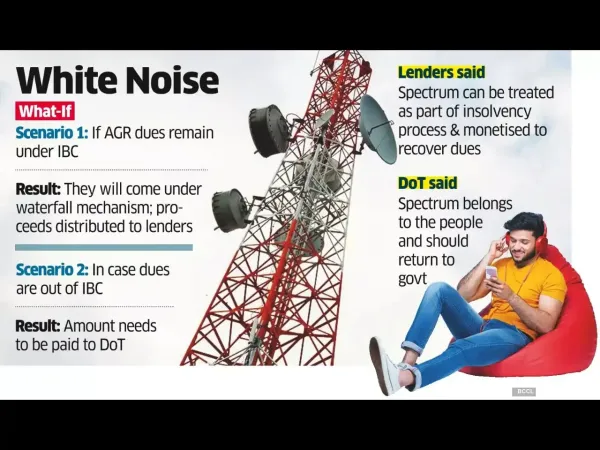
The lenders to RCom and Aircel had contended that spectrum was an intangible asset, and airwaves can thus be treated as part of the insolvency process and monetised to recover dues. However, the DoT had taken the stand that spectrum belongs to the people, being a valuable natural resource, and thus should return to the government.
The court found in its favour, holding that "spectrum allocated to TSPs (telecom service providers) and shown in their books of account as an 'asset' cannot be subjected to proceedings under IBC."
The lenders had moved the Supreme Court against the National Company Law Appellate Tribunal's April 2021 order, which held that spectrum can be transferred as part of insolvency resolution plan only after clearing all government dues.
"The DoT has asked the attorney general (AG) to provide clarity on what should happen with the AGR dues and spectrum of such firms in the wake of the Supreme Court order," people aware of the details told ET. RCom has around ₹25,199.3 crore of AGR dues, while the amount for Aircel is about ₹12,389 crore.
As the companies can't continue the ownership of spectrum in case of default on payment of dues, even under the Insolvency and Bankruptcy Code (IBC), clarity is needed around payment of AGR dues.
"It needs to be ascertained if AGR dues remain under IBC or not," said the person, on condition of anonymity. If the AGR dues are treated as financial dues and remain under IBC, they will come under the waterfall mechanism, through which proceeds are distributed to lenders after liquidation of assets based on a structural and hierarchical system.
In case the dues are out of IBC, like spectrum, the amount needs to be paid to DoT.
The DoT has also sought clarity around steps that can be taken to get the spectrum back from these companies following the top court order last month. Apart from DoT, sources said, the lenders of the companies are also contemplating the next steps following the order. "The committee of creditors are deliberating on options, which may include filing a review petition in the SC," a person privy to the details said.
Another person said a final decision is likely to be taken in the coming days as the lenders don't have much time to decide. "There has to be clarity on what value the spectrum should be returned to DoT. Also, following the return of spectrum, will the DoT have any right as a financial or operational creditor over the monetisation of real estate etc," said the person.
Dept looking at steps to get spectrum back following SC ruling that airwaves can’t be transferred or sold by cos undergoing insolvency process
The lenders to RCom and Aircel had contended that spectrum was an intangible asset, and airwaves can thus be treated as part of the insolvency process and monetised to recover dues. However, the DoT had taken the stand that spectrum belongs to the people, being a valuable natural resource, and thus should return to the government.
The court found in its favour, holding that "spectrum allocated to TSPs (telecom service providers) and shown in their books of account as an 'asset' cannot be subjected to proceedings under IBC."
The lenders had moved the Supreme Court against the National Company Law Appellate Tribunal's April 2021 order, which held that spectrum can be transferred as part of insolvency resolution plan only after clearing all government dues.