New Delhi: India has constituted an inter-ministerial group (IMG) to oversee supply chain resilience and monitor developments in West Asia daily, commerce and industry minister Piyush Goyal said on Tuesday.
The IMG was operationalised by the commerce and industry ministry. Besides overseeing supply chain resilience, it will assess sector-wise export and critical import vulnerabilities, and recommend mitigation measures.
The ministry also set up an internal coordination mechanism within the Directorate General of Foreign Trade (DGFT) to enable real-time tracking of issues and inter-agency coordination.
On Monday, exporters had flagged concerns over insurance, freight and cargo piling up at domestic ports due to the crisis.
The IMG will monitor global developments affecting supply chains, assess sector-wise export and critical import vulnerabilities, facilitate coordination among ministries/departments, engage with stakeholders including export promotion councils, and recommend appropriate mitigation measures.
The move is aimed at enabling a "stable and responsive trade environment for our traders and exporters, safeguarding their interests and ensuring seamless operations", Goyal said. The group held its first meeting on Tuesday evening.
"We have set up an inter-ministerial group that meets on a daily basis and is closely monitoring the developments in West Asia to assess any vulnerabilities in our shipping, logistics, export or even critical imports, and we will coordinate with inter-ministerial actions," Goyal in a post-budget webinar.
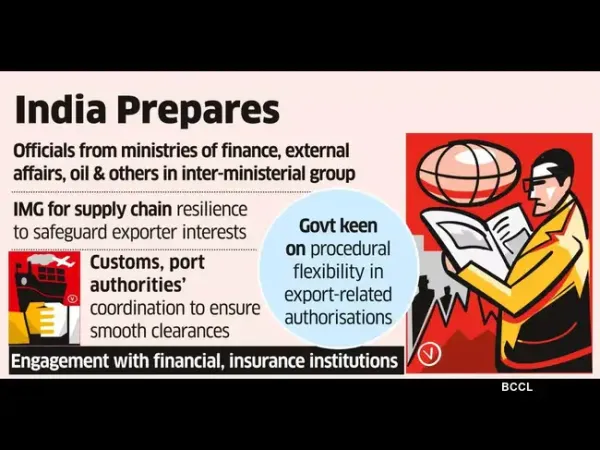
He said the government's readiness to facilitate trade operations was reiterated through measures such as procedural flexibility in export-related authorisation, coordination with customs and port authorities to ensure smooth clearance, an engagement with financial and insurance institutions to safeguard exporter interests.
"Several suggestions have come out of different ministries, different export promotion councils," Goyal said, referring to the first meeting of the IMG.
He said the government shall work on those and continue to look for stakeholders' suggestions "so that we can ensure the minimal impact of the West Asia crisis".
The group comprises officials from ministries of external affairs, revenue, shipping, ports and waterways, and petroleum and natural gas to facilitate effective coordination, monitoring and follow-up.
Tuesday's meeting was held with all stakeholder ministries, key logistics and trade facilitation partners to review the emerging geopolitical situation and its potential impact on India's exports and imports.
A large number of export consignments bound for the US pass through the Red Sea. Exporters are apprehensive that the spread of the conflict in the Arab world may impact movement of goods through Bab-el-Mandeb, the Red Sea and the Suez Canal.
Moody's flagged concern that some nations may align their trade and export control policies more explicitly with geopolitical positioning amid the West Asia crisis. "This raises the risk of selective export restrictions, informal boycotts and tighter customs scrutiny, as governments seek to limit exposure to secondary sanctions or political repercussions," said Choon Hong Chua, senior director at Moody's.
The IMG was operationalised by the commerce and industry ministry. Besides overseeing supply chain resilience, it will assess sector-wise export and critical import vulnerabilities, and recommend mitigation measures.
The ministry also set up an internal coordination mechanism within the Directorate General of Foreign Trade (DGFT) to enable real-time tracking of issues and inter-agency coordination.
On Monday, exporters had flagged concerns over insurance, freight and cargo piling up at domestic ports due to the crisis.
The IMG will monitor global developments affecting supply chains, assess sector-wise export and critical import vulnerabilities, facilitate coordination among ministries/departments, engage with stakeholders including export promotion councils, and recommend appropriate mitigation measures.
The move is aimed at enabling a "stable and responsive trade environment for our traders and exporters, safeguarding their interests and ensuring seamless operations", Goyal said. The group held its first meeting on Tuesday evening.
"We have set up an inter-ministerial group that meets on a daily basis and is closely monitoring the developments in West Asia to assess any vulnerabilities in our shipping, logistics, export or even critical imports, and we will coordinate with inter-ministerial actions," Goyal in a post-budget webinar.
He said the government's readiness to facilitate trade operations was reiterated through measures such as procedural flexibility in export-related authorisation, coordination with customs and port authorities to ensure smooth clearance, an engagement with financial and insurance institutions to safeguard exporter interests.
"Several suggestions have come out of different ministries, different export promotion councils," Goyal said, referring to the first meeting of the IMG.
He said the government shall work on those and continue to look for stakeholders' suggestions "so that we can ensure the minimal impact of the West Asia crisis".
The group comprises officials from ministries of external affairs, revenue, shipping, ports and waterways, and petroleum and natural gas to facilitate effective coordination, monitoring and follow-up.
Tuesday's meeting was held with all stakeholder ministries, key logistics and trade facilitation partners to review the emerging geopolitical situation and its potential impact on India's exports and imports.
A large number of export consignments bound for the US pass through the Red Sea. Exporters are apprehensive that the spread of the conflict in the Arab world may impact movement of goods through Bab-el-Mandeb, the Red Sea and the Suez Canal.
Moody's flagged concern that some nations may align their trade and export control policies more explicitly with geopolitical positioning amid the West Asia crisis. "This raises the risk of selective export restrictions, informal boycotts and tighter customs scrutiny, as governments seek to limit exposure to secondary sanctions or political repercussions," said Choon Hong Chua, senior director at Moody's.
Panel to track supply chain resilience, ensure stable and responsive trade environment