
Bengaluru: Multinationals such as Google, Apple and Airbus are expanding within their existing campuses in India instead of spreading operations across multiple leased offices, signalling their long-term commitment to the country as it strengthens its position in global capability centres (GCCs) and engineering research and development.
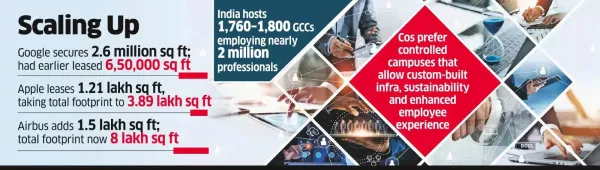
Google's growing presence at Alembic City in Bengaluru's Whitefield neighbourhood is a case in point of the rise of new innovation clusters. The campus, developed within a mixed-use township, offers office infrastructure with room for expansion. When Google leased about 650,000 sq ft at Alembic City in October 2024, it also secured rights to take the total space to 2.4 million square feet at the facility, as per the agreement.
Apple's expansion at Embassy Zenith in the city, where it has leased 389,000 sq ft, underscores the iPhone maker's push to strengthen engineering, design and services operations in India. Aircraft maker Airbus has increased is footprint in Bengaluru's Titanium Tech Park to 800,000 sq ft, according to data shared by Propstack. Ecommerce and technology giant Amazon recently set up one of its largest campuses in India's tech capital.
"Large global occupiers today are prioritising campuses where they can scale in phases without relocation risk," said Quaiser Parvez, chief operating officer at Knowledge Realty Trust. "When a global brand expands within the same ecosystem, it validates the quality of infrastructure and the long-term viability of the micro-market. These are not opportunistic leases; they are strategic commitments."
Industry experts say such expansions are less about short-term headcount growth and more about long-term operational certainty. Companies are increasingly preferring controlled campuses that allow custom-built infrastructure, sustainability compliance and enhanced employee experience.
The expansion comes even as India is cementing its position as the GCC capital of the world. According to industry estimates, the country hosts about 1,800 GCCs that employ 1.9-2.0 million people. Technology, aerospace, fintech and digital services remain dominant sectors driving demand for Grade-A office stock. Projections indicate that GCC headcount could rise to over 2.5-2.8 million by 2030, with a market size of around $100-110 billion.
The campus-led expansion model also reflects a shift in occupier preference. While flexible work remains embedded in corporate culture, large R&D-driven organisations are investing in collaboration-heavy environments within secure perimeters," said Arpit Mehrotra, managing director, office services, at real estate consultant Colliers India. "Dedicated campuses provide better control over intellectual property, advanced lab facilities and customised engineering infrastructure."
Jayaram S Govindaiah, founder, CCIRE - Consortium of Corporates in Research and Education, said expansion within existing campuses often signals operational maturity rather than speculative growth. "When large companies expand within their established locations, it demonstrates stability in their India strategy. It reduces transition costs and ensures workforce continuity. We are seeing a growing share of absorption coming from expansion mandates rather than new market entrants," he said.
India's office market recorded gross leasing of about 71.5 million sq ft of Grade-A office space in 2025, with technology and GCC occupiers accounting for a significant share.
Bengaluru continued to lead the nation in office space absorption, accounting for the largest proportion of leasing activity, while emerging cities such as Ahmedabad and Thiruvananthapuram are gradually carving out specialised niches in engineering and digital services.
Google's growing presence at Alembic City in Bengaluru's Whitefield neighbourhood is a case in point of the rise of new innovation clusters. The campus, developed within a mixed-use township, offers office infrastructure with room for expansion. When Google leased about 650,000 sq ft at Alembic City in October 2024, it also secured rights to take the total space to 2.4 million square feet at the facility, as per the agreement.
Apple's expansion at Embassy Zenith in the city, where it has leased 389,000 sq ft, underscores the iPhone maker's push to strengthen engineering, design and services operations in India. Aircraft maker Airbus has increased is footprint in Bengaluru's Titanium Tech Park to 800,000 sq ft, according to data shared by Propstack. Ecommerce and technology giant Amazon recently set up one of its largest campuses in India's tech capital.
Underscores long-term commitment to the country without spreading ops across multiple leased offices
"Large global occupiers today are prioritising campuses where they can scale in phases without relocation risk," said Quaiser Parvez, chief operating officer at Knowledge Realty Trust. "When a global brand expands within the same ecosystem, it validates the quality of infrastructure and the long-term viability of the micro-market. These are not opportunistic leases; they are strategic commitments."
Industry experts say such expansions are less about short-term headcount growth and more about long-term operational certainty. Companies are increasingly preferring controlled campuses that allow custom-built infrastructure, sustainability compliance and enhanced employee experience.
The expansion comes even as India is cementing its position as the GCC capital of the world. According to industry estimates, the country hosts about 1,800 GCCs that employ 1.9-2.0 million people. Technology, aerospace, fintech and digital services remain dominant sectors driving demand for Grade-A office stock. Projections indicate that GCC headcount could rise to over 2.5-2.8 million by 2030, with a market size of around $100-110 billion.
The campus-led expansion model also reflects a shift in occupier preference. While flexible work remains embedded in corporate culture, large R&D-driven organisations are investing in collaboration-heavy environments within secure perimeters," said Arpit Mehrotra, managing director, office services, at real estate consultant Colliers India. "Dedicated campuses provide better control over intellectual property, advanced lab facilities and customised engineering infrastructure."
Jayaram S Govindaiah, founder, CCIRE - Consortium of Corporates in Research and Education, said expansion within existing campuses often signals operational maturity rather than speculative growth. "When large companies expand within their established locations, it demonstrates stability in their India strategy. It reduces transition costs and ensures workforce continuity. We are seeing a growing share of absorption coming from expansion mandates rather than new market entrants," he said.
India's office market recorded gross leasing of about 71.5 million sq ft of Grade-A office space in 2025, with technology and GCC occupiers accounting for a significant share.
Bengaluru continued to lead the nation in office space absorption, accounting for the largest proportion of leasing activity, while emerging cities such as Ahmedabad and Thiruvananthapuram are gradually carving out specialised niches in engineering and digital services.