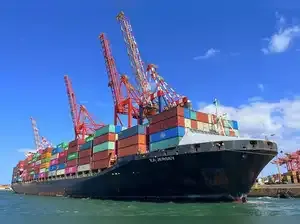
The centre is closely monitoring the evolving maritime security situation in West Asia, and has strengthened precautionary measures to safeguard Indian-flagged vessels and seafarers operating in the region. Union Minister for Ports, Shipping and Waterways, Sarbananda Sonowal, chaired a review meeting on Tuesday to assess the prevailing security environment in the region and examine its implications for Indian maritime assets and personnel.
Senior government officials directly overseeing the situation briefed the minister even as the situation in West Asia remained tense, with Iran continuing attacks on strategic and commercial assets of the United States, Israel, and other nations around the Persian Gulf.
“We remain in constant touch with relevant national and international agencies and are prepared to respond swiftly to any emerging development,” Sonowal said.
It is estimated that some 23,000 Indian seafarers are stranded across Gulf countries. There are currently 37 Indian-flagged vessels in the Persian Gulf with over 1,100 seafarers aboard. Of these, public sector undertaking Shipping Corporation of India (SCI) has seven stranded vessels in the region.
Back home, approximately 38,000 TEUs (twenty-foot equivalent units) of containerised cargo are currently held at all Indian ports, of which around 1,000 TEUs are perishable goods. One TEU is roughly the size of a standard shipping container. The Jawaharlal Nehru Port handled 737,682 TEUs of containers in January alone.
“Around 10 vessels are waiting and drifting at major (central government governed) ports,” a senior official told ET.
The Ministry, through the Directorate General of Shipping (DGS), has activated enhanced monitoring and security oversight with respect to Indian seafarers and Indian-flagged ships in response to reported threats in the Persian Gulf, Strait of Hormuz, Gulf of Oman and adjoining sea areas, including missile and drone activity, electronic interference, and other maritime security concerns.
Real-time tracking of Indian-flagged vessels with increased reporting frequency is also underway, along with 24×7 monitoring.
“Mandatory reporting protocols have also been prescribed for vessels, owners and managers,” an official statement said, adding that close coordination is being maintained with the Indian Navy, the Ministry of External Affairs, the Information Fusion Centre–Indian Ocean Region (IFC-IOR), the Maritime Rescue Coordination Centre (MRCC), and Indian missions abroad.
Shipping companies and Recruitment and Placement Service Licensees have been advised to exercise caution in crew deployment and maintain regular communication with seafarers and their families, the statement said.
Vessels operating in the region have been directed to maintain an enhanced security posture and bridge watch, ensure continuous communication readiness, and report suspicious activity immediately.
Senior government officials directly overseeing the situation briefed the minister even as the situation in West Asia remained tense, with Iran continuing attacks on strategic and commercial assets of the United States, Israel, and other nations around the Persian Gulf.
“We remain in constant touch with relevant national and international agencies and are prepared to respond swiftly to any emerging development,” Sonowal said.
It is estimated that some 23,000 Indian seafarers are stranded across Gulf countries. There are currently 37 Indian-flagged vessels in the Persian Gulf with over 1,100 seafarers aboard. Of these, public sector undertaking Shipping Corporation of India (SCI) has seven stranded vessels in the region.
Back home, approximately 38,000 TEUs (twenty-foot equivalent units) of containerised cargo are currently held at all Indian ports, of which around 1,000 TEUs are perishable goods. One TEU is roughly the size of a standard shipping container. The Jawaharlal Nehru Port handled 737,682 TEUs of containers in January alone.
“Around 10 vessels are waiting and drifting at major (central government governed) ports,” a senior official told ET.
The Ministry, through the Directorate General of Shipping (DGS), has activated enhanced monitoring and security oversight with respect to Indian seafarers and Indian-flagged ships in response to reported threats in the Persian Gulf, Strait of Hormuz, Gulf of Oman and adjoining sea areas, including missile and drone activity, electronic interference, and other maritime security concerns.
Real-time tracking of Indian-flagged vessels with increased reporting frequency is also underway, along with 24×7 monitoring.
“Mandatory reporting protocols have also been prescribed for vessels, owners and managers,” an official statement said, adding that close coordination is being maintained with the Indian Navy, the Ministry of External Affairs, the Information Fusion Centre–Indian Ocean Region (IFC-IOR), the Maritime Rescue Coordination Centre (MRCC), and Indian missions abroad.
Shipping companies and Recruitment and Placement Service Licensees have been advised to exercise caution in crew deployment and maintain regular communication with seafarers and their families, the statement said.
Vessels operating in the region have been directed to maintain an enhanced security posture and bridge watch, ensure continuous communication readiness, and report suspicious activity immediately.