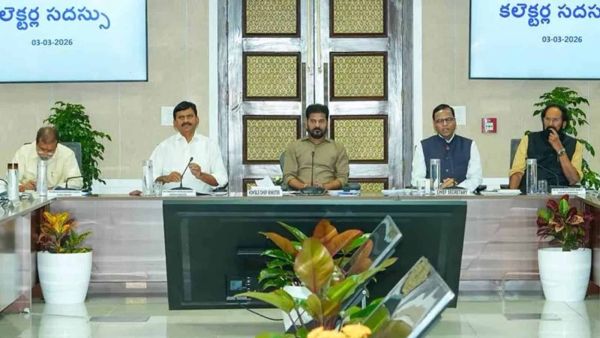
Hyderabad: Telangana Chief Minister A Revanth Reddy on Tuesday, March 3, directed that a designated officer be made responsible for the mid-day meal in each of the state’s 26,000 government schools, with the officer required to have lunch alongside students. District collectors, he said, must also eat the mid-day meal at a government school at least once a week.
Chairing a meeting of all district collectors at the Dr BR Ambedkar Telangana State Secretariat in Hyderabad, Revanth Reddy warned that food poisoning incidents in schools would no longer be tolerated and directed officials to clear mid-day meal agency bills every month without delay, a longstanding grievance among the Self-Help Groups’ (SHG) cooks who run the programme.
The meeting was called primarily to issue instructions for the effective implementation of the “99-day action plan,” which will run from March 6 to June 12, covering welfare scheme monitoring and field-level intervention across the state.

Collectors must visit field 10 days a month
The Chief Minister told collectors that IAS officers must earn public trust by ensuring the delivery of government scheme benefits to those who need them, and directed each collector to undertake field visits for at least 10 days every month.
“The district authorities cannot understand the people’s issues without field visits. We will know the Collectors’ performance based on the annual performance report, and we will hold another meeting on the performance of the Collectors in June,” he said.
He described Collectors as the “eyes and ears” of the government and said they must function as a bridge between the administration and the people.
Expressing displeasure over some Collectors not residing in their districts and instead commuting daily from the outskirts of Hyderabad, Revanth Reddy made clear this was unacceptable.
Strict action on sand mafia, bogus payrolls
Revanth Reddy warned Collectors to remain vigilant against outsourcing agencies padding their payrolls with bogus employees, and directed strict action against those found doing so. Collectors, he said, would also be held responsible for recovering paddy from rice millers found committing fraud.
On illegal sand mining, the warning was unambiguous. “The Collectors and Superintendents of Police (SP) would be suspended if they don’t take strict action against the sand mafia and illegal mining, as the government has already been keeping a close eye,” he said.
99-day action plan: 5 phases, 10 themes
The 99-day action plan will be implemented across five phases, with the Planning Department acting as the nodal agency. Preparatory meetings under the auspices of ministers will be held on March 6.
The plan spans 10 themes across departments, such as cleanliness from village to state level, clearance of pending bills in government offices, health; road safety, welfare, child safety, drug control, farmer welfare and agriculture, education, youth and sports and environment.
Village-level gram sabhas will be held on April 2, followed by mandal-level programmes on April 16, constituency-level on May 2 and district-level on May 22. The plan culminates with the Telangana State Formation Day celebrations on June 2.
All people’s representatives, including newly elected sarpanches, ward members and mayors, are required to actively participate. Details of government expenditure on welfare schemes and the list of beneficiaries must be displayed at gram sabhas.
Facial recognition to weed out ineligible beneficiaries
The Chief Minister directed Collectors to implement facial recognition technology across all government schemes to ensure only eligible persons receive benefits. He cited the Aasara pension scheme as an example. “With the implementation of facial recognition, 3,00,000 ineligible people were identified. Such a large number of people got undue benefits due to the improper use of technology,” he noted.
He also said beneficiary details for ration cards, fine rice, Indiramma housing, free electricity up to 200 units, farm loan waivers, free bus travel and Rs 500 gas cylinders must be publicly displayed at village and ward assemblies.
Link PHCs, CHCs to medical colleges: CM
Revanth Reddy said the services of all 35 government medical colleges in the state must be made accessible to people at the grassroots level. He directed that Primary Health Centres (PHC) and Community Health Centres (CHC) refer patients to government medical colleges, and that medical colleges be equipped with state-of-the-art equipment, doctors and faculty.
Vehicle fitness tests, eye tests for drivers
The transport department has been asked to conduct fitness tests for school buses and other vehicles, and to set up eye-testing camps for Road Transport Corporation (RTC) bus drivers and drivers of goods transport vehicles at locations where large numbers of drivers are present.
Revanth Reddy also directed the department to provide a dedicated WhatsApp number to report large potholes and accident-prone spots, based on which repairs and precautionary measures can be taken.
Curb drugs in schools, appoint psychologists
On the drug menace, the CM directed that drug use and e-cigarette consumption in schools and colleges be actively curbed, with the owners of educational institutions held directly responsible. He ordered every private and corporate school and college to appoint a psychologist, on par with physical education teachers.
Solar power, crop diversification
Collectors were asked to promote solar power among farmers, encouraging the use of solar pump sets over conventional agricultural pump sets, and to create awareness in villages about income generation through grid-connected solar plants.
On agriculture, Revanth Reddy asked officials to inform farmers about soil fertility and suitable crops, and to encourage cultivation of crops in high market demand. He flagged confusion around the Urea App and asked that it be made more farmer-friendly, while also promoting nano urea through field demonstrations. All Collectors were directed to submit a report on crop diversification opportunities in their respective districts.
Action on garbage dumping along ORR
The Chief Minister directed action against those dumping garbage and construction waste along the Outer Ring Road (ORR) and its service roads, including vehicle seizure, case registration and fines. The agency maintaining the ORR, he said, must also be held accountable.
He also directed that all working women’s and men’s hostels and student hostels in cities and towns be registered, with permissions required for their establishment and owners held accountable in the event of any untoward incident.
-
'Why the hell are you living in Britain?' LBC host erupts on air in furious rant

-
Lando Norris calls out George Russell's behaviour as rivalry heats up before first F1 race

-
Safe and calm Holi 2026 celebrations for families with ADHD children

-
Two Gods. Two Protections. One Protects Your House. One Protects Your Destiny

-
Exploring the Health Benefits of Cardamom