
India’s beauty and personal care (BPC) segment, estimated at $27 billion in FY25, is set to grow to $39 billion in FY30, according to a report by 1Lattice, a market intelligence firm. Notably, the online BPC market is emerging as a fast-growing channel for the sector, driven by Gen Z shoppers, content commerce, and access.
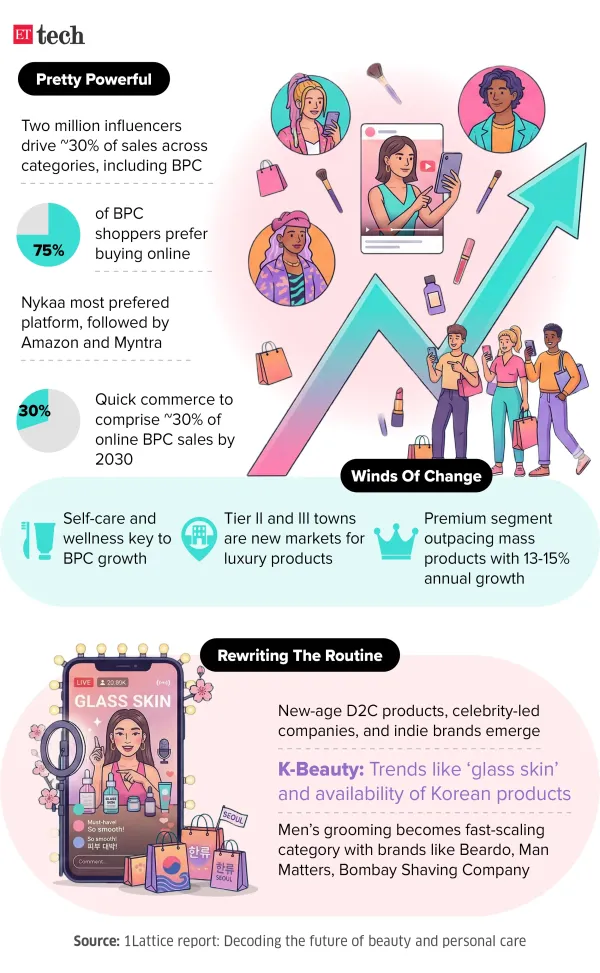
The online BPC segment has grown 2X since 2020 as customers prefer to shop online. According to the report, with about 75% of users preferring to buy beauty products online, Nykaa has emerged as the preferred platform, followed by Amazon and Myntra.
“The industry has experienced a major shift towards self-care products. It is not just about wanting to look good; it’s about wanting to care for yourself,” said the report’s author, Ashish Dhir, senior director, consumer and retail, 1Lattice.
According to Dhir, while most online sales currently take place on e-commerce platforms, quick commerce is growing fast. “Currently, quick commerce contributes about 14% to total online sales in BPC, and it will increase to about 30% by 2030. This is an important category for quick commerce because products are space-efficient,” he said.
The ease of getting orders within 10-15 minutes and immediate gratification is driving sales on this channel, per experts. Nykaa is expanding its rapid delivery arm, 'Nykaa Now,' to cater to this demand.
Multiple founders of BPC brands told ET that quick commerce is slowly becoming a preferred channel for shopping for their regular customers. For Pilgrim, about 8-9% of its overall sales come from quick commerce apps.

Gen Z drives sales
India’s young consumers, especially Gen Z, are already powering 45% of total BPC spends, the report highlighted.
“It is a reflection of where the country is going. We are a very young country with an average age of 28, compared to 48 in countries like Japan. That is a huge catalyst,” said Radhika Ghai, founder and CEO of beauty and wellness platform Kindlife.
“We are plugged into trends, and demographics show that Gen Z and even Gen Alpha are willing to spend money on themselves,” she added.
Customers' purchases show a focus on premiumisation and ingredients as international beauty trends like Korean beauty become popular. K-Beauty has helped in shifting Indian consumers’ needs from instant cosmetic fixes to long-term skin health, the report stated.
For Kindlife, for instance, about 70% of its sales are from Korean beauty products, which are typically priced between Rs 800 and Rs 1,500.
Choices expand, awareness increases
New-age brands like Minimalist, The Derma Co, Hyphen, mCaffeine, Pilgrim and more are launching new products to cater to a wide range of consumers’ needs across age groups.
“Digital brands are able to innovate much faster and offer products that are otherwise not available in the market. If you launch 10 products and seven don’t work, it’s okay; as long as a few become superstars, that is enough for a digital brand to grow into a large company,” said Anurag Kedia, cofounder of Pilgrim.
Meanwhile, slowly, D2C brands are emerging for niche customers. Moxie Beauty and Fix My Curls focus on curly hair products, Beardo and Bombay Shaving Company are launching new products for men’s grooming, and Minimalist and Derma Co. create ingredient-led products.
According to the 1Lattice report, men’s grooming has emerged as a fast-scaling category as it “moves from basic hygiene to routine-based care”.
The change in consumer behaviour to opt for clean and ingredient-focussed products is driven by awareness, founders noted.
“Consumers have evolved significantly post-pandemic,” said Vaishali Gupta, cofounder of mCaffeine. “People want to understand how a product behaves on different skin types and demographics. When influencers speak about their direct usage patterns, it gives customers a deeper understanding.”
After making a great product, this content-to-commerce pipeline is the second-most important factor in generating demand, according to Gupta.
The online BPC segment has grown 2X since 2020 as customers prefer to shop online. According to the report, with about 75% of users preferring to buy beauty products online, Nykaa has emerged as the preferred platform, followed by Amazon and Myntra.
“The industry has experienced a major shift towards self-care products. It is not just about wanting to look good; it’s about wanting to care for yourself,” said the report’s author, Ashish Dhir, senior director, consumer and retail, 1Lattice.
According to Dhir, while most online sales currently take place on e-commerce platforms, quick commerce is growing fast. “Currently, quick commerce contributes about 14% to total online sales in BPC, and it will increase to about 30% by 2030. This is an important category for quick commerce because products are space-efficient,” he said.
The ease of getting orders within 10-15 minutes and immediate gratification is driving sales on this channel, per experts. Nykaa is expanding its rapid delivery arm, 'Nykaa Now,' to cater to this demand.
Multiple founders of BPC brands told ET that quick commerce is slowly becoming a preferred channel for shopping for their regular customers. For Pilgrim, about 8-9% of its overall sales come from quick commerce apps.
Gen Z drives sales
India’s young consumers, especially Gen Z, are already powering 45% of total BPC spends, the report highlighted.
“It is a reflection of where the country is going. We are a very young country with an average age of 28, compared to 48 in countries like Japan. That is a huge catalyst,” said Radhika Ghai, founder and CEO of beauty and wellness platform Kindlife.
“We are plugged into trends, and demographics show that Gen Z and even Gen Alpha are willing to spend money on themselves,” she added.
Customers' purchases show a focus on premiumisation and ingredients as international beauty trends like Korean beauty become popular. K-Beauty has helped in shifting Indian consumers’ needs from instant cosmetic fixes to long-term skin health, the report stated.
For Kindlife, for instance, about 70% of its sales are from Korean beauty products, which are typically priced between Rs 800 and Rs 1,500.
Choices expand, awareness increases
New-age brands like Minimalist, The Derma Co, Hyphen, mCaffeine, Pilgrim and more are launching new products to cater to a wide range of consumers’ needs across age groups.
“Digital brands are able to innovate much faster and offer products that are otherwise not available in the market. If you launch 10 products and seven don’t work, it’s okay; as long as a few become superstars, that is enough for a digital brand to grow into a large company,” said Anurag Kedia, cofounder of Pilgrim.
Meanwhile, slowly, D2C brands are emerging for niche customers. Moxie Beauty and Fix My Curls focus on curly hair products, Beardo and Bombay Shaving Company are launching new products for men’s grooming, and Minimalist and Derma Co. create ingredient-led products.
According to the 1Lattice report, men’s grooming has emerged as a fast-scaling category as it “moves from basic hygiene to routine-based care”.
The change in consumer behaviour to opt for clean and ingredient-focussed products is driven by awareness, founders noted.
“Consumers have evolved significantly post-pandemic,” said Vaishali Gupta, cofounder of mCaffeine. “People want to understand how a product behaves on different skin types and demographics. When influencers speak about their direct usage patterns, it gives customers a deeper understanding.”
After making a great product, this content-to-commerce pipeline is the second-most important factor in generating demand, according to Gupta.