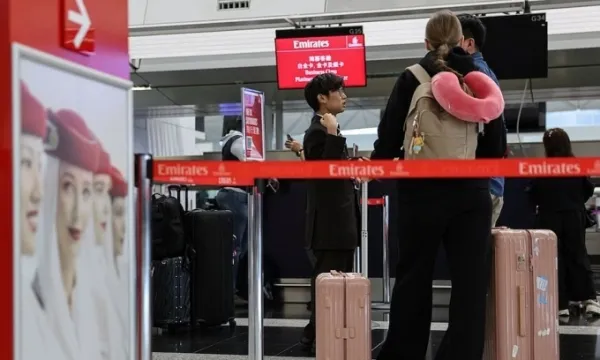
Major hubs in the Persian Gulf including Dubai, the world’s busiest international airport, remain closed or severely restricted for a fourth day, leaving tens of thousands of passengers stranded.
According to Flightradar24, some 21,300 flights have been canceled at seven major airports including Dubai, Doha and Abu Dhabi since the strikes started. The attacks have upended travel across a growing region with several thriving business hubs that is trying to diversify away from oil-dominated economies.
The turmoil also narrows an already-slim flight corridor for long-haul flights between Europe and Asia, complicating operations for global air carriers.
Stranded travelers across the Gulf rushed to secure seats on a limited number of repatriation flights as governments moved to bring passengers home even as explosions tore through Tehran and Beirut. Emirates, flydubai and Etihad have been operating a limited number of flights since Monday mostly to repatriate stranded passengers.
“It’s pretty well the biggest shutdown we’ve seen certainly since the Covid pandemic,” said Paul Charles, CEO of luxury travel consultancy PC Agency, adding that beyond passenger disruption the cargo impact would run to “billions of dollars.”
The UAE government said 60 flights had taken off, operating in dedicated emergency air corridors. The next phase will be operating more than 80 flights.
The United States is securing military and charter flights to evacuate Americans from the Middle East, a U.S. State Department official said on social media platform X on Tuesday, adding that it was in contact with nearly 3,000 U.S. citizens. The department is under fire from U.S. lawmakers who said the Trump administration should have advised people to leave before the attacks started.
Demand for alternatives to Gulf airlines has surged, with bookings and ticket prices jumping on routes such as Hong Kong-London, checks showed on Tuesday. Should the conflict linger, it could cost the Middle East billions in tourism dollars, analysts estimate.
“We can’t get home, we can’t go back to work, we can’t get the kids back to school,” said Tatiana Leclerc, a French tourist stuck in Thailand, whose flight had been set to go via the Middle East hubs that are a key link between Asia and Europe. In an early sign of a thaw, Virgin Atlantic said on Tuesday it would resume services as scheduled between London’s Heathrow Airport and Dubai or Riyadh.
Shares of air carriers worldwide fell on Tuesday, though U.S. shares pared losses in afternoon trading. The operational and financial effect varies significantly among airlines, said Karen Li, J.P. Morgan’s head of Asia infrastructure, industrials and transport research.
“There are important differences across carriers in terms of hedging strategy, air cargo exposure, and network rerouting capabilities that will shape the actual impact from the Middle East situation,” Li said.
Oil prices have surged amid the widening conflict. Benchmark crude is up roughly 30% so far this year, threatening to lift jet fuel costs and squeeze airline profits, as most airlines long ago gave up on hedging their fuel purchase, their second-largest operating cost behind labor.
In its latest annual filing, Delta Air said every one-cent increase in the price of jet fuel per gallon added about $40 million to its yearly fuel bill; a 10% increase would add $1 billion to Delta’s 2026 fuel bill, Third Bridge analyst Peter McNally said.
Shares of U.S. carriers fell early but later pared losses, with Delta’s stock turning positive in afternoon action. Shares of Southwest fell 0.6%.
In Europe, shares of Wizz Air, British Airways owner IAG, Lufthansa and Air France KLM ended down 5% to 8%. Ryanair CEO Michael O’Leary said the airline was hedged for the next 12 months at about $67 a barrel and that the recent fluctuations would not impact the business. Its stock fell 2.2% on Tuesday.
Qantas Airways CEO Vanessa Hudson said the airline has “pretty good” fuel hedging but the spike in oil prices was significant for the industry. The Australian airline’s shares fell 1.8%.
Shares of Japan Airlines closed down 6.4%, while Korean Air Lines dropped 10.3%, its biggest drop since March 2020.
Shares of major Chinese carriers including Air China and China Southern Airlines lost between 2% and 4% in Hong Kong and Shanghai.
-
'Superman Sanju' toast of India after T20 World Cup heroics

-
Homemade best Holi dessert recipes with bourbon biscuits that melt in your mouth

-
Holi 2026: Are you also troubled by indigestion? Get instant relief with these 5 home remedies

-
Stylish Jutti Tips for Ramadan

-
Rajpal Yadav broke his silence on check bounce case, said – fabricated stories spread on social media