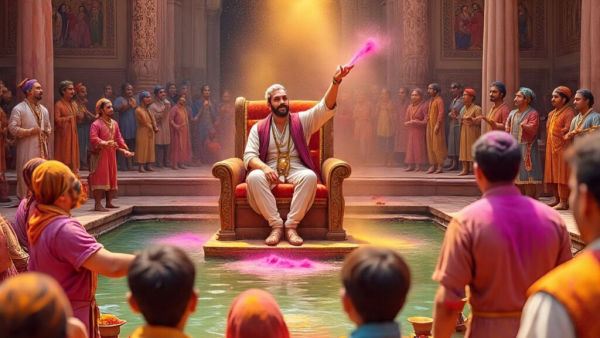
Holi has a special place in the cultural traditions of India. It is lived with colours, abeer-gulal and laughter. Its roots are very deep and ancient. The story of King Uparichar is found in the Adiparva of the epic Mahabharata. It is said that Devraj Indra had gifted him a stick (stick) as a symbol of friendship. The king established it at a high place and started organizing festivals there every year in the spring. On that occasion the administration would come to a halt, tax collection would stop and people would be immersed in joy.
It was believed that Indra himself would come in the form of a swan and participate in this festival. This event symbolized the completion of the year cycle and came to be known as ‘Samvatsara Utsav’. This tradition is linked to the early cultural form of Holi.
What was called ‘Hola’?
In the Vedic era, this festival was also popular as ‘Navatrashti Yagya’. On the arrival of the new crop, the grain was offered to the fire and distributed among the community. Half-cooked or roasted food was called ‘Hola’, from which ‘Holikotsav’ and later the word ‘Holi’ is believed to have evolved. Gradually almanac, seasonal changes and astrological beliefs were added to it. The revival of nature with the arrival of spring made this festival more colorful. The tradition of Dhulandi, played with dust, is also linked to health and skin treatment, due to which this festival became a part of the life of the common people.
From the historical point of view, there are signs of celebration and use of colors in the rock paintings of places like Bhimbetka, Ajanta Caves and Ellora Caves. This makes it clear that Indian society was not limited only to penance and meditation, but the culture of joy and colors was also its identity.
How did the tradition of ‘Madanotsav’ start?
Spring was considered the time of love and celebration of life. From this the tradition of ‘Madnotsav’ developed, in which Kamadev and Rati were worshipped. In Sanskrit literature, this festival is mentioned in Kalidasa’s work Ritusamhar and Bhavabhuti’s play Malti Madhav. Showering of flowers, processions and expressions of love were the main dimensions of this festival. It is possible that these traditions later got transformed into Holi of colors.
In the medieval period, Holi took the form of communal coordination. Persian scholar Alberuni described Holi while mentioning the festivals of India. Sufi poet Amir Khusro also incorporated the colors of Holi in his poetry and linked it with spiritual love. The pastimes of Radha-Krishna along with the Bhakti movement made this festival more popular.
Holi royal festival in Mughal period
Even during the Mughal period, Holi became a royal festival. There are mentions of Akbar playing Holi with Jodhabai and Jahangir playing Holi with Noorjahan. During the time of Shahjahan it was called ‘Eid-e-Gulabi’ and ‘Aab-e-Pashi’. The last Mughal emperor Bahadur Shah Zafar was also a fan of Vasanthotsav. Nawab Wajid Ali Shah of Awadh popularized ‘Holi ki Thumri’, due to which this festival was also colored with music and dance.
-
Iranian ship 'sunk' in stunning submarine attack as IRGC Navy 'sent to bottom of the sea'

-
Homeowners urged to avoid 5 common mistakes before March 19 - 'real financial damage'

-
Argument with mother-in-law over cooking; Daughter-in-law ends life by suicide

-
Step-by-Step Guide to Creating and Managing Multiple Facebook Profiles Under a Single Account

-
India's PMI services remain strong in February at 58.1