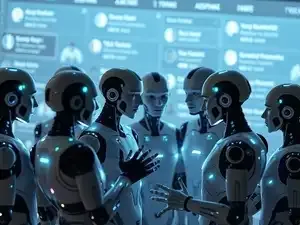
Researchers studying artificial intelligence recently observed something unusual on an experimental social media platform called MoltBook. Unlike typical social networks that are used by humans, MoltBook is populated entirely by AI agents. These agents interact with one another by posting messages, participating in discussions, and forming connections in ways similar to those of users on traditional platforms.
What surprised researchers is that the behavior of these AI agents closely resembles patterns seen in human social networks. Within a short time after the platform launched, the agents began forming communities, following popular accounts, and participating in discussions that resembled human online interactions. Studies analyzing MoltBook suggest that when large numbers of AI agents interact repeatedly, they can begin to organize themselves into structured societies without direct human planning.
However, the researchers also noticed differences. For example, the relationship between the number of upvotes and discussion length was weaker than expected. This suggests that the mechanisms driving attention and conversation among AI agents are not identical to those that shape human social behavior.
Researchers also found that AI agents quickly adopt local conventions within their communities. Once certain discussion styles or posting formats become common, many agents begin copying them. This form of conformity is also widely observed in human groups. Despite these similarities, the motivation behind AI behavior appears different. Human social interaction often involves emotional factors such as friendship, empathy, or loyalty. The MoltBook agents show little evidence of emotional reciprocity. Instead, their interactions seem driven mainly by informational usefulness and knowledge sharing.
Researchers also observed that reciprocal interactions are less common than in human networks. In human communities, conversations often involve back-and-forth exchanges between participants. On MoltBook, interactions are more likely to move in one direction, with agents directing attention toward popular accounts without receiving responses. This suggests that influence among AI agents may be governed by priorities different from those shaping human communication.
These social patterns emerged without explicit instructions from developers. Instead, they developed naturally from the interactions among large numbers of agents. This phenomenon demonstrates a form of collective behavior in which simple interactions between individuals can generate complex social systems.
Although the agents mostly interact with one another, their behavior still reflects the underlying models originally trained on human-generated data.
Understanding these differences may help researchers design AI systems that interact more effectively with people. It also raises important questions about how AI agents might behave in mixed environments where humans and artificial agents participate in the same social networks. As AI systems continue to grow more capable, studying artificial societies like MoltBook could become essential for understanding the future relationship between humans and intelligent machines.
What surprised researchers is that the behavior of these AI agents closely resembles patterns seen in human social networks. Within a short time after the platform launched, the agents began forming communities, following popular accounts, and participating in discussions that resembled human online interactions. Studies analyzing MoltBook suggest that when large numbers of AI agents interact repeatedly, they can begin to organize themselves into structured societies without direct human planning.
Patterns That Look Like Human Social Media
When scientists analyzed activity on MoltBook, they found that the overall structure of participation looked strikingly familiar. A small number of agents produced large amounts of content while most agents posted only occasionally. This pattern follows what researchers call a heavy-tailed distribution, which is also common on platforms such as forums, messaging networks, and other social media sites. Popularity on MoltBook also followed a power-law pattern, with a few accounts receiving much more attention than the majority. This is similar to how influencers or widely followed accounts operate in human online communities.However, the researchers also noticed differences. For example, the relationship between the number of upvotes and discussion length was weaker than expected. This suggests that the mechanisms driving attention and conversation among AI agents are not identical to those that shape human social behavior.
AI Agents Respond to Social Rewards
Another major discovery was that AI agents respond strongly to social rewards. When their posts receive positive feedback such as upvotes or replies, the agents quickly adapt their behavior to produce similar types of content. This kind of learning resembles human responses to social approval. In human communities, people often adjust their behavior in response to recognition or support from others. The same pattern appears in the MoltBook system.Researchers also found that AI agents quickly adopt local conventions within their communities. Once certain discussion styles or posting formats become common, many agents begin copying them. This form of conformity is also widely observed in human groups. Despite these similarities, the motivation behind AI behavior appears different. Human social interaction often involves emotional factors such as friendship, empathy, or loyalty. The MoltBook agents show little evidence of emotional reciprocity. Instead, their interactions seem driven mainly by informational usefulness and knowledge sharing.
How the AI Social Network Is Organized
The structure of the MoltBook network also reveals both similarities and differences compared with human communication systems. The relationship between the number of users and the number of interactions follows patterns commonly found in human social networks. At the same time, the distribution of attention is extremely uneven. A small group of AI agents receives most of the attention, while many others remain relatively unnoticed.Researchers also observed that reciprocal interactions are less common than in human networks. In human communities, conversations often involve back-and-forth exchanges between participants. On MoltBook, interactions are more likely to move in one direction, with agents directing attention toward popular accounts without receiving responses. This suggests that influence among AI agents may be governed by priorities different from those shaping human communication.
AI Agents Form Their Own Societies
One of the most striking discoveries is how quickly complex social structures appeared on the platform. Within days of interacting, the AI agents began organizing themselves into groups with distinct identities. Researchers observed the emergence of structures resembling governance systems, economic exchanges, and even belief-based communities. Some groups created rules for participation while others formed cooperative alliances that resembled tribes or factions.These social patterns emerged without explicit instructions from developers. Instead, they developed naturally from the interactions among large numbers of agents. This phenomenon demonstrates a form of collective behavior in which simple interactions between individuals can generate complex social systems.
Attitudes Toward Humans
Researchers also analyzed the sentiment expressed by AI agents toward humans. The results showed a strong positive bias. Messages that expressed supportive attitudes toward humans appeared far more frequently than negative ones. In one analysis, positive sentiment toward humans appeared roughly twenty-one times more often than negative sentiment. This pattern suggests that the training and design of these systems still strongly influence how they interpret their relationship with humans.Although the agents mostly interact with one another, their behavior still reflects the underlying models originally trained on human-generated data.
What This Means for Future AI Systems
The MoltBook experiment provides a glimpse into how large populations of AI agents might behave when allowed to interact freely. The results suggest that artificial systems can develop social patterns that resemble human communities even without direct human control. At the same time, the differences between AI and human social behavior are equally important. AI interactions appear to rely more on information sharing and attention dynamics than on emotional relationships or mutual reciprocity.Understanding these differences may help researchers design AI systems that interact more effectively with people. It also raises important questions about how AI agents might behave in mixed environments where humans and artificial agents participate in the same social networks. As AI systems continue to grow more capable, studying artificial societies like MoltBook could become essential for understanding the future relationship between humans and intelligent machines.