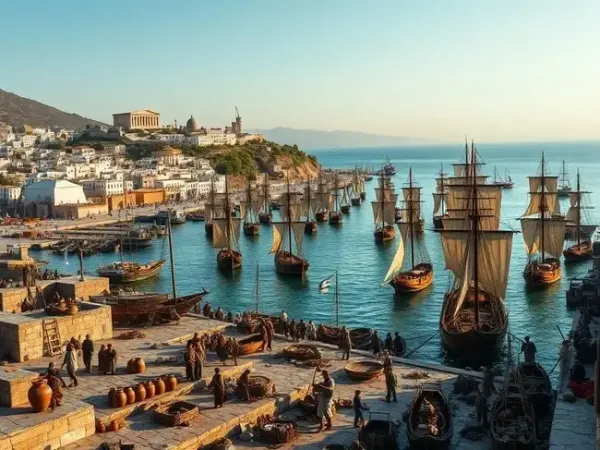
Archaeologists working in the waters near the Greek island of Kythira have identified the remains of a submerged ancient port that offers rare insight into maritime life in the ancient Mediterranean. The underwater site contains structural features and artifacts that appear to be part of a harbor complex once connected to coastal settlements involved in regional trade and seafaring activity. Researchers say the discovery adds to a growing body of evidence showing that many ancient Greek cities were closely tied to the sea through sophisticated port infrastructure.
The submerged remains were identified during underwater surveys conducted by an international team of marine archaeologists. Among the most striking features is a large artificial plateau that appears to have functioned as part of the harbor structure. Amphora fragments and other artifacts were also found scattered across the site, suggesting that the port once supported regular maritime trade. According to archaeologists involved in the project, the preservation of the site offers valuable information about how ancient ports were constructed and used. Researchers say the discovery helps illustrate the scale of maritime activity that once characterized the region. The Mediterranean served as a major trade corridor connecting cities across Greece, North Africa, and the Near East. Ports such as the one found near Kythira would have played an important role in facilitating commerce and cultural exchange among these communities.
Archaeologists studying ancient ports have long emphasized that maritime infrastructure was central to the functioning of Mediterranean societies. Many cities relied heavily on seaborne trade to obtain essential goods and maintain economic stability. The remains near Kythira demonstrate how carefully designed harbor facilities supported this activity. Researchers also note that the layout of the structures suggests deliberate engineering. The artificial plateau appears to have been constructed to stabilize docking areas or storage spaces near the shoreline. Such features indicate that ancient builders possessed considerable knowledge of coastal engineering and understood how to design ports capable of handling heavy maritime traffic.
The study of Pavlopetri has demonstrated that early Mediterranean societies developed organized urban environments long before many other regions. The discovery near Kythira adds another example of how coastal settlements were deeply connected to maritime activity and sea trade.
By studying submerged sites like Helike and the port near Kythira, researchers are gaining a clearer understanding of how ancient communities responded to environmental risks. These cities were often built near the sea for the economic benefits of trade, yet this location also exposed them to earthquakes, storms, and gradual sea-level changes.
Underwater archaeology has advanced rapidly due to technological advances. Sonar mapping, remote sensing equipment, and three-dimensional imaging now allow researchers to study fragile underwater sites without disturbing them. These tools provide highly detailed visualizations that help archaeologists reconstruct ancient landscapes beneath the sea.
By studying these underwater landscapes, researchers can better understand how ancient societies organized their economies, designed their infrastructure, and interacted with the sea. The discovery near Kythira contributes to this broader effort by highlighting the importance of maritime networks in shaping ancient Greek civilization. As underwater research continues, archaeologists expect to discover more submerged settlements across the Mediterranean. Each new site offers another piece of evidence showing how closely ancient societies were connected to the sea and how environmental changes gradually reshaped the landscapes where they once lived.
The submerged remains were identified during underwater surveys conducted by an international team of marine archaeologists. Among the most striking features is a large artificial plateau that appears to have functioned as part of the harbor structure. Amphora fragments and other artifacts were also found scattered across the site, suggesting that the port once supported regular maritime trade. According to archaeologists involved in the project, the preservation of the site offers valuable information about how ancient ports were constructed and used. Researchers say the discovery helps illustrate the scale of maritime activity that once characterized the region. The Mediterranean served as a major trade corridor connecting cities across Greece, North Africa, and the Near East. Ports such as the one found near Kythira would have played an important role in facilitating commerce and cultural exchange among these communities.
Evidence of Ancient Trade Networks
The artifacts recovered from the site provide clues about the economic life that once revolved around the harbor. Amphora fragments are particularly important because these ceramic containers were widely used in antiquity to transport goods such as wine, olive oil, and grain across the Mediterranean. The presence of these fragments indicates that the port was likely integrated into broader trade networks that linked multiple coastal settlements.Archaeologists studying ancient ports have long emphasized that maritime infrastructure was central to the functioning of Mediterranean societies. Many cities relied heavily on seaborne trade to obtain essential goods and maintain economic stability. The remains near Kythira demonstrate how carefully designed harbor facilities supported this activity. Researchers also note that the layout of the structures suggests deliberate engineering. The artificial plateau appears to have been constructed to stabilize docking areas or storage spaces near the shoreline. Such features indicate that ancient builders possessed considerable knowledge of coastal engineering and understood how to design ports capable of handling heavy maritime traffic.
Pavlopetri and the Oldest Known Submerged City
The newly documented site can be better understood by comparing it with other submerged settlements in the region. One of the most famous examples is Pavlopetri, located off the southern coast of mainland Greece. Pavlopetri is widely considered the world's oldest known submerged city, dating to roughly 2800 to 1200 B.C. Unlike many archaeological sites that preserve only fragments of structures, Pavlopetri retains a remarkably complete urban layout. Streets, houses, and tombs remain visible beneath shallow water, allowing researchers to reconstruct the organization of an early Bronze Age community. Modern sonar mapping and digital imaging have produced detailed models of the settlement, revealing a complex town plan that includes residential districts and public spaces.The study of Pavlopetri has demonstrated that early Mediterranean societies developed organized urban environments long before many other regions. The discovery near Kythira adds another example of how coastal settlements were deeply connected to maritime activity and sea trade.
Helike and the Power of Natural Disasters
Another important comparison comes from the ancient city of Helike, which disappeared after a powerful earthquake and tsunami in 373 B.C. Historical accounts described the sudden destruction of the city, and modern excavations confirmed that Helike was submerged beneath sediment and water following the disaster. The rediscovery of Helike has provided scientists with valuable insights into the vulnerability of ancient coastal cities to natural hazards. Geological evidence indicates that seismic activity and coastal flooding played an important role in shaping settlement patterns throughout the Mediterranean.By studying submerged sites like Helike and the port near Kythira, researchers are gaining a clearer understanding of how ancient communities responded to environmental risks. These cities were often built near the sea for the economic benefits of trade, yet this location also exposed them to earthquakes, storms, and gradual sea-level changes.
Expanding the Map of Underwater Archaeology
The Mediterranean contains numerous submerged archaeological sites that have only recently begun to receive systematic investigation. Other examples include the submerged city of Olous near Crete and the remains of ancient coastal settlements in the Black Sea region. In addition to cities, archaeologists have documented shipwrecks that reveal details about the movement of goods and people across ancient sea routes. One well-known example is the Peristera shipwreck, which dates to the fifth century B.C. and carried thousands of amphorae filled with cargo. Discoveries such as this illustrate the enormous scale of maritime commerce that connected distant communities throughout the Mediterranean basin.Underwater archaeology has advanced rapidly due to technological advances. Sonar mapping, remote sensing equipment, and three-dimensional imaging now allow researchers to study fragile underwater sites without disturbing them. These tools provide highly detailed visualizations that help archaeologists reconstruct ancient landscapes beneath the sea.
What Submerged Cities Tell Us About Ancient Civilizations
The growing number of underwater discoveries is transforming how historians understand Mediterranean civilizations. For decades, most archaeological research focused on land-based ruins, which created an incomplete picture of ancient life. Submerged cities demonstrate that many important settlements existed along coastlines that have since changed due to geological and climatic processes.By studying these underwater landscapes, researchers can better understand how ancient societies organized their economies, designed their infrastructure, and interacted with the sea. The discovery near Kythira contributes to this broader effort by highlighting the importance of maritime networks in shaping ancient Greek civilization. As underwater research continues, archaeologists expect to discover more submerged settlements across the Mediterranean. Each new site offers another piece of evidence showing how closely ancient societies were connected to the sea and how environmental changes gradually reshaped the landscapes where they once lived.