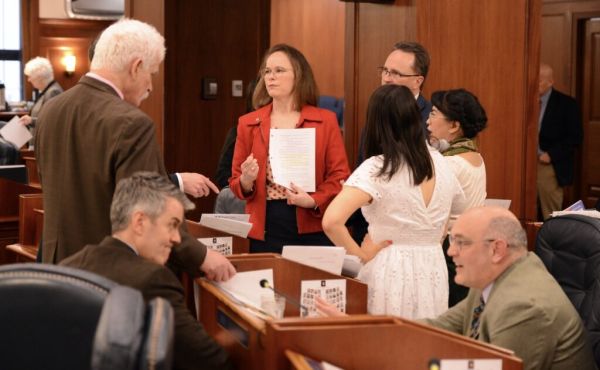
The Alaska House of Representatives voted without opposition on Friday to ban AI-generated child sexual abuse material, advancing a bill that has been a top priority for Republican Rep. Sarah Vance of Homer.
House Bill 47 began as a narrow update to state law. It aimed to close a gap that required proof that a real child was harmed in order to prosecute child sexual abuse material. The bill now makes it a crime to create or share obscene images of minors generated by artificial intelligence, even if no real child was involved.
“Currently in statute, you have to prove the harm of an actual child,” Vance said. “What this bill does is say that anything that is generated obscene material of minors will be criminalized to the same level as if it were a real child.”
Lawmakers from both parties backed that goal. Democratic Rep. Andrew Gray of Anchorage said the state must act fast.
“AI is moving forward at lightning speed. Alaska is behind the curveball,” Gray said. “We really need guardrails as quickly as possible to protect children, first and foremost, but all of us.”
Before final passage, lawmakers expanded the bill in major ways.
Alaska Lawmakers Target AI Deepfakes and Non-Consensual Sexual Content
Democratic Rep. Zack Fields of Anchorage added language that targets the use of AI to create sexual images of adults without consent. One change makes it a crime to create a synthetic sexual image of a real person.
Fields pointed to a recent episode involving Elon Musk’s company xAI. Users of its chatbot Grok were able to generate “undressed” images of people. The incident drew scrutiny from European regulators.
“I agree with the underlying bill,” Fields said. “I also don’t think that perverts should be able to create obscene sexual material about a 19-year-old.”
Another amendment makes it a misdemeanor to harass or threaten someone with a forged digital likeness, often called a deepfake. Fields said the goal is to address revenge porn created with AI tools.
Lawmakers also added a provision that would hold AI companies liable for $1 million per case if their systems are used to produce child sexual abuse material. That change drew little debate.
Vance said the bill must stay within First Amendment limits. Courts often strike down laws that sweep too broadly, she noted.
The most debated addition came from a separate package that restricts how minors use social media.
Under the amended bill, anyone under 18 would need parental consent to open a social media account. Parents would have full access to their child’s account. The bill sets a default curfew of 10:30 p.m. for minors.
It also bars platforms from targeting minors with ads or using algorithms to push content based on personal data. The bill bans what it calls “addictive features” that reward heavy use.
Social Media Amendment Ignites Debate Over Bill’s Survival and Free Speech
Fields framed the measure as a safety issue. He cited the recent arrest of a legislative staffer accused of exploiting children through Snapchat.
“I think the fundamental question with this amendment is, do parental rights supersede the rights of predators?” Fields said. “And do parental rights supersede the rights of multinational corporations?”
He said he drew ideas from a similar law in Utah. Other states have passed measures. Many face court challenges from tech companies that argue the rules violate free speech rights. The U.S. Supreme Court recently allowed a Mississippi law on children’s social media access to remain in effect while litigation moves forward.
Some lawmakers raised concerns. They questioned how the state would verify ages or confirm parental status. Others warned that minors could bypass limits with virtual private networks. A few said the restrictions could infringe on minors’ First Amendment rights.
Republican Rep. Dan Saddler of Eagle River supported the goals but feared the added language could slow the bill in the Senate.
“If I could cast a single vote, make all these things happen to be law and be effective, I would do it in a heartbeat,” Saddler said. “But I fear that this is such a large issue that it imperils bogging down the rest of the good work that’s in this bill.”
A similar bill stalled last year after lawmakers attached social media limits.
Vance said she trusts the Senate to refine the measure. She urged senators, including members of the Judiciary Committee, to move the bill forward and strengthen it where needed.
-
Misty Roberts, Louisiana ex-mayor, ‘very disappointed’ with guilty verdict; lawyer says ‘no apology’ after conviction in rape case involving son’s 16-year-old friend
-
Iran says it struck Kurdish militant headquarters in Iraqi Kurdistan: IRNA

-
From scale to structure: The ET Gen AI Hackathon and India’s next phase of AI

-
Who is MacKenzie Weegar? Utah Mammoth acquire Calgary Flames defenseman in blockbuster five-piece trade

-
Iran war snarls key global hub for fertilizer supplies