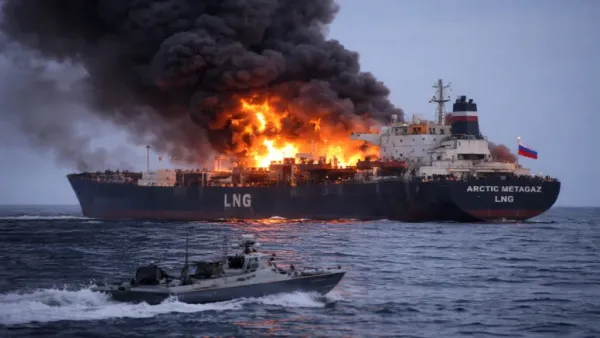
On March 3, a Russian-flagged liquefied natural gas (LNG) tanker, Arctic Metagaz, was caught fire in the Mediterranean Sea, which brought new apprehension with regard to the broadening scope of attacks involving Russian energy infrastructure not directly linked to the war in Ukraine. The case, which was announced by the various international media, has exposed Maritime insecurity and the increased application of naval drone in contemporary warfare to greater scrutiny.
Maritime sources as reported by Reuters reported that the ship was on fire off Malta coast during the early hours of March 3. Other reports indicated that the incident could have been nearer to the shoreline of Libya. Social media photos and videos that circulated were showing masses of flames and heavy smoke emerging out of the tanker as the fire engulfed much of the ship.
The armed forces of Malta reported that the tanker was empty with its crew safely evacuating the vessel when later the crew was in a lifeboat in the search and rescue zone of Libya. The Malteser and Russian rescue services are said to have helped in saving the crew with all the crew of 30 individuals being confirmed safe and accounted.
It has not been clearly established how the fire broke out but there was initial information that the fire could be as a result of an outside attack. A source of maritime security informed Reuters that the fire could have been caused by a Ukrainian naval attack with a drone. These assertions were not confirmed, and the military officials of Ukraine did not provide any official statement about the incident.
On March 4 the Russian Ministry of Transport was quoted by the Russian state media agency TASS that the tanker was attacked by Ukrainian sea drones. The ministry said that the ship had left the northern Russian port of Murmansk and was targeted by drones that had probably been fired at the ship by waters off the Libyan coast.
The Russian officials announced that the tanker transported liquefied natural gas cargo which had been cleared as per the international regulations. Another point made by Moscow was that the emergency response service was effective in avoiding the loss of lives among the crew.
It is estimated that the tanker belongs to the group of so-called Russian shadow fleet of vessels that are used to deliver Russian oil and gas despite the Western sanctions that were enforced due to the invasion of Ukraine. These vessels usually have an obscure ownership framework, flags of convenience and chaotic shipping routines that are meant to circumvent limitations that the United States, the European Union and the United Kingdom have put in place.
Should it be true, the attack will be another milestone in the Ukrainian campaign of growing in attack on Russian energy infrastructure. Kyiv has continued to attack Russian oil and gas resources as part of a larger gambit to diminish Moscow funding of military action. Exports of energy are among the most significant sources of income of the Russian wartime economy, and tankers and maritime logistics are an important target of attack.
Over the past few months, Ukrainian security services have taken credit claiming to have carried out a number of attacks in the form of naval drones on Russian ships. Ukrainian officials had earlier claimed attacks on approved Russian tankers off the coast of Black Sea in Turkey, and the ability to target ships associated with the Russian shadow fleet using Sea Baby naval drones.
Ukrainian troops claimed in December 2025 to have made their first successful attack against a Russian tanker in the Mediterranean, striking a ship in neutral waters more than 2,000 kilometers off Ukrainian airspace. That operation marked an important increase in the territorial range of the maritime operation of Ukraine.
The covered fire on the Arctic Metagaz shows the growing weakness of commercial shipping associated with approved energy shipment. With the increase in the use and more affordable technology of the naval drones, maritime routes which are not traditionally within the areas of conflict are being exposed to new security threats.
It has also been seen that the incident has exposed greater issues in the global energy markets and shipping insurers, especially when attacks on tankers spread further into major shipping lanes worldwide. The cause of the fire is still investigated and more information should be released as the maritime authorities and governments examine the situation in which the incident took place.
-
Download Telangana SSC exam hall tickets 2026 from March 5

-
Capitol scuffle with anti-war activist leaves 3 officers injured

-
Two charred bodies found after fire engulfs building in Delhi

-
Holi clash in Uttar Pradesh’s Barabanki leaves 11 injured

-
Bigg Boss 17’s Anurag Dobhal Alleges Family Torture, Says He Attempted Suicide