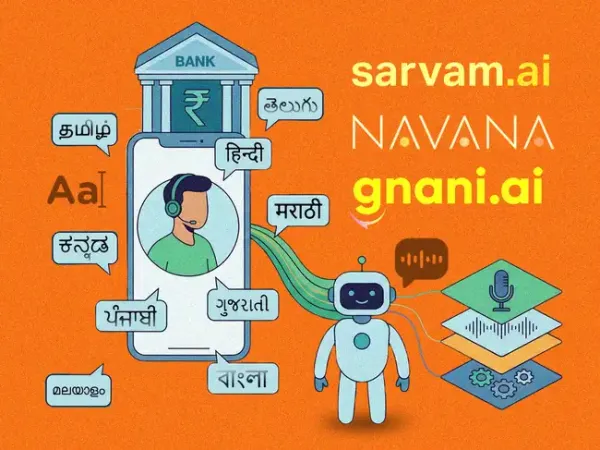
Financial services companies are using artificial intelligence (AI) and Gen-AI capabilities to go beyond simple contact centre automation, getting into more complex functions such as risk compliance, customer onboarding and life cycle management of borrowers, industry insiders told ET.
While automation of call centres saw the first wave of AI adoption in the highly regulated sector, more applications are getting powered by this technology now. The remit of AI applications widened after the Reserve Bank of India (RBI) listed down broad guidelines in August in the Free-AI regulatory document, detailing the adoption of AI in banks’ internal workflow.
The document managed to create a benchmark for every financial institution to build out on the regulator-approved architecture.
“Initially, the focus around AI implementation was only on smoothening operations. Now, the focus is slowly shifting toward KYC-validation, credit decisioning (to a certain extent) and other customer-facing workflows,” said Ranga Reddy, cofounder, Maveric Systems, a banking and financial services technology company based in Chennai. “This shows overall confidence in AI going up for this sector.”
Homegrown startup Sarvam AI and Navana, which have built multilingual voice-bot capabilities, are doubling down on deploying their products for banks and non-banks for basic customer servicing.
Navana Tech, which offers solutions in 15 Indian languages, is already deployed at Bajaj Finance and Ujjivan Small Finance Bank to run their personal loan sales voice bots. Info Edge Ventures-backed Gnani.ai is also working with banks and enterprise clients such as HDFC Bank, IDFC First Bank and Tata Motors for their voice-AI capabilities.
Sarvam, backed by the government’s India AI Mission and venture capital funds such as Peak XV Partners, Lightspeed, among others, is developing solutions on top of its own large language model (LLM) stack targeting banks and other such institutions, after having built India’s own LLM.
Vivek Raghavan, cofounder, Sarvam, told ET that BFSI (banking, financial services and insurance) is one of their major focus areas as the company looks at revenue generation opportunities by deploying its language models at enterprises.
To be sure, BFSI is the biggest industry on the Nifty by weighting, accounting for nearly 40% of the index.
'Business intelligence'
Bajaj Finance disclosed in its December earnings that it disbursed around Rs 1,600 crore in the third quarter through its AI-led call centres.
For now, customer engagement and servicing remain the primary application areas, but collections and credit underwriting are expected to witness wider adoption as banks build more confidence in this frontier technology.
“Currently, mostly standard processes are going to AI, but whenever there is an escalation or more complex tasks involved, humans are still front-ending them,” said Navana Tech cofounder, Raoul Nanavati.
Mumbai-based Navana has raised $1.5 million from Angel List, Antler and others.
The startup, which currently processes around 100 million calls annually, manages loan sales, collection calls, compliance-related calls, and inbound customer support for financial services companies.
On AI deployment, a lot of conversations revolve around cost, a key factor for any financial services major.
Some of the founders of voice AI startups believe the cost of an AI agent is half that of a human agent.
“The cost of deploying AI currently ranges between Rs 5 and Rs 10 per minute, while human agents cost anywhere from Rs 12 to Rs 20 per minute,” Nanavati added.
However, Yashish Dahiya, group chief executive officer, PB Fintech, had told ET earlier that in a country like India, the cost arbitrage on AI-bots is yet to be real.
“AI is not cheap, but there is no doubt that the cost is consistently going down. Maybe three years later, the cost of an AI agent might be one-tenth of a human agent, but currently for Indian salaries they are mostly the same,” Dahiya had told ET last month.
Another important determinant for the use of AI in regulated domains is data privacy and regulatory compliance, especially amid implementation of the Digital Personal Data Protection Act 2023.
“The integration of AI into the financial sector introduces a broad and complex spectrum of risks that challenge traditional risk management frameworks. The risks may undermine market integrity, erode consumer trust, and amplify systemic vulnerabilities. All of this needs to be well understood for effective risk management,” the central bank had said in its Free-AI report.
While automation of call centres saw the first wave of AI adoption in the highly regulated sector, more applications are getting powered by this technology now. The remit of AI applications widened after the Reserve Bank of India (RBI) listed down broad guidelines in August in the Free-AI regulatory document, detailing the adoption of AI in banks’ internal workflow.
The document managed to create a benchmark for every financial institution to build out on the regulator-approved architecture.
“Initially, the focus around AI implementation was only on smoothening operations. Now, the focus is slowly shifting toward KYC-validation, credit decisioning (to a certain extent) and other customer-facing workflows,” said Ranga Reddy, cofounder, Maveric Systems, a banking and financial services technology company based in Chennai. “This shows overall confidence in AI going up for this sector.”
Homegrown startup Sarvam AI and Navana, which have built multilingual voice-bot capabilities, are doubling down on deploying their products for banks and non-banks for basic customer servicing.
Navana Tech, which offers solutions in 15 Indian languages, is already deployed at Bajaj Finance and Ujjivan Small Finance Bank to run their personal loan sales voice bots. Info Edge Ventures-backed Gnani.ai is also working with banks and enterprise clients such as HDFC Bank, IDFC First Bank and Tata Motors for their voice-AI capabilities.
Sarvam, backed by the government’s India AI Mission and venture capital funds such as Peak XV Partners, Lightspeed, among others, is developing solutions on top of its own large language model (LLM) stack targeting banks and other such institutions, after having built India’s own LLM.
Vivek Raghavan, cofounder, Sarvam, told ET that BFSI (banking, financial services and insurance) is one of their major focus areas as the company looks at revenue generation opportunities by deploying its language models at enterprises.
To be sure, BFSI is the biggest industry on the Nifty by weighting, accounting for nearly 40% of the index.
'Business intelligence'
Bajaj Finance disclosed in its December earnings that it disbursed around Rs 1,600 crore in the third quarter through its AI-led call centres.
For now, customer engagement and servicing remain the primary application areas, but collections and credit underwriting are expected to witness wider adoption as banks build more confidence in this frontier technology.
“Currently, mostly standard processes are going to AI, but whenever there is an escalation or more complex tasks involved, humans are still front-ending them,” said Navana Tech cofounder, Raoul Nanavati.
Mumbai-based Navana has raised $1.5 million from Angel List, Antler and others.
The startup, which currently processes around 100 million calls annually, manages loan sales, collection calls, compliance-related calls, and inbound customer support for financial services companies.
On AI deployment, a lot of conversations revolve around cost, a key factor for any financial services major.
Some of the founders of voice AI startups believe the cost of an AI agent is half that of a human agent.
“The cost of deploying AI currently ranges between Rs 5 and Rs 10 per minute, while human agents cost anywhere from Rs 12 to Rs 20 per minute,” Nanavati added.
However, Yashish Dahiya, group chief executive officer, PB Fintech, had told ET earlier that in a country like India, the cost arbitrage on AI-bots is yet to be real.
“AI is not cheap, but there is no doubt that the cost is consistently going down. Maybe three years later, the cost of an AI agent might be one-tenth of a human agent, but currently for Indian salaries they are mostly the same,” Dahiya had told ET last month.
Another important determinant for the use of AI in regulated domains is data privacy and regulatory compliance, especially amid implementation of the Digital Personal Data Protection Act 2023.
“The integration of AI into the financial sector introduces a broad and complex spectrum of risks that challenge traditional risk management frameworks. The risks may undermine market integrity, erode consumer trust, and amplify systemic vulnerabilities. All of this needs to be well understood for effective risk management,” the central bank had said in its Free-AI report.