
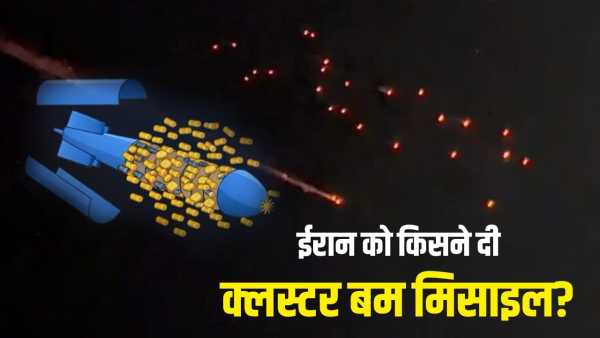
Cluster bomb missiles are being used by Iran against Israel. Its attacks are so deadly that even Israel has groaned. These bombs are falling on the population in droves. That's why there is more discussion going on. Israel itself has given information about this by posting on social media and has also told how its attacks have proved dangerous.
In the midst of war, it is important to know what cluster bomb missiles are? How does this technology work? Where did it come to Iran from? How big a threat is this to Israel?
What is a cluster bomb missile?
Cluster bomb missile is a special type of missile. There is no big warhead inside it. Many small bombs are filled. These are called submunitions or bomblets. When the missile reaches near the target it opens in the air. After this, dozens of small bombs scatter in different directions. Each small bomb falls and explodes at a different place, that is, one missile can explode at many places. For this reason it is considered very dangerous.

Difference between ordinary bomb and cluster bomb
An ordinary missile carries a single warhead. It falls at some place and makes a big explosion. What does a cluster missile do? Opens at a certain height in the air. Many small bombs inside it come out. These spread over an area of a few kilometers. Every bomb makes its own explosion. This means that while an ordinary missile causes a big explosion at one place, a cluster missile is capable of causing explosions at many places simultaneously. In war, cluster missile bombs can damage large areas of the enemy. And Iran is carrying out the same blasts against Israel.
What are the claims of the Israeli army?
The Israeli Army claims that Iran has fired ballistic missiles with cluster munition. At least one of these missiles attacked the central part of Israel. A missile opened fire at an altitude of about seven kilometers. He released about 20 submunitions. These spread over a radius of about 8 kilometers. A bomblet fell on a house in the town of Azor, near Tel Aviv. The house was damaged, but there was no death. Overall, many people were injured and a lot of property was damaged in the attacks. The Israeli army warned the common people that unexploded bombs lying on the ground are very dangerous.
The Israeli Army claims that Iran has fired ballistic missiles with cluster munition.
How is a cluster missile launched?
Cluster missiles are launched from ground or mobile launchers. Some missiles can also be launched from ships or submarines. The missile moves on a ballistic or guided path. Computers and systems are installed inside it. These systems decide at what altitude the warhead is to be launched. The warhead of the missile opens after reaching above or near the target. This work usually takes place at a height of a few kilometers. Small bombs come out from the warhead.
Some missiles of Iran can release 20 to 80 submunitions. Each submunition contains a few kilograms of explosive. It has as much power as a small rocket or mortar shell. Submunitions fall at different places. Many bombs explode as soon as they hit the ground. Many times some bombs do not explode and remain lying there and this is where the biggest danger begins.
There is danger even if the bomb does not explode
The most dangerous aspect of cluster bombs are the unexploded submunitions. Some percentage of submunitions do not explode upon falling. These can remain lying in the ground or on the surface for years. It can burst due to someone's foot falling, child lifting, farmer plowing or any shock. In this way these bombs remain a live threat even after the war is over. These start working like mini landmines. Unexploded pieces of cluster bombs are still found in many countries even years after the war. Every year civilians keep getting injured by such bombs. For this reason, there is a lot of international debate and opposition on cluster munition.
The latest scene of Iranian missile strikes on Israeli occupation sites in Palestine. pic.twitter.com/Dw5m9PiSj3
— Quds News Network (@qudsn) March 1, 2026
Where did Iran get this technology from?
Iran does not officially reveal much about its cluster weapons program but some things emerge from open sources. Iran has developed many ballistic missiles itself. Zulfikar, Qader, Khorramshahr etc. are prominent among them. Media reports say that the Kader missile can carry a cluster warhead and can hit a distance of about two thousand kilometers. Many of Iran's missiles are based on the Soviet Scud design. In this the name of Qiyam is prominently used.
According to the facts coming out in media reports quoting defense experts, the technology behind Iran's cluster capability could be from Russia or China. But this is not solid information. There is only apprehension because China-Russia already have advanced cluster warhead technology. Iran has Soviet-designed KMGU dispensers, which are designed to drop submunitions. Cluster bombs like British-made BL755 are also said to be in Iran's possession.
How big a threat is it to Israel?
Israel is a militarily strong country. It has advanced missile defense systems like Iron Dome, David's Sling, Arrow, yet cluster missiles pose certain threats. Tel Aviv and its surroundings are densely populated. If several submunitions fall simultaneously, there can be simultaneous explosions in several localities. This could increase the number of injuries and damage, even if each blast is small. Unexploded bombs will remain a threat for years. If Iran fires multiple barrages in a single day, and some of them are cluster warheads, Israeli systems will have to decide which missile to shoot down first. Missiles with cluster warheads often become a special priority because their effect is very widespread over the area. Overall, this threat to Israel is both technical and human.In addition to direct military losses, civilian security, mental health and economic activities could be deeply affected.
Also know about the Convention on Cluster Munitions
A major treaty was signed in 2008 regarding cluster munition. It is known as the Convention on Cluster Munitions. A total of 111 countries and 12 other organizations are associated with this treaty. These countries have agreed to stop the use, production, transfer and storage of such weapons, but neither Iran has signed this treaty, nor Israel has signed it. America is also not a part of this treaty. The debate on cluster bombs has also intensified during the Ukraine war. America gave such weapons to Ukraine, while Russia has also been accused of using them. This means that cluster bombs are not just an issue of Iran and Israel. This is a big question for the whole world related to human rights, humanitarian law and morality of war.
-
Justice coupled with mercy: Delhi HC quashes attempted culpable homicide case in family dispute

-
UPSC CSE 2025 Final Results Expected This Week

-
भारत की 8 सबसे कठिन धार्मिक यात्राएं: चुनौतियों का सामना करें

-
'I was King Charles' gardener and there's one job you need to do now for summer'

-
Two 'sublime' chip shops ranked among Top 10 in UK customers can't stop raving about