Finland’s President Alexander Stubb on Thursday said India and the broader Global South will play a decisive role in shaping the next international order, arguing that the era of Western dominance in global politics is drawing to a close.
"Era of a western dominated world is over. But it will take some time to sink in across the West," he said.
Speaking at the opening of the three-day Raisina Dialogue in New Delhi, Stubb said the world is entering a period of profound geopolitical change in which decisions taken by emerging powers, particularly India, will influence whether the future global system becomes cooperative or increasingly confrontational.
Also Read | 'Seat at UNSC for India is of utmost importance,' says Finland President Stubb
The Raisina Dialogue, hosted annually in New Delhi, brings together global leaders, policymakers, diplomats and strategic experts to discuss major geopolitical and economic challenges facing the international system. President Stubb is the chief guest for the 2026 forum.
“I believe that the Global South will decide what the next world order will look like and India will be a major force in deciding,” Stubb said. “Policy decisions that India makes will decide the direction of the future."
The Finnish leader also argued that the traditional rules-based balance of power is under strain. “Rule-based power is dead. We are living through a major challenge in world politics,” he said.
However, he cautioned against viewing the moment purely through a pessimistic lens. “I would argue against a binary ‘everything is lost’ view. Reality is more complex,” he said.
The President further said the emerging global system could move in two very different directions depending on how major powers respond to current tensions.
Also Read | Finland President Stubb arrives in India, boosting bilateral ties with PM Modi
“I believe that the global south will decide what the next world order will look like, and India as a major power, will be a major or, if not, the force, in deciding whether the world will tilt towards conflictual multipolarity, characterized by deals, transactions and spheres of interests, or whether the world will tilt towards a new cooperative, fair and Representative multilateral world order based on international institutions, rules and norms,” he said.
He warned that if international institutions weaken further, geopolitical competition could increasingly be driven by raw power.
“Without a functioning world order, power vacuums will be filled by raw power and predatory hegemony,” Stubb said.
At the same time, he said there remains an opportunity to build a more balanced global architecture.
According to him, India could play a central role in determining whether the world moves toward “conflictual multipolarity”, marked by transactional alliances and competing spheres of influence, or toward a more cooperative multilateral order based on institutions, rules and norms.
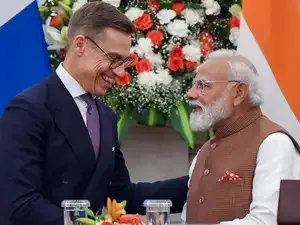
Stubb arrived in New Delhi on Wednesday morning on a state visit and was accorded a ceremonial welcome and a Guard of Honour. He was received at the airport by Minister of State for External Affairs K V Singh and welcomed by PM Modi.
During his visit, the Finnish President is also scheduled to hold bilateral talks with Prime Minister Modi focusing on strengthening economic and strategic cooperation, as well as discussing key regional and global issues.
"Era of a western dominated world is over. But it will take some time to sink in across the West," he said.
Speaking at the opening of the three-day Raisina Dialogue in New Delhi, Stubb said the world is entering a period of profound geopolitical change in which decisions taken by emerging powers, particularly India, will influence whether the future global system becomes cooperative or increasingly confrontational.
Also Read | 'Seat at UNSC for India is of utmost importance,' says Finland President Stubb
The Raisina Dialogue, hosted annually in New Delhi, brings together global leaders, policymakers, diplomats and strategic experts to discuss major geopolitical and economic challenges facing the international system. President Stubb is the chief guest for the 2026 forum.
“I believe that the Global South will decide what the next world order will look like and India will be a major force in deciding,” Stubb said. “Policy decisions that India makes will decide the direction of the future."
The Finnish leader also argued that the traditional rules-based balance of power is under strain. “Rule-based power is dead. We are living through a major challenge in world politics,” he said.
However, he cautioned against viewing the moment purely through a pessimistic lens. “I would argue against a binary ‘everything is lost’ view. Reality is more complex,” he said.
The President further said the emerging global system could move in two very different directions depending on how major powers respond to current tensions.
Also Read | Finland President Stubb arrives in India, boosting bilateral ties with PM Modi
“I believe that the global south will decide what the next world order will look like, and India as a major power, will be a major or, if not, the force, in deciding whether the world will tilt towards conflictual multipolarity, characterized by deals, transactions and spheres of interests, or whether the world will tilt towards a new cooperative, fair and Representative multilateral world order based on international institutions, rules and norms,” he said.
He warned that if international institutions weaken further, geopolitical competition could increasingly be driven by raw power.
“Without a functioning world order, power vacuums will be filled by raw power and predatory hegemony,” Stubb said.
At the same time, he said there remains an opportunity to build a more balanced global architecture.
According to him, India could play a central role in determining whether the world moves toward “conflictual multipolarity”, marked by transactional alliances and competing spheres of influence, or toward a more cooperative multilateral order based on institutions, rules and norms.
Stubb arrived in New Delhi on Wednesday morning on a state visit and was accorded a ceremonial welcome and a Guard of Honour. He was received at the airport by Minister of State for External Affairs K V Singh and welcomed by PM Modi.
During his visit, the Finnish President is also scheduled to hold bilateral talks with Prime Minister Modi focusing on strengthening economic and strategic cooperation, as well as discussing key regional and global issues.