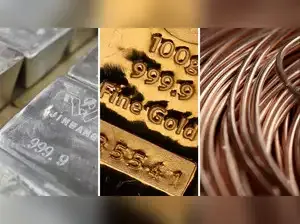
Why gold and silver prices crashed today: Gold prices slipped to $5,130 on Thursday while silver dropped near $82, as a stronger US dollar and rising Treasury yields triggered selling across the precious metals market. Data from futures contracts GC00 (gold), SI00 (silver), PL00 (platinum), and HG00 (copper) shows that metals faced broad pressure despite rising geopolitical tensions in the Middle East.
Gold futures traded around $5,128–$5,130, down roughly 0.1%, while silver fell nearly 1%, reflecting a sharp shift in investor sentiment. The US Dollar Index (DXY) climbed to 99.10, supported by strong economic data including ADP private employment growth of 63,000 jobs and an unexpectedly strong ISM Services PMI of 56.1 for February.
Copper led all losses at 1.77% to $5.80, while Platinum slipped 0.19% to $2,149.90.
Every 0.1% rise in the US Dollar Index historically compresses Gold by $8 to $12 per ounce in short-term trading. Today the DXY climbed 0.35% to 99.10, which alone accounts for roughly $28 to $42 of Gold's intraday pressure. Silver absorbs even more pain because XAG/USD is more sensitive to currency swings than Gold. The $82.00 level is now critical near-term support for Silver. A daily close below that opens a move toward $79.50.
At the same time, global markets are reacting to the sixth day of the Iran-Israel-US conflict, after reports that a US submarine sank an Iranian warship near Sri Lanka, marking what US Defense Secretary Pete Hegseth described as the first such naval attack on an enemy vessel since World War II.
However, bullion markets did not rally strongly on geopolitical fears. Instead, investors shifted toward the US dollar and Treasury bonds, pushing yields on the 10-year US Treasury to 4.11%. Rising yields reduce the attractiveness of non-yielding assets like gold and silver, causing short-term selling pressure across the precious metals complex.
Meanwhile, policy developments also weighed on metals. The US government plans to introduce a temporary 15% global tariff, replacing the earlier 10% tariff regime, after the Supreme Court invalidated parts of former tariff policies under President Donald Trump. Markets are now watching whether trade tensions, inflation risks from higher oil prices, and Federal Reserve interest-rate expectations will drive the next major move in gold, silver, platinum, and copper.
The main driver behind the fall in gold price today and silver price today is the sharp rebound in the US dollar. When the dollar strengthens, commodities priced in dollars become more expensive for global investors, reducing demand.
The US Dollar Index (DXY) climbed 0.35% to 99.10, a move that immediately pressured precious metals. Investors rushed toward the dollar after stronger-than-expected US economic data suggested the American economy remains resilient.
At the same time, rising Treasury yields at 4.11% made bonds more attractive compared with non-yielding assets such as gold and silver. When interest rates rise or remain high, investors often shift capital away from bullion into income-generating assets.
This explains why bullion markets saw profit-taking rather than panic buying, even as the US-Israel-Iran conflict escalated across the Middle East. Traders appear to believe that the conflict could eventually de-escalate, especially after reports that Iran signaled possible talks through intelligence channels — although Tehran later denied the claim.
As a result, gold and silver are experiencing short-term volatility rather than a structural decline, with macroeconomic forces dominating safe-haven demand.
The XAU/USD pair currently trades near $5,130, remaining above the 50-day Exponential Moving Average (EMA), which signals that the broader trend remains upward.
Technical indicators also show steady buying momentum. The 14-day Relative Strength Index (RSI) remains in the mid-50 range, suggesting that gold is neither overbought nor oversold.
Analysts believe that if bullish momentum continues, gold prices could test the upper boundary of the ascending channel around $5,470, followed by a potential retest of the all-time high near $5,598, reached earlier this year.
However, downside risks remain if macro conditions shift further. Immediate support levels sit near $5,163, which corresponds to the nine-day EMA. If that support breaks, prices could slide toward $5,070, the lower boundary of the channel. A deeper correction could bring gold toward the 50-day EMA around $4,874.
In short, the gold market today is consolidating rather than collapsing. Investors remain cautious as they weigh geopolitical tensions, inflation risks, and Federal Reserve policy expectations.
Silver prices (XAG/USD) dropped about 1.6% to near $82 during the European trading session. Silver is more sensitive to economic expectations than gold because it has significant industrial demand. Strong US economic data often pushes interest rates higher, which can weaken silver in the short term.
The ADP employment report showing 63,000 jobs added and the ISM Services PMI rising to 56.1 reinforced the idea that the Federal Reserve may keep interest rates higher for longer. According to CME FedWatch estimates, traders now expect no rate cuts in the first half of the year.
That outlook reduces demand for precious metals because higher interest rates increase the opportunity cost of holding them.
Other metals are also showing mild declines:
Platinum (PL00) trades near $2,149, down about 0.23%, reflecting weaker investment demand.
Copper (HG00) dropped nearly 1.8% to around $5.80, as traders reassess global growth expectations amid geopolitical tensions and trade policy uncertainty.
At the same time, rising oil and gas prices triggered by the Middle East conflict are raising concerns about inflation returning. Higher inflation expectations can sometimes support gold, but they can also delay central-bank rate cuts, which ultimately pressures metals in the short term.
The medium-term bull case for Gold prices remains solid. Central banks globally are buying Gold at near-record rates. The Iran conflict — even if it shortens — leaves structural supply disruptions and elevated geopolitical uncertainty embedded in energy markets. The Federal Reserve will cut rates eventually. When it does, non-yielding assets like Gold and Silver will benefit directly and immediately. Today's decline is noise inside a longer-term signal that still points higher.
The next direction for bullion markets will depend on three major factors: the Middle East conflict, US monetary policy, and global trade tensions.
If the conflict between the United States, Israel and Iran intensifies further — especially after the reported sinking of an Iranian warship — safe-haven demand for gold could surge again.
However, if diplomatic negotiations begin or ceasefire signals emerge, the US dollar may remain dominant, keeping pressure on gold and silver.
Another major factor is the Federal Reserve. If economic data continues to show strong growth and inflation risks rise due to higher energy prices, the Fed may delay rate cuts. That scenario would likely cap upside in gold and silver prices in the near term.
Meanwhile, the introduction of a 15% global tariff by the United States could trigger fresh volatility across commodities and industrial metals like copper.
For now, the metals market is in a tug-of-war between geopolitics and macroeconomics. Geopolitical risks are supporting gold in the long term, while a stronger dollar and higher yields are limiting immediate gains.
FAQs:
Gold futures traded around $5,128–$5,130, down roughly 0.1%, while silver fell nearly 1%, reflecting a sharp shift in investor sentiment. The US Dollar Index (DXY) climbed to 99.10, supported by strong economic data including ADP private employment growth of 63,000 jobs and an unexpectedly strong ISM Services PMI of 56.1 for February.
Copper led all losses at 1.77% to $5.80, while Platinum slipped 0.19% to $2,149.90.
Every 0.1% rise in the US Dollar Index historically compresses Gold by $8 to $12 per ounce in short-term trading. Today the DXY climbed 0.35% to 99.10, which alone accounts for roughly $28 to $42 of Gold's intraday pressure. Silver absorbs even more pain because XAG/USD is more sensitive to currency swings than Gold. The $82.00 level is now critical near-term support for Silver. A daily close below that opens a move toward $79.50.
At the same time, global markets are reacting to the sixth day of the Iran-Israel-US conflict, after reports that a US submarine sank an Iranian warship near Sri Lanka, marking what US Defense Secretary Pete Hegseth described as the first such naval attack on an enemy vessel since World War II.
However, bullion markets did not rally strongly on geopolitical fears. Instead, investors shifted toward the US dollar and Treasury bonds, pushing yields on the 10-year US Treasury to 4.11%. Rising yields reduce the attractiveness of non-yielding assets like gold and silver, causing short-term selling pressure across the precious metals complex.
Meanwhile, policy developments also weighed on metals. The US government plans to introduce a temporary 15% global tariff, replacing the earlier 10% tariff regime, after the Supreme Court invalidated parts of former tariff policies under President Donald Trump. Markets are now watching whether trade tensions, inflation risks from higher oil prices, and Federal Reserve interest-rate expectations will drive the next major move in gold, silver, platinum, and copper.
Why are gold and silver prices falling despite the Middle East war?
Normally, geopolitical conflicts increase demand for safe-haven assets such as gold and silver. However, the current market reaction shows a more complex picture.The main driver behind the fall in gold price today and silver price today is the sharp rebound in the US dollar. When the dollar strengthens, commodities priced in dollars become more expensive for global investors, reducing demand.
The US Dollar Index (DXY) climbed 0.35% to 99.10, a move that immediately pressured precious metals. Investors rushed toward the dollar after stronger-than-expected US economic data suggested the American economy remains resilient.
At the same time, rising Treasury yields at 4.11% made bonds more attractive compared with non-yielding assets such as gold and silver. When interest rates rise or remain high, investors often shift capital away from bullion into income-generating assets.
This explains why bullion markets saw profit-taking rather than panic buying, even as the US-Israel-Iran conflict escalated across the Middle East. Traders appear to believe that the conflict could eventually de-escalate, especially after reports that Iran signaled possible talks through intelligence channels — although Tehran later denied the claim.
As a result, gold and silver are experiencing short-term volatility rather than a structural decline, with macroeconomic forces dominating safe-haven demand.
What is happening in the gold market right now?
The gold price outlook remains technically stable despite the latest dip. Gold futures are still trading above key technical support levels.The XAU/USD pair currently trades near $5,130, remaining above the 50-day Exponential Moving Average (EMA), which signals that the broader trend remains upward.
Technical indicators also show steady buying momentum. The 14-day Relative Strength Index (RSI) remains in the mid-50 range, suggesting that gold is neither overbought nor oversold.
Analysts believe that if bullish momentum continues, gold prices could test the upper boundary of the ascending channel around $5,470, followed by a potential retest of the all-time high near $5,598, reached earlier this year.
However, downside risks remain if macro conditions shift further. Immediate support levels sit near $5,163, which corresponds to the nine-day EMA. If that support breaks, prices could slide toward $5,070, the lower boundary of the channel. A deeper correction could bring gold toward the 50-day EMA around $4,874.
In short, the gold market today is consolidating rather than collapsing. Investors remain cautious as they weigh geopolitical tensions, inflation risks, and Federal Reserve policy expectations.
Why silver, platinum and copper are also under pressure
The broader metals complex is also reacting to the same macroeconomic drivers affecting gold.Silver prices (XAG/USD) dropped about 1.6% to near $82 during the European trading session. Silver is more sensitive to economic expectations than gold because it has significant industrial demand. Strong US economic data often pushes interest rates higher, which can weaken silver in the short term.
The ADP employment report showing 63,000 jobs added and the ISM Services PMI rising to 56.1 reinforced the idea that the Federal Reserve may keep interest rates higher for longer. According to CME FedWatch estimates, traders now expect no rate cuts in the first half of the year.
That outlook reduces demand for precious metals because higher interest rates increase the opportunity cost of holding them.
Other metals are also showing mild declines:
Platinum (PL00) trades near $2,149, down about 0.23%, reflecting weaker investment demand.
Copper (HG00) dropped nearly 1.8% to around $5.80, as traders reassess global growth expectations amid geopolitical tensions and trade policy uncertainty.
At the same time, rising oil and gas prices triggered by the Middle East conflict are raising concerns about inflation returning. Higher inflation expectations can sometimes support gold, but they can also delay central-bank rate cuts, which ultimately pressures metals in the short term.
What could happen next in gold, silver and commodity markets?
Gold is trading inside an ascending channel. The upper boundary of that channel sits near $5,470. A breakout above $5,470 reopens the path to the all-time high of $5,598, reached on January 29. On the downside, the nine-day EMA at $5,163 is immediate support. A break below that exposes the channel's lower boundary at $5,070. A close below $5,070 points directly at the 50-day EMA at $4,874 — the strongest technical floor in the current structure. Silver needs to hold $82.00 on a daily close to avoid further technical selling. Copper's picture is more damaged; it needs a recovery in global manufacturing sentiment or relief from US trade tensions to stabilise above $5.75.The medium-term bull case for Gold prices remains solid. Central banks globally are buying Gold at near-record rates. The Iran conflict — even if it shortens — leaves structural supply disruptions and elevated geopolitical uncertainty embedded in energy markets. The Federal Reserve will cut rates eventually. When it does, non-yielding assets like Gold and Silver will benefit directly and immediately. Today's decline is noise inside a longer-term signal that still points higher.
The next direction for bullion markets will depend on three major factors: the Middle East conflict, US monetary policy, and global trade tensions.
If the conflict between the United States, Israel and Iran intensifies further — especially after the reported sinking of an Iranian warship — safe-haven demand for gold could surge again.
However, if diplomatic negotiations begin or ceasefire signals emerge, the US dollar may remain dominant, keeping pressure on gold and silver.
Another major factor is the Federal Reserve. If economic data continues to show strong growth and inflation risks rise due to higher energy prices, the Fed may delay rate cuts. That scenario would likely cap upside in gold and silver prices in the near term.
Meanwhile, the introduction of a 15% global tariff by the United States could trigger fresh volatility across commodities and industrial metals like copper.
For now, the metals market is in a tug-of-war between geopolitics and macroeconomics. Geopolitical risks are supporting gold in the long term, while a stronger dollar and higher yields are limiting immediate gains.