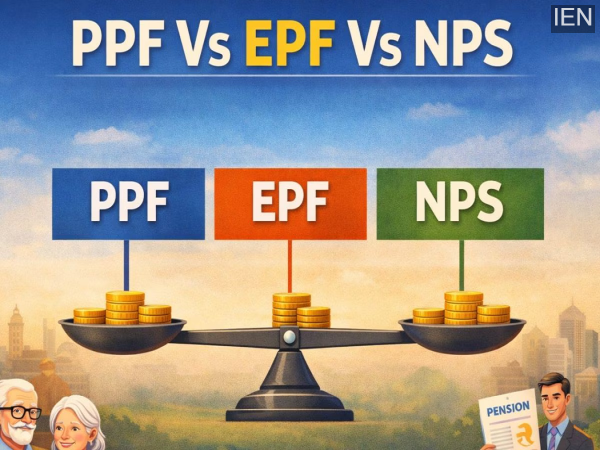
Planning for retirement is one of the most important financial decisions individuals make during their working life. In India, investors often compare three popular long-term savings schemes — Employees’ Provident Fund (EPF), Public Provident Fund (PPF), and National Pension System (NPS). Each of these investment options is designed to help individuals build a retirement corpus, but they differ in terms of returns, tax benefits, flexibility, and eligibility.
Because of these differences, many investors remain confused about which option can deliver the maximum benefit. Financial experts say the right choice depends on factors such as income source, risk tolerance, tax planning needs, and investment horizon.
Here is a detailed explanation of how EPF, PPF, and NPS work and which one may be suitable for different investors.
What Is EPF and Who Can Invest?
The Employees’ Provident Fund (EPF) is a government-backed retirement savings scheme designed primarily for salaried employees. It is one of the most disciplined investment options because contributions are made automatically from an employee’s salary every month.
Under this scheme:
-
A fixed portion of an employee’s basic salary plus dearness allowance (DA) is deposited into the EPF account.
-
The employer contributes an equal amount every month.
-
The accumulated corpus grows with interest and benefits from long-term compounding.
One of the biggest advantages of EPF is that it carries very low risk, as it is regulated by the government. Additionally, the amount received at retirement is generally tax-free under certain conditions, making it an attractive option for long-term wealth creation.
However, EPF is mainly available for salaried employees working in the organized sector, and individuals cannot voluntarily contribute to it unless they are part of the workforce covered by the EPF system.
Why PPF Is a Popular Long-Term Investment
The Public Provident Fund (PPF) is one of India’s oldest and most trusted long-term savings schemes. It is open to both salaried and self-employed individuals, making it accessible to a wider group of investors.
Key features of PPF include:
-
A 15-year lock-in period, which encourages disciplined long-term savings.
-
Government-backed security with minimal risk.
-
Annual investment limit of ₹1.5 lakh.
-
Attractive tax benefits under the EEE (Exempt–Exempt–Exempt) category.
The EEE status means that:
-
Contributions are tax-deductible.
-
Interest earned is tax-free.
-
The maturity amount is also tax-exempt.
Due to these tax advantages, PPF is considered one of the safest and most tax-efficient investment options for building a long-term financial corpus.
Understanding the National Pension System (NPS)
The National Pension System (NPS) is a relatively newer retirement-focused investment scheme introduced by the Government of India. Unlike EPF and PPF, NPS is a market-linked investment option, meaning its returns depend partly on market performance.
NPS allows investors to allocate their funds into different asset classes such as:
-
Equity
-
Corporate bonds
-
Government securities
Because of its exposure to financial markets, NPS has the potential to deliver higher long-term returns, although it may also involve slightly higher risk compared to EPF or PPF.
Another advantage of NPS is its additional tax deduction benefit under Section 80CCD(1B), which allows investors to claim an extra tax deduction of up to ₹50,000 beyond the standard Section 80C limit.
However, one limitation of NPS is liquidity. At retirement, a portion of the accumulated corpus must be used to purchase an annuity plan, which provides regular pension income.
Key Differences Between EPF, PPF and NPS
Understanding the differences between these schemes can help investors make better financial decisions.
EPF
-
Suitable mainly for salaried employees
-
Employer contribution included
-
Low risk and stable returns
-
Retirement corpus generally tax-free
PPF
-
Open to all individuals
-
Government-backed with minimal risk
-
15-year lock-in period
-
EEE tax benefit structure
NPS
-
Market-linked investment option
-
Potential for higher returns over the long term
-
Additional tax deduction benefits
-
Partial mandatory annuity at retirement
Which Investment Option Is Best for You?
Financial planners believe that there is no single investment product that is ideal for everyone. The best choice depends on an individual’s financial goals and risk appetite.
-
EPF works best for salaried employees seeking disciplined, low-risk retirement savings.
-
PPF is ideal for individuals who prefer safe, long-term investments with strong tax advantages.
-
NPS may suit investors willing to take limited market exposure for potentially higher returns.
In many cases, investors choose to combine these schemes to create a balanced retirement portfolio.
A Balanced Approach to Retirement Planning
Experts often recommend diversifying retirement savings across multiple instruments rather than relying on just one. By combining EPF, PPF, and NPS, investors can balance safety, tax benefits, and growth potential.
Ultimately, successful retirement planning requires careful evaluation of personal financial goals, investment duration, and risk tolerance. Choosing the right mix of these government-supported schemes can help individuals build a strong and secure financial future.
-
A favorite of Mumbaikars… this time make street style ‘Desi Cheese Vadapav’ at home, the taste of this will tempt you.

-
International Women’s Day: Smriti Mandhana Barbie unveiled; Serena Williams, Chloe Kelly among global Dream Team

-
Eye Care Diet: Are you worried about increasing number of glasses? Include these 5 things in your diet today

-
Free Fire Max: New Holi event entry in the game, players will get Gulal Guard Glue Wall Skin for free

-
WhatsApp Tips- WhatsApp is soon going to ban WhatsApp accounts of 81 lakh Indians, know the reason for this