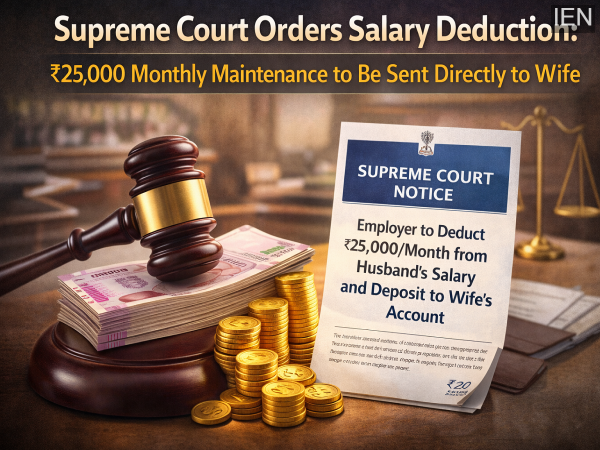
In a significant ruling, the Supreme Court of India directed a company to deduct ₹25,000 every month from an employee’s salary and transfer the amount directly to his estranged wife’s bank account. The decision came after the employee repeatedly failed to comply with court orders requiring him to provide financial support to his wife and minor daughter.
The court emphasized that maintenance is not charity but a legal right, and necessary steps can be taken to ensure that such payments are made regularly.
Court Steps in After Husband Fails to Pay MaintenanceThe order was passed by a bench comprising J. B. Pardiwala and K. V. Viswanathan.
The case involved a couple who had been living separately. Earlier, the court had directed the husband to pay maintenance to his wife and their minor daughter. However, despite repeated instructions, the husband failed to make the required payments.
To ensure compliance with the court’s order, the bench directed the employer to deduct the maintenance amount directly from the employee’s salary and transfer it to the wife’s bank account.
Maintenance Is a Legal Right, Not CharityLegal experts noted that the Supreme Court has repeatedly clarified that maintenance is a legal entitlement for a spouse and dependent children, not a voluntary payment.
According to Aeddhaas Legal LLP partner Yatharth Rohilla, the objective of maintenance laws is to ensure that the wife and children can live with dignity and financial security.
In cases where individuals refuse to follow court orders, direct salary deductions can be an effective way to enforce compliance and ensure regular payments.
Court Asked Husband to Deposit ₹2.5 LakhDuring the hearing, the court also asked the husband whether he was willing to deposit ₹2.5 lakh as interim maintenance arrears. However, he declined to pay the amount.
After his refusal, the bench decided that direct salary deduction would be the most appropriate way to implement the maintenance order.
Employer Ordered to Transfer ₹25,000 Every MonthThe court instructed the husband’s employer to:
-
Deduct ₹25,000 from his salary every month
-
Transfer the amount directly to the wife’s bank account
-
Complete the payment through RTGS or bank transfer
The arrangement will remain in effect until the court issues a new directive.
The next hearing in the matter has been scheduled for April, when the court will review whether the order is being properly implemented.
Legal Impact of the Supreme Court RulingLegal experts believe this ruling could set an important precedent in cases where husbands fail to comply with maintenance orders.
According to Accord Juris managing partner Alay Razvi, family courts have the authority to instruct employers to deduct maintenance payments directly from an employee’s salary if necessary.
This mechanism ensures that wives and children receive regular financial support and prevents individuals from avoiding their legal responsibilities.
Can Other Women Seek Similar Orders?Legal professionals point out that such orders are not automatically granted in every case. Courts evaluate each case individually and consider the circumstances before issuing such directions.
According to Singhania & Co. partner Apeksha Lodha, if a husband fails to comply with a maintenance order, the wife can approach the court and request salary-based deductions to ensure payment.
However, the final decision always depends on the court’s discretion and the specific facts of the case.
Ensuring Financial Support for DependentsThe Supreme Court’s ruling highlights the judiciary’s commitment to ensuring that maintenance orders are enforced effectively. By allowing direct deductions from salary, courts can prevent delays in payments and provide consistent financial support to spouses and children.
For many families involved in legal disputes, such decisions play an important role in ensuring financial stability and dignity for dependents.
-
International Women’s Day 2026 card ideas: Thoughtful handmade designs to honour inspiring women

-
Best gift giving ideas on Women’s Day

-
Political turmoil over Nitish Kumar’s Rajya Sabha nomination, brother-in-law Anil Kumar accused of conspiracy, said ‘Ravan is sitting in the party’
-
Big change for UPI users, now they will not be able to make payments through Google Pay-PhonePe

-
Launched in India with 6.8 inch HD+ LCD display and MediaTek Dimensity 6300 SoC, check details