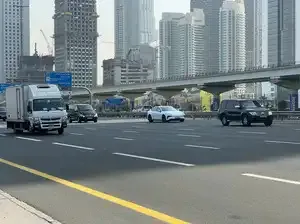
Every war produces images that stick in the mind. For many people around the world, but particularly in South Asia, the opening nights of this conflict will always be associated with footage from Dubai: a fire near a well-known hotel in Palm Jumeirah, debris from an aerial interception near the iconic Burj-al-Arab, videos of eerily empty highways.
The damage to the United Arab Emirates’ biggest city has been minimal so far, and far more fake or mislabeled videos have emerged than real ones. But that isn’t the point. What makes the real visuals shocking is that Dubai has always appeared invulnerable to South Asians, a shimmering oasis of calm and capitalism unaffected by the turbulent geopolitics of the region and the world. However this war turns out, that long-held image will have imploded.
It is easy to mock, and even dislike, Dubai. Visitors accustomed to real, organic cities sense that there’s something artificial about it. Even many long-term residents can’t really say they belong to it, since Emirati citizenship isn’t generally available. Ethnic and class hierarchies are uncomfortably evident and rigidly maintained.
Plus many of those who have recently discovered Dubai — waves of recent arrivals include Instagram influencers, those avoiding the the war between Russia and Ukraine, and various crypto grifters — are difficult to sympathize with. Particularly off-putting are right-wing pundits and politicians who rail against migrants and Muslims back home while being migrants in an Islamic emirate, and tax exiles who nevertheless expect public funds to be spent on protecting them in an emergency.
(Join our ETNRI WhatsApp channel for all the latest updates)
Yet there is much more to the city than these unappetizing types. It is one of the few genuinely international, multicultural cities outside the West. And many Indians and Pakistanis would automatically identify it as the only functional city in which we can feel absolutely at home. Probably about half the city is of South Asian extraction, but it feels like more.
For the Indian middle class, Dubai has always been the ideal of what a city can and should become, in ways both good and bad. It tucks the poor and the working class away in labor camps “at least 5 kilometers away from family housing areas,” something much harder to do in free and democratic India. The roads are great, even if the bus system isn’t. Governance seems efficient and responsive, though the city is famously undemocratic and you can only stay there if you work at being inoffensive and aggressively apolitical.
Yet it has always beckoned to us, offering dreams of prosperity and acceptance that our own megacities like New Delhi, Karachi or Dhaka could never match. Many middle-class South Asians would prefer to be second-class residents in Dubai, with its servants and home-style food, then full citizens in a West that feels alien and unwelcoming. And either is better than staying home, where even if you become a big fish in the largest of cities you will always still suspect that you’re in a very small pond.
And this is even more true for less affluent Indians, Pakistanis, and Bangladeshis. For generations, going to Dubai has been synonymous with breaking out of the cycle of poverty and deprivation that our economies and social systems have imposed on the poorest citizens. About 80 flights from India land each day in the city’s airport; and the vast majority of passengers are working class. Any kid in north India knows that Delhi is where they might have to go to survive, and Mumbai is where they want to go to become famous — but Dubai is where you want to go to make your fortune.
In South Asia, it seems that everything is political. It’s politics, we think, that holds back our cities from developing. It’s an inability to manage geoeconomics that causes us to be vulnerable to every global price shock in food and fuel. The very size of our countries means that they are ungovernable. Dubai — manageably small, apolitical, apparently invulnerable — was the exact opposite of everything we wanted to escape.
What we have learned over the past week, however, is that Dubai cannot escape politics either. The UAE may skillfully have balanced the US and Saudi Arabia for years, while opening up to Israel and warning against isolating Iran; but in a general conflagration of the sort that is now enveloping West Asia, it will not be ignored. Dubai has worked hard to make itself visible; but it has, tragically also made itself into a tempting target for those, like Tehran, that want to lash out at the world.
The chances are that Dubai will go back to what passes for “normal” there. Some of the more tiresome late-comers will quit and return chastened, and the city’s reputation will be the better for it. South Asians will continue to come to work in its companies, construction sites, and restaurants.
But it may never again appear to us as it did: A place apart from the region around it. Perhaps it really is a South Asian city; of all people, we understand how hard it is to escape the position where destiny placed you.
The damage to the United Arab Emirates’ biggest city has been minimal so far, and far more fake or mislabeled videos have emerged than real ones. But that isn’t the point. What makes the real visuals shocking is that Dubai has always appeared invulnerable to South Asians, a shimmering oasis of calm and capitalism unaffected by the turbulent geopolitics of the region and the world. However this war turns out, that long-held image will have imploded.
It is easy to mock, and even dislike, Dubai. Visitors accustomed to real, organic cities sense that there’s something artificial about it. Even many long-term residents can’t really say they belong to it, since Emirati citizenship isn’t generally available. Ethnic and class hierarchies are uncomfortably evident and rigidly maintained.
Plus many of those who have recently discovered Dubai — waves of recent arrivals include Instagram influencers, those avoiding the the war between Russia and Ukraine, and various crypto grifters — are difficult to sympathize with. Particularly off-putting are right-wing pundits and politicians who rail against migrants and Muslims back home while being migrants in an Islamic emirate, and tax exiles who nevertheless expect public funds to be spent on protecting them in an emergency.
(Join our ETNRI WhatsApp channel for all the latest updates)
Yet there is much more to the city than these unappetizing types. It is one of the few genuinely international, multicultural cities outside the West. And many Indians and Pakistanis would automatically identify it as the only functional city in which we can feel absolutely at home. Probably about half the city is of South Asian extraction, but it feels like more.
For the Indian middle class, Dubai has always been the ideal of what a city can and should become, in ways both good and bad. It tucks the poor and the working class away in labor camps “at least 5 kilometers away from family housing areas,” something much harder to do in free and democratic India. The roads are great, even if the bus system isn’t. Governance seems efficient and responsive, though the city is famously undemocratic and you can only stay there if you work at being inoffensive and aggressively apolitical.
Yet it has always beckoned to us, offering dreams of prosperity and acceptance that our own megacities like New Delhi, Karachi or Dhaka could never match. Many middle-class South Asians would prefer to be second-class residents in Dubai, with its servants and home-style food, then full citizens in a West that feels alien and unwelcoming. And either is better than staying home, where even if you become a big fish in the largest of cities you will always still suspect that you’re in a very small pond.
And this is even more true for less affluent Indians, Pakistanis, and Bangladeshis. For generations, going to Dubai has been synonymous with breaking out of the cycle of poverty and deprivation that our economies and social systems have imposed on the poorest citizens. About 80 flights from India land each day in the city’s airport; and the vast majority of passengers are working class. Any kid in north India knows that Delhi is where they might have to go to survive, and Mumbai is where they want to go to become famous — but Dubai is where you want to go to make your fortune.
In South Asia, it seems that everything is political. It’s politics, we think, that holds back our cities from developing. It’s an inability to manage geoeconomics that causes us to be vulnerable to every global price shock in food and fuel. The very size of our countries means that they are ungovernable. Dubai — manageably small, apolitical, apparently invulnerable — was the exact opposite of everything we wanted to escape.
What we have learned over the past week, however, is that Dubai cannot escape politics either. The UAE may skillfully have balanced the US and Saudi Arabia for years, while opening up to Israel and warning against isolating Iran; but in a general conflagration of the sort that is now enveloping West Asia, it will not be ignored. Dubai has worked hard to make itself visible; but it has, tragically also made itself into a tempting target for those, like Tehran, that want to lash out at the world.
The chances are that Dubai will go back to what passes for “normal” there. Some of the more tiresome late-comers will quit and return chastened, and the city’s reputation will be the better for it. South Asians will continue to come to work in its companies, construction sites, and restaurants.
But it may never again appear to us as it did: A place apart from the region around it. Perhaps it really is a South Asian city; of all people, we understand how hard it is to escape the position where destiny placed you.