
New Delhi: The escalating conflict in West Asia may continue to keep global crude oil prices elevated, potentially adding 10-20 basis points to India's FY27 inflation based on assumptions that domestic fuel retailers undertake only a partial pass-through to consumers, according to economists.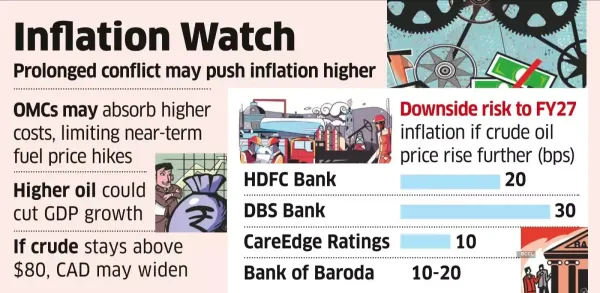
Brent crude has already surged to about $85 per barrel from $73 since the joint US-Israel strikes on Iran on February 28, followed by the latter's retaliation against US allies and assets in the region.
HDFC Bank estimates FY27 inflation at 4.3% if crude averages $65/barrel though cautioning the print could rise around 20 bps if prices increase to $75.
"If the issue is more prolonged, the impact could be higher around 50 bps, assuming no change in excise duty," said Sakshi Gupta, principal economist at HDFC Bank.
Rajani Sinha, chief economist at CareEdge Ratings, said if crude stays above $80 per barrel for a sustained period, the indirect effects alone could raise FY27 inflation by about 10 bps from the earlier 4.3% projection. Consumer Price Index (CPI) sensitivity to fuel prices has increased with the weightage of petrol and diesel in the new CPI series more than doubling to 4.8% from 2.3% earlier.
Petrol and diesel prices rose 0.04% and 0.22%, respectively, in January.
"A sharp spike from the central bank's assumptions where the baseline is set at around $70bbl might pose around 30 bps upside risk to inflation, assuming unchanged excise duties," said Radhika Rao, executive director and senior economist at DBS Bank.
India imports more than 85% of its crude oil requirements, with about half passing through the Strait of Hormuz. Nearly 47% was sourced from Middle Eastern suppliers such as Saudi Arabia, UAE, Kuwait, and Iraq during the first ten months of FY26.
Still, experts expect limited near-term retail fuel price changes, as oil marketing companies (OMCs) may absorb some of the highest costs.
Nomura has estimated a lower impact of around 10 basis points on inflation and gross domestic product (GDP) growth.
Gaura Sengupta, chief economist at IDFC First Bank believes that the actual impact would be even lower as retail petrol and diesel prices are unlikely to rise, protecting consumers. "The drag will mainly be from rise in net crude oil imports and reduction in producer margins," said Sengupta.
Sinha at CareEdge however said if crude prices trend above $90 per barrel and retail prices remain unchanged, government intervention could become necessary.
Higher energy prices would likely feed into inflation, lifting global CPI by more than 1% annual rate in the first half of 2026, according to JP Morgan Global Research.
GDP, Current Account Deficit
Higher crude prices could also weigh on economic growth. Madan Sabnavis, chief economist at Bank of Baroda said prolonged tensions could reduce growth by 20-30 bps due to supply disruptions.
According to the Reserve Bank of India's (RBI) sensitivity analysis, a 10% rise in crude prices reduces real GDP growth by 15 bps.
India's current account deficit (CAD) could also widen if oil prices remain higher. CareEdge estimates if crude stays above $80 per barrel for several months, FY27 CAD could rise to 1.3-1.8% of GDP.
Nomura expects India's CAD to remain relatively comfortable at around 0.9% of GDP in FY26 and 0.8% of GDP next year, assuming global oil prices average around $65/bbl over the year. It added that every 10% rise in oil prices typically widens the CAD by around 0.4% of GDP.
Crude surge could add 10–20 bps if fuel prices partly passed on, say economists
Brent crude has already surged to about $85 per barrel from $73 since the joint US-Israel strikes on Iran on February 28, followed by the latter's retaliation against US allies and assets in the region.
HDFC Bank estimates FY27 inflation at 4.3% if crude averages $65/barrel though cautioning the print could rise around 20 bps if prices increase to $75.
"If the issue is more prolonged, the impact could be higher around 50 bps, assuming no change in excise duty," said Sakshi Gupta, principal economist at HDFC Bank.
Rajani Sinha, chief economist at CareEdge Ratings, said if crude stays above $80 per barrel for a sustained period, the indirect effects alone could raise FY27 inflation by about 10 bps from the earlier 4.3% projection. Consumer Price Index (CPI) sensitivity to fuel prices has increased with the weightage of petrol and diesel in the new CPI series more than doubling to 4.8% from 2.3% earlier.
Petrol and diesel prices rose 0.04% and 0.22%, respectively, in January.
"A sharp spike from the central bank's assumptions where the baseline is set at around $70bbl might pose around 30 bps upside risk to inflation, assuming unchanged excise duties," said Radhika Rao, executive director and senior economist at DBS Bank.
India imports more than 85% of its crude oil requirements, with about half passing through the Strait of Hormuz. Nearly 47% was sourced from Middle Eastern suppliers such as Saudi Arabia, UAE, Kuwait, and Iraq during the first ten months of FY26.
Still, experts expect limited near-term retail fuel price changes, as oil marketing companies (OMCs) may absorb some of the highest costs.
Nomura has estimated a lower impact of around 10 basis points on inflation and gross domestic product (GDP) growth.
Gaura Sengupta, chief economist at IDFC First Bank believes that the actual impact would be even lower as retail petrol and diesel prices are unlikely to rise, protecting consumers. "The drag will mainly be from rise in net crude oil imports and reduction in producer margins," said Sengupta.
Sinha at CareEdge however said if crude prices trend above $90 per barrel and retail prices remain unchanged, government intervention could become necessary.
Higher energy prices would likely feed into inflation, lifting global CPI by more than 1% annual rate in the first half of 2026, according to JP Morgan Global Research.
GDP, Current Account Deficit
Higher crude prices could also weigh on economic growth. Madan Sabnavis, chief economist at Bank of Baroda said prolonged tensions could reduce growth by 20-30 bps due to supply disruptions.
According to the Reserve Bank of India's (RBI) sensitivity analysis, a 10% rise in crude prices reduces real GDP growth by 15 bps.
India's current account deficit (CAD) could also widen if oil prices remain higher. CareEdge estimates if crude stays above $80 per barrel for several months, FY27 CAD could rise to 1.3-1.8% of GDP.
Nomura expects India's CAD to remain relatively comfortable at around 0.9% of GDP in FY26 and 0.8% of GDP next year, assuming global oil prices average around $65/bbl over the year. It added that every 10% rise in oil prices typically widens the CAD by around 0.4% of GDP.