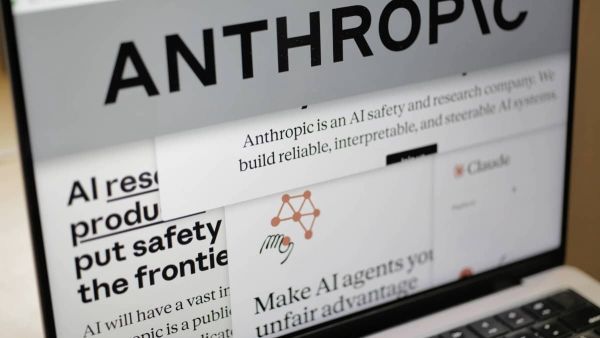
Artificial intelligence is changing the way people work, and new research from Anthropic - the company behind the chatbot Claude - shows which jobs in the United States are most at risk.
The study highlights that computer programmers, customer service representatives, data entry workers, medical record specialists, market research analysts, and marketing specialists are among the most exposed roles. Other jobs that could be affected include sales representatives, financial analysts, software testers, information security analysts, and IT support staff.
Anthropic says it has built an early warning system to track how AI overlaps with human work. The researchers found that, so far, AI has had little direct impact on employment, meaning fears of mass job losses may be overstated. However, they did note that hiring of younger workers in exposed fields has slowed, which could be an early sign of change.
Looking ahead, jobs that rely heavily on information processing are expected to grow more slowly through 2034, according to U.S. Bureau of Labor Statistics data. By contrast, jobs that require physical skills - such as construction, healthcare support, and logistics - are less likely to be replaced by AI.
This report comes at a time when many workers are worried. Recent layoffs at big companies and the rise of generative AI tools have made both young graduates and older professionals question their job security. Anthropic’s findings suggest that while the labor market has not yet been disrupted, AI could eventually have a major impact on professions ranging from lawyers to salespeople.
Adding another twist, Anthropic itself has faced challenges outside the workplace debate. The company was dropped from a U.S. defense deal earlier this year, showing how governments are still cautious about relying on private AI firms for sensitive projects. This decision highlights the tension between using AI for progress and managing its risks in areas like national security.
Anthropic’s research makes clear that AI has not yet caused widespread job losses, but the warning signs are there. Jobs that depend on data and analysis are most exposed, while hands-on roles remain safer. As AI grows more powerful, the challenge for the U.S. will be to balance innovation with stability making sure technology helps workers instead of replacing them.
-
One arrested in Dhoolpet for selling ganja, 390 gm seized

-
TMC to support no-confidence motion against Lok Sabha Speaker Om Birla

-
Over 70L forms for including names, 2.6L for deletion: UP SIR in a nutshell

-
Telangana eyes USD 3 trillion economy, focus on skills development: Minister

-
Adnaan Shaikh clarifies wife converted to Islam before marriage