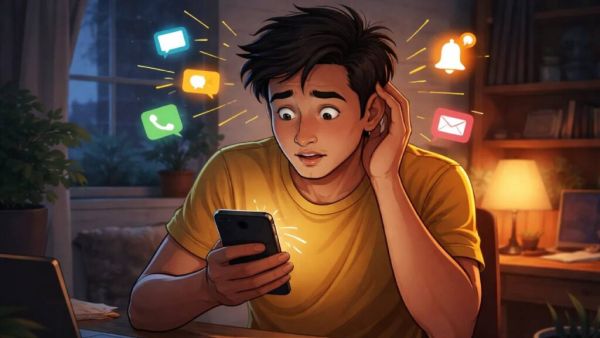
Phantom Vibration Syndrome: In today’s digital world, mobile phones have become an important part of our everyday life. From waking up in the morning till sleeping at night, most of the people remain in touch with their smartphones. The constant flow of calls, messages, social media notifications and emails has affected our daily routine to a great extent.
With this changing lifestyle, people are increasingly experiencing a new psychological experience, which is called Phantom Vibration Syndrome. In this, the person feels as if his phone has vibrated or some notification has come, whereas in reality nothing like this has happened.
Is this some mental illness?
Regarding this problem, we talked to Dr. Vinit Banga, (Director-Neurology Fortis Hospital, Faridabad), he told that Phantom Vibration Syndrome is not officially considered a mental illness, but a lot of research has been done on it in the field of psychology and neuroscience. According to experts, this situation arises when our brain starts guessing the signals coming from the mobile and sometimes senses it even without any actual vibration. Apart from this, stress and change in lifestyle also trigger it.
What is Phantom Vibration Syndrome?
Phantom vibration syndrome is an experience in which a person feels that his phone vibrates or rings in his pocket or bag, when in reality it does not happen. Many times a person immediately takes out the phone and sees that no call, message or notification has come. The intensity of Phantom Vibration Syndrome is so much that people often feel the vibration of the phone kept on their body.
This experience is also called phantom phone vibration or phantom notification. This experience is becoming more common with the increasing use of smartphones. Some people feel this several times a day.
According to many studies, a large number of people using smartphones have gone through and are going through this experience at least once in their lives. However, in most cases this condition is temporary and does not turn into a serious problem. However, in some cases it has also taken a serious form.
What does the research say?
Many scientific studies have been conducted on Phantom Vibration Syndrome. A study published in the journal Computers in Human Behavior in 2012 found that about 80 to 90 percent of smartphone users have experienced phantom vibrations at some point.
Similarly, a study conducted by researchers at Indiana University found that this experience is quite common among college students and medical interns. During the study, about 89 percent of the participants said that at some point they felt that their phone was vibrating, whereas in reality it was not.
Another study conducted in 2016 found that this experience is more common in people who check their phones more often or constantly wait for notifications.
Psychology experts believe that this phenomenon is to the expectation and alertness of our brain. When we constantly wait for messages on the phone, our brain can interpret even small physical signals as vibrations of the phone.
How does the brain create this feeling?
To understand Phantom Vibration Syndrome, it is important to know how our brain understands external signals. The human brain continuously processes signals coming from the surrounding environment. These include touch, sound and visual signals.
When a person walks with the phone in his pocket for a long time and regularly feels the vibration of the phone, his brain creates a pattern of that experience. After this, sometimes even slight movement of clothes, slight movement of muscles or slight pressure on the skin may seem like phone vibration to the brain. According to neuroscience, this is a kind of sensory misinterpretation. That is, the brain misinterprets the normal signals coming from the body.
This process happens to some extent in the same way as sometimes people think that their phone is ringing, while in reality there is some other sound nearby.
What is the impact of digital habits?
Experts say that Phantom Vibration Syndrome is also to our digital behavior. Nowadays, on an average, people check their phones dozens of times a day. Many surveys show that some people check their phones 100 to 200 times a day.
This habit of constantly checking the phone trains the brain to recognize any small signal as a notification. This is the reason why many times a person starts feeling the vibration of the phone without any reason.
Apart from this, social media and messaging apps also affect this situation. Waiting for notifications, pressure to respond immediately and the habit of constantly being online keeps the mind alert.
In which people is this syndrome seen more?
Studies show that Phantom Vibration Syndrome is more common in certain groups. This experience is seen more in people whose work depends more on mobile, like journalists, doctors, IT professionals or people associated with business. Such people often keep waiting for calls or messages.
Research conducted on medical interns and employees working in the health sector also found that they experience phantom vibration more due to frequent calls while on duty. Apart from this, people who keep the phone in their pocket most of the time or keep it on vibration mode are also more likely to suffer from this.
Which people have Phantom Vibration Syndrome more often?
Journalists
Constant waiting for calls and messages.
Doctors
Continuous calls while on duty.
IT Professionals
Dependence on phones and notifications for work.
Heavy Phone Users
Phone in pocket and on vibration mode.
Phantom Vibration Syndrome is more likely to occur in people whose work depends more on mobile phones.
Is this a mental problem?
Phantom vibration syndrome is not generally considered a serious mental illness. Most experts see it as a common psychological experience associated with excessive smartphone use. However, if a person starts having this experience very often, due to which anxiety or stress increases or he starts checking his phone continuously, then it can be a sign of digital dependence or technological stress.
Some studies have also found that people who have high levels of anxiety or who are always in a state of alert may also have more of this experience.
Are there any health risks?
Under normal circumstances, Phantom Vibration Syndrome does not cause any direct physical harm. But it definitely gives an indication about our digital habits. If a person starts feeling that his phone vibrates several times a day, it may be a sign that he has become overly dependent on his phone.
The habit of constantly checking the phone can affect the quality of sleep, concentration ability and mental peace. Several studies have found that excessive smartphone use is linked to stress and digital fatigue. It has been observed in many people that whenever they feel these phantom vibrations, their heartbeat increases rapidly and the stress level also increases.
How can this experience be reduced?
According to experts, the experience of phantom vibration can be reduced by making some simple changes. The first way is to avoid keeping the phone on continuous vibration mode. If the phone is kept on silent or ring mode, the habit of vibration can be reduced. Keeping the phone in a bag or on the table instead of in the pocket can also reduce this experience, because the body does not receive signals like vibration again and again.
Limiting notification settings is also a useful solution. Keeping notifications on only for essential apps reduces the number of signals coming to the brain. Digital detox i.e. staying away from the phone for some time can also be helpful. Many experts recommend that putting the phone away for certain parts of the day while working or relaxing helps keep the mind calm.
technology and human behavior
Phantom vibration syndrome is an interesting example of how new technologies can affect our brains and behavior. Smartphones have made communication easier, but at the same time it is also changing our attention, habits and mental reactions.
Psychology experts believe that as technology develops, new changes will be seen in human behavior. Phantom vibration syndrome is one of these changes, which shows how our brain tries to keep pace with digital signals.
However, in most cases this experience is normal and temporary. But it definitely gives us an opportunity to think to what extent we are using our smartphones and whether we need to bring balance in our digital habits.
-
PM Modi Congratulates Balendra Shah On RSP’s Big Win In Nepal Elections

-
Allu Arjun Gifts Swanky Car Worth Nearly ₹70 Lakh To His Mother On International Women's Day; Photo Goes Viral

-
Buckingham Palace looking to hire someone to fill live-in Royal Household role

-
Indian Sports Reporter Faces Harassment During T20 World Cup Celebration

-
Tragic Death of 15-Year-Old Student in Madhya Pradesh Raises Concerns Over Silent Attacks