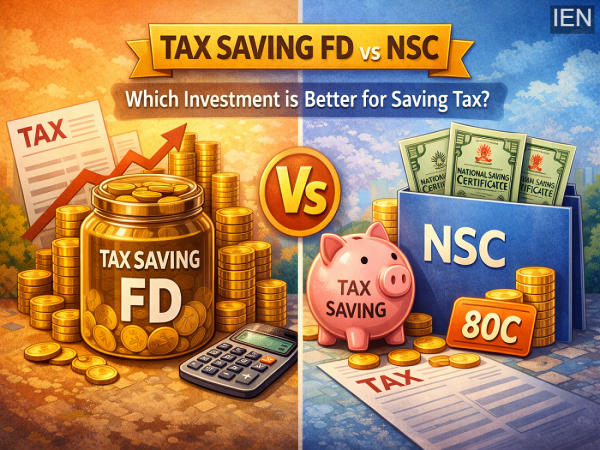
Investors looking for safe investment options with tax benefits often compare two popular choices — Tax Saving Fixed Deposits (FDs) and the National Savings Certificate (NSC). Both schemes are considered low-risk investment instruments that offer stable returns along with tax deductions under the Income Tax Act.
For individuals planning their finances and aiming to reduce their tax burden, these schemes can be attractive alternatives to traditional savings accounts. They usually offer higher interest rates than regular savings accounts and come with the added benefit of tax savings.
However, despite their similarities, Tax Saving FDs and NSC differ in terms of interest rates, flexibility, taxation, and investment rules. Understanding these differences before investing can help individuals choose the option that best suits their financial goals.
How Tax Saving Fixed Deposits Work
A Tax Saving Fixed Deposit is a special type of bank FD designed to provide tax benefits to investors. By investing in this scheme, individuals can claim deductions of up to ₹1.5 lakh under Section 80C of the Income Tax Act, provided they opt for the old tax regime.
One of the key features of a tax-saving FD is its mandatory lock-in period of five years. During this period, the invested money cannot be withdrawn prematurely. The only exception is in rare cases such as the death of the account holder.
This lock-in feature encourages long-term savings while offering guaranteed returns. However, investors should keep in mind that the interest earned on tax-saving FDs is fully taxable. The tax is applied according to the investor’s income tax slab.
Key Features of Tax Saving FD
Tax-saving fixed deposits come with several features that attract conservative investors:
-
Minimum investment: Many banks allow investors to start with as little as ₹1,000.
-
Lock-in period: Minimum 5 years, with some banks offering extended tenures up to 10 years.
-
Interest rates: These vary across banks and currently range between 5.5% and 7.75%.
-
Tax benefit: Deduction of up to ₹1.5 lakh under Section 80C.
-
Loan facility: Loans or overdrafts are generally not allowed against tax-saving FDs.
Another advantage is that tax-saving FDs can be opened by resident individuals, senior citizens, Hindu Undivided Families (HUFs), NRIs, and even in the name of minors. Joint accounts are also permitted in most banks.
What Is the National Savings Certificate (NSC)?
The National Savings Certificate (NSC) is a government-backed savings scheme available through post offices across India. It is widely preferred by investors who want secure returns with minimal risk.
The scheme currently offers an annual interest rate of about 7.7%, which is compounded annually but paid at maturity.
Investors can begin with a minimum investment of ₹1,000, and additional investments can be made in multiples of ₹100. While there is no upper limit on total investment, the tax deduction under Section 80C is capped at ₹1.5 lakh per financial year.
Rules and Investment Conditions in NSC
The NSC scheme is accessible to most Indian residents and comes with clear investment rules.
-
Eligibility: Any Indian citizen can invest.
-
Joint accounts: Allowed between two or three individuals.
-
Investment for children: Parents or guardians can purchase NSC certificates in the name of minors.
-
Lock-in period: The investment generally has a five-year maturity period.
Premature withdrawal is not allowed under normal circumstances. However, exceptions are made in special cases such as the death of the account holder or a court order.
Tax Saving FD vs NSC: Key Differences
Although both schemes offer tax benefits and stable returns, there are some important distinctions between them.
1. Investment Platform
Tax Saving FDs are offered by banks, whereas NSC is available through post offices.
2. Interest Rate Structure
FD interest rates vary from bank to bank. In contrast, the NSC interest rate is fixed by the government and revised periodically.
3. Current Returns
While tax-saving FDs typically offer interest between 5.5% and 7.75%, NSC currently provides around 7.7% annual interest.
4. Loan Facility
NSC certificates can sometimes be used as collateral to obtain loans, while tax-saving FDs usually do not allow loans or overdrafts against the deposit.
5. Taxation of Interest
Interest earned from tax-saving FDs is fully taxable each year. NSC interest, although taxable, is reinvested automatically and can qualify for Section 80C deduction during the initial years.
Which Option Should You Choose?
Both Tax Saving FD and NSC are suitable for investors seeking low-risk investments with tax benefits. However, the right option depends on individual financial goals.
Tax-saving FDs may appeal to investors who prefer bank-based investments and flexible interest options, while NSC may suit those looking for a government-backed scheme with relatively stable returns.
Before making a decision, investors should consider factors such as interest rates, taxation, lock-in conditions, and liquidity needs. Careful evaluation can help ensure that the chosen investment aligns with both tax planning and long-term financial security.
-
Heat build‑up in uttar pradesh could push temps above 40°C in several districts

-
Heat build‑up in uttar pradesh could push temps above 40°C in several districts

-
Why 'In Which Annie Gives It Those Ones' resonates: 'No heroes here, just unsure characters'

-
'Uniform Civil Code is the answer': SC on plea challenging provisions of Muslim personal law

-
ASUS launches ProArt GoPro Edition (PX13) in the UAE