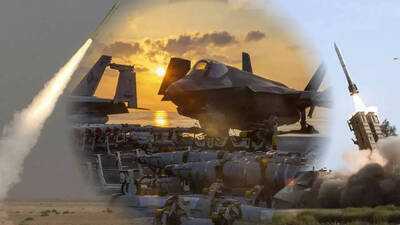
The current conflict in the Middle East has rapidly evolved into a complex technological battleground. Each side employs distinct strategies and weaponry. Iran has opted for mass deployments of cost-effective drones and ballistic missiles, aiming to overwhelm defenses through sheer numbers. In contrast, the United States and its allies utilize advanced technologies, including stealth aircraft, precision-guided missiles, and comprehensive missile defense systems. This divergence has transformed the conflict into a contest of technology, economics, and endurance.
Shahed-136: Iran's Key Drone Shahed-136: The Drone Driving Iran’s Strategy
Among the most impactful weapons in this conflict is Iran’s Shahed-136 loitering munition. This drone, measuring approximately three meters with a delta-wing design, carries an explosive payload estimated between 40 and 60 kilograms. It is programmed to navigate to predetermined coordinates before detonating upon impact. Its effectiveness lies in its low cost and scalability, with estimates suggesting a price range of $20,000 to $50,000 per unit, capable of traveling nearly 2,000 kilometers. Iran frequently launches these drones in coordinated swarms targeting military bases, oil infrastructure, and urban areas across the Gulf. Even with interception efforts, some drones often manage to breach defenses.
Shahed-131: Tactical Support Shahed-131: The Swarm Multiplier
In addition to the Shahed-136, Iran employs the smaller Shahed-131 drone. Although it has a reduced warhead and shorter range, its tactical role is significant. This drone is often deployed in large swarms alongside larger strike drones or ballistic missiles. The presence of numerous smaller drones complicates interception for air defense systems, as radar operators must prioritize multiple targets at once. Frequently, these smaller drones serve as decoys, enhancing the likelihood that more destructive weapons will reach their intended targets.
Shahab-3: Iran's Ballistic Missile Shahab-3: Iran’s Long-Range Missile Backbone
While drones are often highlighted, ballistic missiles remain a crucial component of Iran’s military capabilities. The Shahab-3 medium-range ballistic missile boasts a range of approximately 2,000 kilometers, enabling Iran to strike targets throughout much of the Middle East. This missile carries a warhead weighing around 770 kilograms and travels at high speeds along steep trajectories. During the ongoing conflict, Shahab missiles have frequently been launched in conjunction with drone swarms, creating a multi-layered attack strategy that poses significant challenges for air defense systems.
Fattah Hypersonic Missile: A New Threat Fattah Hypersonic Missile: Iran’s Claimed Next-Generation Weapon
Iran has also introduced the Fattah missile, touted by officials as a hypersonic weapon capable of exceeding Mach 15 speeds. Hypersonic missiles are particularly challenging to intercept due to their ability to maneuver during flight, deviating from predictable ballistic paths. While Tehran claims this missile signifies a major technological advancement, Western analysts express skepticism regarding its actual capabilities. Nonetheless, the potential existence of maneuverable hypersonic missiles complicates defensive strategies.
US Strategic Assets B-2 Spirit And The GBU-57 Bunker-Buster
On the American front, the B-2 Spirit stealth bomber stands out as a platform with significant strategic implications. Its unique flying-wing design and radar-absorbent materials enable it to penetrate heavily fortified airspace. The B-2 is currently the sole aircraft capable of deploying the GBU-57 Massive Ordnance Penetrator, a 30,000-pound bunker-buster bomb designed to target deeply buried facilities, including hardened nuclear sites and underground command centers.
Tomahawk Missiles Tomahawk Cruise Missiles
Another vital asset in US military operations is the Tomahawk land-attack cruise missile, extensively utilized by the United States Navy. These missiles, launched from destroyers and submarines, can cover distances exceeding 1,500 kilometers. Tomahawks fly at low altitudes and can navigate complex pre-programmed routes, allowing them to evade radar detection and accurately strike targets such as radar installations, command centers, or missile launch sites. Several were reportedly deployed during Operation Epic Fury from naval vessels in the region.
LUCAS Drone: A Cost-Effective Solution LUCAS Drone: America’s Low-Cost Counter
The United States has also adopted a strategy akin to Iran’s drone tactics. The Low-cost Unmanned Combat Attack System (LUCAS) is designed as an affordable one-way attack drone capable of targeting radar stations or missile launchers. By utilizing low-cost drones instead of expensive cruise missiles, military leaders can conduct strikes without exhausting high-value munitions.
Patriot Missile Defense System Patriot Missile Defence System
As drone assaults escalated, US forces increasingly relied on the Advanced Precision Kill Weapon System (APKWS). This system converts standard Hydra rockets into laser-guided munitions using a cost-effective guidance kit. At approximately $25,000 per shot, APKWS offers a more economical solution for neutralizing slow-moving drones compared to deploying Patriot missiles.
The Underlying Economic Battle The Real Battlefield: Economics And Endurance
Beyond the technological aspects, the weapons utilized in this conflict highlight a deeper strategic rivalry. Iran’s approach focuses on deploying large quantities of inexpensive drones and missiles to overwhelm defenses, while the United States relies on precision strike capabilities and advanced missile defense systems that, while superior, come at a higher cost. Ultimately, the outcome may hinge less on the sophistication of weaponry and more on which side can sustain its arsenal over time.
-
CM Shri Devendra Fadnavis Lists Maharashtra's First Public Issue of Municipal Green Bond of Nashik Municipal Corporation (NMC) at NSE

-
Petrol and Diesel Prices Today: Check Latest Fuel Rates in Major Indian Cities

-
YouTuber Anurag Dobhal's Dangerous Live Stream Sparks Mental Health Debate

-
Allu Arjun and Deepika Padukone Unite in Groundbreaking Film AA22xA6

-
Connected care: The data and AI shift in healthcare