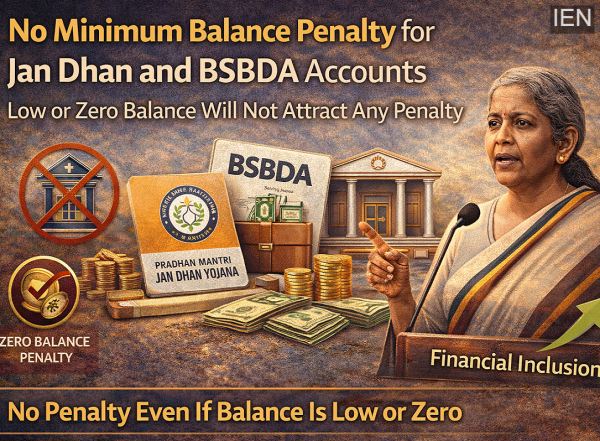
Millions of bank account holders in India may find relief following an important clarification from the government regarding minimum balance rules. Finance Minister Nirmala Sitharaman informed the Lok Sabha that a large number of savings accounts in the country do not attract penalties for maintaining low or zero balance.
According to the Finance Minister, around 72 crore savings bank accounts in India are exempt from minimum balance penalties. This relief mainly applies to accounts opened under the Pradhan Mantri Jan Dhan Yojana (PMJDY) and Basic Savings Bank Deposit Accounts (BSBDA).
These accounts are specifically designed to support financial inclusion and ensure that people from economically weaker sections can access banking services without worrying about penalties.
Zero Balance Allowed in Jan Dhan and BSBDA Accounts
Under the rules governing Jan Dhan accounts and BSBDA accounts, customers are not required to maintain any minimum balance.
This means that even if the account balance falls to zero, banks cannot impose a penalty or charge any fee for non-maintenance of minimum balance.
The Finance Minister emphasized that this policy is meant to make banking services more accessible to low-income households and first-time account holders.
What Happens in Regular Savings Accounts
In contrast, many traditional savings accounts offered by banks require customers to maintain a minimum average balance.
If customers fail to maintain the required balance, banks typically impose low balance penalties or service charges.
These charges vary from bank to bank and depend on factors such as:
-
Type of account
-
Bank policies
-
Location of the branch (urban, semi-urban, or rural)
For individuals who cannot maintain regular balances, these penalties can become a financial burden.
Why These Accounts Are Different
The government created Jan Dhan and BSBDA accounts with the goal of bringing more people into the formal banking system.
Many individuals in rural or low-income groups previously avoided banking because of minimum balance requirements. By removing this condition, the government aims to encourage greater participation in financial services.
Through these accounts, customers can access several basic banking facilities such as:
-
Deposits and withdrawals
-
Debit card services
-
Direct Benefit Transfer (DBT) for government schemes
-
Access to insurance and pension schemes
A Key Step Toward Financial Inclusion
The government considers these accounts an essential tool for financial inclusion, ensuring that even individuals with very small incomes can participate in the banking system.
With around 72 crore savings accounts now free from minimum balance penalties, a significant portion of India’s population can maintain bank accounts without worrying about additional charges.
This initiative has played a major role in expanding banking access across rural and economically weaker regions.
Banking Access Without Financial Pressure
By removing the requirement of maintaining a minimum balance, Jan Dhan and BSBDA accounts allow customers to use banking services without financial pressure.
Government officials believe that such policies will continue to strengthen India’s financial system while ensuring that banking remains accessible to everyone, regardless of income level.
For millions of Indians, this rule ensures that having a bank account does not come with the fear of penalties when the balance is low or zero.
-
Rain likely in parts of Karnataka from March 15 to 17: IMD

-
Two 'doomsday fish' have washed up on Mexico's shore and it's causing panic

-
Terrorist hideout busted in J-K's Rajouri; IED recovered

-
EPF Interest Rate 2025-26 Explained: How 8.25% Returns Will Grow Your PF Savings and How It Is Calculated

-
26 injured as fire breaks out at electric meter factory in Noida